

Der Anwendungsfall: wie Filevine Zilliz einsetzt
Filevine, a legal work platform, stores and searches embeddings of legal and medical documents in Zilliz Cloud. This powers AI features such as natural-language case Q&A, automatic field extraction, demand letter generation and deposition assistance.
Weitere angegebene Ergebnisse
Zahlen aus der Fallstudie von Zilliz. usedby hat sie nicht unabhängig gemessen.
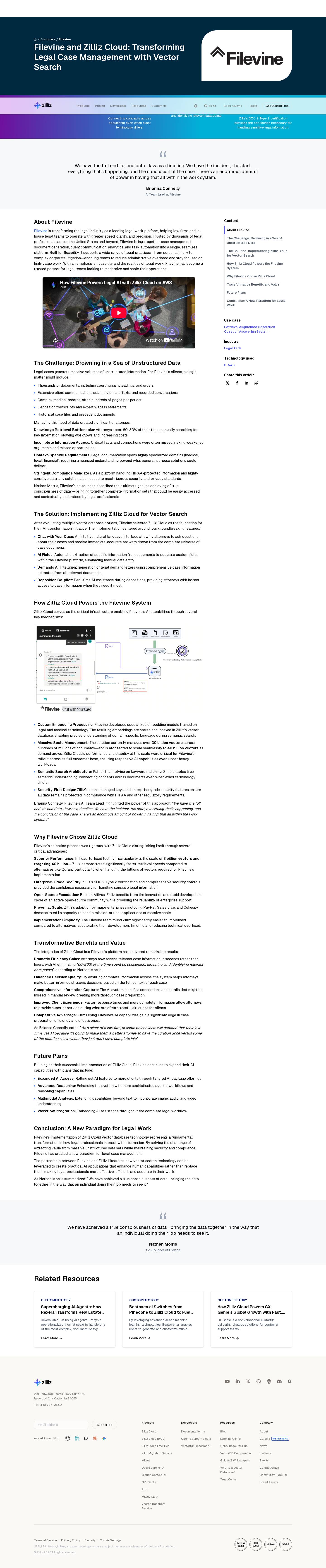
The solution currently manages over 30 billion vectors across hundreds of millions of documents
is architected to scale seamlessly to 40 billion vectors as demand grows
In den Worten des Kunden
We have the full end-to-end data... law as a timeline. We have the incident, the start, everything that's happening, and the conclusion of the case. There's an enormous amount of power in having that all within the work system.Zilliz helps our teams deliver fast, reliable retrieval across complex legal workflows, so customers can find the context they need when it matters.Weitere KI-Tools von Filevine
Weitere öffentliche Beziehungen, die auf usedby erfasst sind.
Den KI-Stack von Filevine ansehen
Weitere Unternehmen, die Zilliz nutzen
Kunden aus allen Branchen, mit öffentlichen Belegen.
 AirtableBestätigt
 ConsensusBestätigt
 ExaBestätigt
 GorgiasBestätigt
 MiniMaxBestätigt
 OpenEvidenceBestätigt
Direkt zur Quelle
Auf Basis der veröffentlichten Fallstudie von Zilliz. Wir prüfen die öffentlichen Belege; die Ergebnisse gibt der Anbieter an.
zilliz.com- Zuletzt geprüft
- 6. Okt. 2026
 Screenshot der Quelle öffnen
Was die Fallstudie behauptet und was wir geprüft haben
Was wir mit der Seite verglichen haben.
- Die Zahl: 60-80%Geprüft
Steht wörtlich auf der Seite, nahe dem Namen Filevine.
- Die oben zitierte PassageGeprüft
Wörtlich von der Seite übernommen, nahe dem Namen Filevine.
- Filevine nutzt ZillizGeprüft
Eintrag mit Stufe Bestätigt.
- Das Ergebnis selbstNicht geprüft
Wir zitieren es; wir haben es nicht gemessen.
Dramatic Efficiency Gains: Attorneys now access relevant case information in seconds rather than hours, with AI eliminating "60-80% of the time spent on consuming, digesting, and identifying relevant data points," according to Nathan Morris.