
Der Anwendungsfall: wie SigmaMind AI Deepgram einsetzt
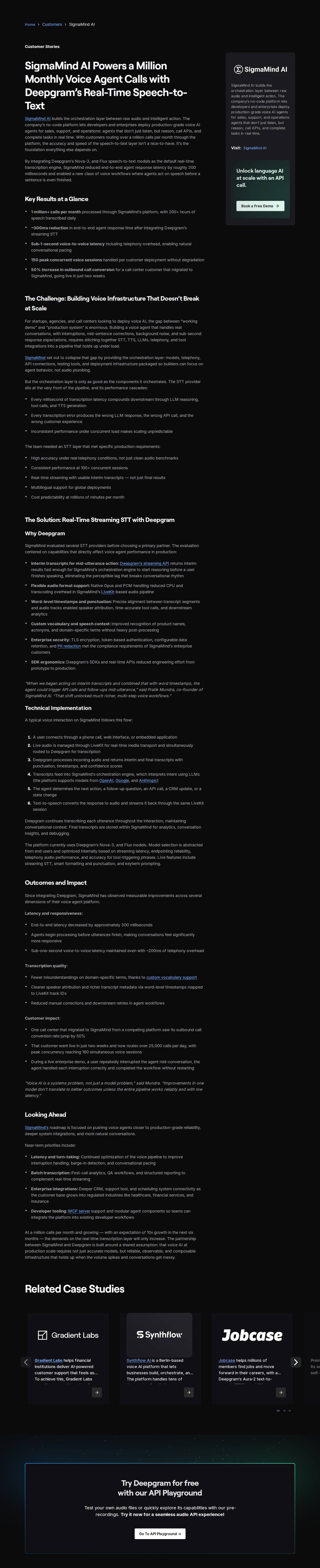
SigmaMind AI uses Deepgram's Nova-3 and Flux models as the default real-time speech-to-text engine in its no-code platform for building voice AI agents. Transcripts, including interim results, feed its orchestration engine so agents can start acting before a speaker finishes.
Weitere angegebene Ergebnisse
Zahlen aus der Fallstudie von Deepgram. usedby hat sie nicht unabhängig gemessen.
50% increase in outbound call conversion for a call center customer that migrated to SigmaMind, going live in just two weeks
1 million+ calls per month processed through SigmaMind’s platform, with 200+ hours of speech transcribed daily
150 peak concurrent voice sessions handled per customer deployment without degradation
Sub-1-second voice-to-voice latency including telephony overhead, enabling natural conversational pacing
In den Worten des Kunden
When we began acting on interim transcripts and combined that with word timestamps, the agent could trigger API calls and follow-ups mid-utterance,” said Pratik Mundra, co-founder of SigmaMind AI. “That shift unlocked much richer, multi-step voice workflows.Nutzer von Deepgram in der Branche Künstliche Intelligenz
Unternehmen derselben Branche, mit öffentlichen Belegen.
 CreovaiBestätigt
 FlowticaBestätigt
 GetVocal AIBestätigt
 Prem AIBestätigt
 Synthflow AIBestätigt
 CognigyBeobachtet
Direkt zur Quelle
Auf Basis der veröffentlichten Fallstudie von Deepgram. Wir prüfen die öffentlichen Belege; die Ergebnisse gibt der Anbieter an.
deepgram.com- Zuletzt geprüft
- 9. Okt. 2026
 Screenshot der Quelle öffnen
Was die Fallstudie behauptet und was wir geprüft haben
Was wir mit der Seite verglichen haben.
- Die Zahl: ~300msGeprüft
Steht wörtlich auf der Seite, nahe dem Namen SigmaMind AI.
- Die oben zitierte PassageGeprüft
Wörtlich von der Seite übernommen, nahe dem Namen SigmaMind AI.
- SigmaMind AI nutzt DeepgramGeprüft
Eintrag mit Stufe Bestätigt.
- Das Ergebnis selbstNicht geprüft
Wir zitieren es; wir haben es nicht gemessen.
By integrating Deepgram’s Nova-3, and Flux speech-to-text models as the default real-time transcription engine, SigmaMind reduced end-to-end agent response latency by roughly 300 milliseconds and enabled a new class of voice workflows where agents act on speech before a sentence is even finished.