Scale AI and Nvidia on Greptile: Two Ways to Put an AI Reviewer Before Humans
Scale AI uses Greptile as a first-pass reviewer with narrow auto-approval. Nvidia runs a self-hosted setup across Perforce and GitLab. Here is how they differ.
The short answer
Both companies put Greptile ahead of human reviewers, but in different ways. According to Greptile's customer page, Scale AI uses it as a first-pass reviewer for about 650 engineers. It scores and explains each pull request, and a small set of trivial changes can be promoted without a human.
Nvidia's page describes a different shape of project: a self-hosted instance that reviews code on both Perforce and GitLab, with custom features that Greptile says it built for each. Each page reports its own outcomes, measured differently. This article keeps them separate.
What Greptile does before it comments
Greptile says it builds a graph of a repository's files, functions and dependencies. A swarm of agents then reviews each pull request with that wider context, assessing impact beyond the diff and flagging bugs, security risks and style violations.
www.greptile.com · www.usedby.ai
Two other vendor-described features matter for these stories. Greptile says it learns a team's standards from past review comments, and it accepts custom rules written in plain English. The vendor lists full support for languages including Python, JavaScript, TypeScript, Go, Java, C++ and Rust, and generally offers self-hosting, including in a customer's AWS environment.
The Nvidia page puts the difference in plain terms: a change is reviewed against callers and contracts it does not touch, rather than only the lines in the diff. The same page quotes a point about independence: the tools that write software are not the tools that review it.
Scale AI: a scored first pass, with a narrow shortcut
Scale's page says Greptile is used by about 650 engineers working mainly in Python, Go, TypeScript and React. Greptile reviews first. Human reviewers then open a pull request that already carries context and a score. Scale's VP of Engineering says reviewers feel more confident with pull requests that Greptile has pre-scored, and that code review had become a growing bottleneck as development sped up.
There is one exception. A change is promoted automatically only if it is low risk, below a complexity ceiling and explicitly approved by Greptile, for example a fixture file or a log-line edit. The page says only a small share of changes qualifies today, and that Scale could raise it as its production monitoring and testing mature. Nearly all pull requests still get a human review.
The adoption story is unusual. Scale started with larger repositories and then expanded to teams that asked for the tool. Early feedback from engineers called it noisy and annoying. Scale kept it running for several weeks, then switched it off for a day or two. Engineers asked for it back, and the page presents that reaction as the clearest sign of value.
The VP reports that the company is merging and shipping faster, particularly on simpler diffs, with more reviewer confidence. The headline number is more than 100,000 bugs caught. These are Scale's reported figures. The page as read does not say how a bug was counted or break the number down by severity.
Nvidia: a self-hosted first reviewer across Perforce and GitLab
Nvidia's page describes a self-hosted Greptile instance working with Perforce and GitLab, on a codebase that includes C++, Python and CUDA. Greptile says it delivered 35 custom features for the Perforce setup and 55 for the GitLab setup. That is a lot of bespoke work, and it is the clearest sign that this was not a standard install.
The page reports about 395,000 pull requests reviewed, across roughly 880,000 review runs and about 930,000 review comments. Those are volume figures. They show how much traffic passes through the reviewer, not how many comments were right or useful.
On results, the time figure comes from a single team. Its average time to merge fell from more than 24 hours to six, according to the page. The deployment spans multiple Nvidia teams and products, so that figure should not be read as a company-wide average.
What differs, and what does not compare
The setups differ in several ways. Nvidia's deployment is self-hosted and spans two version control systems with extensive custom integration. The Scale page describes a rollout to a large engineering group in Python, Go, TypeScript and React, and does not describe its hosting model. Scale also spells out a narrow automatic-promotion boundary, while the Nvidia page, as read, describes Greptile as a first reviewer without a similar path.
www.greptile.com · www.greptile.com
The outcomes differ too. Scale reports a count of bugs caught. Nvidia reports total review volume and a merge-time change for one team. These are vendor-hosted customer pages with different populations and metrics, so they cannot be read as a head-to-head benchmark. Neither page explains why the company chose Greptile.
www.greptile.com · www.greptile.com
Lessons for other teams
These are editorial takeaways drawn from the two pages, not vendor claims. First, treat the tool as a first pass that makes human review easier, as Scale does, rather than a replacement. Second, if you allow any automatic promotion, write the criteria down first. Scale's pairing of low risk with a complexity ceiling is a useful model.
Third, an editorial inference from Scale's story: early annoyance is not the whole picture. Scale's engineers found the tool noisy, yet asked for it back once it was off. Asking whether people miss it is one way to judge it. Fourth, Nvidia shows a different path: self-hosting on Perforce and GitLab came with substantial custom integration work, as the feature counts suggest. Teams with unusual version control or hosting requirements should expect that kind of effort. Teams on common setups may face less.
www.greptile.com · www.greptile.com
Method and limits
2026-10-15
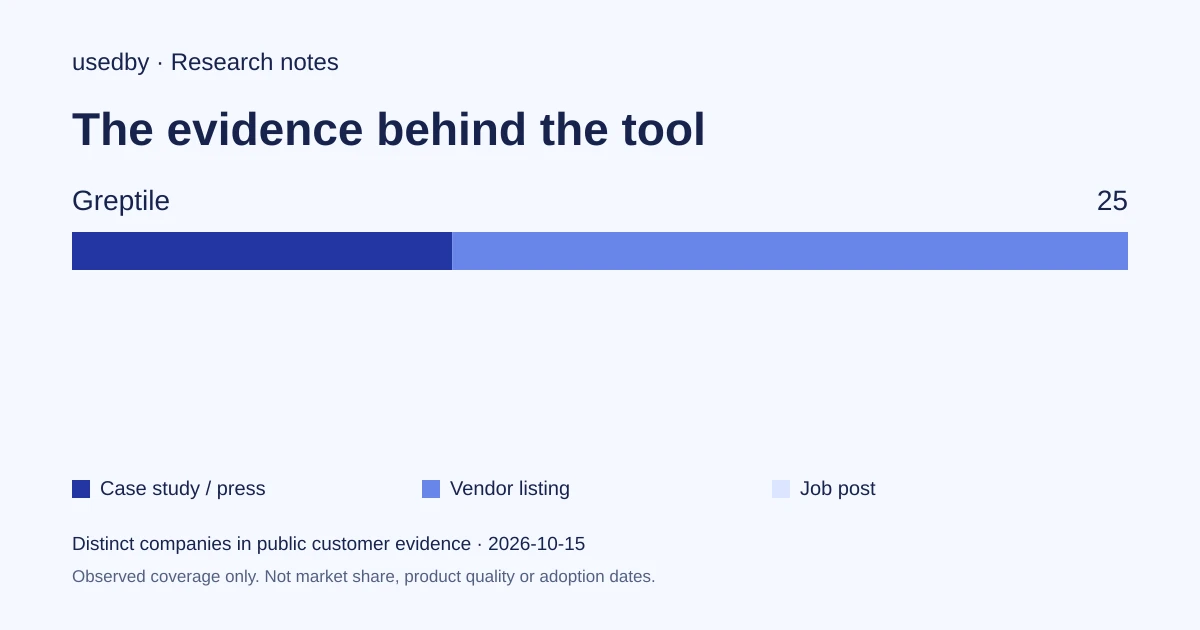
This dated snapshot counts distinct companies in public customer evidence. CONFIRMED means a case study, named testimonial or press source; OBSERVED means a vendor listing; SIGNAL means a job post. All three count, but their strength differs. Removed and unlevelled lines are excluded. Examples are a capped selection verified within 90 days. Vendor facts are sourced records checked within 60 days. Coverage is uneven and missing evidence is unknown. These figures measure neither market share nor product performance; capture dates are not adoption dates.
Sources
- www.greptile.comgreptile.com
- www.greptile.comgreptile.com
- www.greptile.comgreptile.com
Questions
Does Scale AI let Greptile approve changes without a human?
Only for a small category. Scale's page says automatic promotion applies to low-risk changes below a complexity ceiling, such as fixture files or log-line edits. Nearly all pull requests still get human review.
Is Nvidia's Greptile deployment self-hosted?
Yes, according to Nvidia's customer page, which describes a self-hosted instance working with Perforce and GitLab. Greptile says it built 35 custom features for Perforce and 55 for GitLab.
What did Nvidia report about merge times with Greptile?
Nvidia's page says one team's average time to merge fell from more than 24 hours to six. That is one team's result, reported on a vendor-hosted page, not an average for all of Nvidia.
How does Greptile review code beyond the diff?
Greptile says it builds a graph of files, functions and dependencies and uses a swarm of agents to review each pull request. It also says it learns team standards from past comments and accepts plain-English rules.
Can I compare Scale AI's and Nvidia's results directly?
No. Scale reports bugs caught, while Nvidia reports review volume and one team's merge time. The populations and metrics differ, and both come from vendor-hosted customer pages.
Tools in this article

Explore the data
Who uses which AI tool, and how each line was found.