

The use case: how Miris deploys CoreWeave
Miris uses CoreWeave's cloud to process and optimize 3D assets once upstream on GPUs, then streams them in an adaptive volumetric format to end users, so it does not need a GPU for each user. The platform handles its asset pipelines using integrated storage and Kubernetes orchestration.
More reported results
Figures published in CoreWeave’s case study. They are not independently measured by usedby.
<200ms avg. time to first read
~10x More efficient
CoreWeave users in DevTools & Infrastructure
Companies in the same sector, with public evidence.
See all CoreWeave customers
Go straight to the source
Based on CoreWeave’s published case study. We check the public evidence; the results are reported by the vendor.
wf.coreweave.com- Source published
- Oct 6, 2026
- Last checked
- Oct 7, 2026
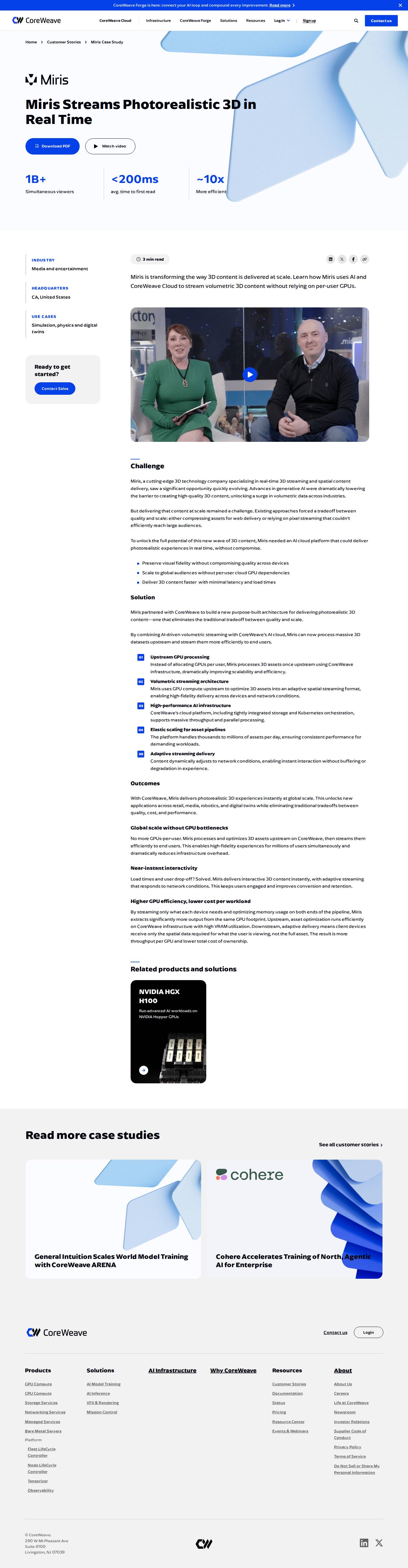 Open source capture
What the story claims, and what we checked
What we compared with the page.
- The figure: 1B+Checked
Printed word for word on the page, near the name of Miris.
- The passage quoted aboveChecked
Copied word for word from the page, near the name of Miris.
- The numbers in our summaryChecked
Each one is printed on the page.
- The publication dateChecked
Read from the page’s own metadata, never guessed.
- Miris uses CoreWeaveChecked
Confirmed line.
- The result itselfNot checked
We quote it; we did not measure it.
Instead of allocating GPUs per user, Miris processes 3D assets once upstream using CoreWeave infrastructure, dramatically improving scalability and efficiency.