

The use case: how Pax Historia deploys OpenRouter
Pax Historia is an alternate-history sandbox game where AI models decide how countries react to player actions. It uses OpenRouter to offer players a choice of many AI models from multiple providers through a single integration, with automatic fallback if a provider goes down.
More reported results
Figures published in OpenRouter’s case study. They are not independently measured by usedby.
They've routed 4.87 million requests through OpenRouter over the last month alone.
Players are then able to pick from 28+ AI models to optimize the kind of quality and pricepoint they want to play at.
Today, Pax Historia routes through 7+ AI providers via OpenRouter.
In the customer’s words
Stealth models are a game-changer for us — our players get access to the newest models the moment they drop, with minimal developer burden. And the provider fallback means if one provider hiccups at 2 AM, the game just keeps running.Other companies using OpenRouter
Customers across industries, with public evidence.
See all OpenRouter customers





Go straight to the source
Based on OpenRouter’s published case study. We check the public evidence; the results are reported by the vendor.
openrouter.ai- Last checked
- Oct 31, 2026
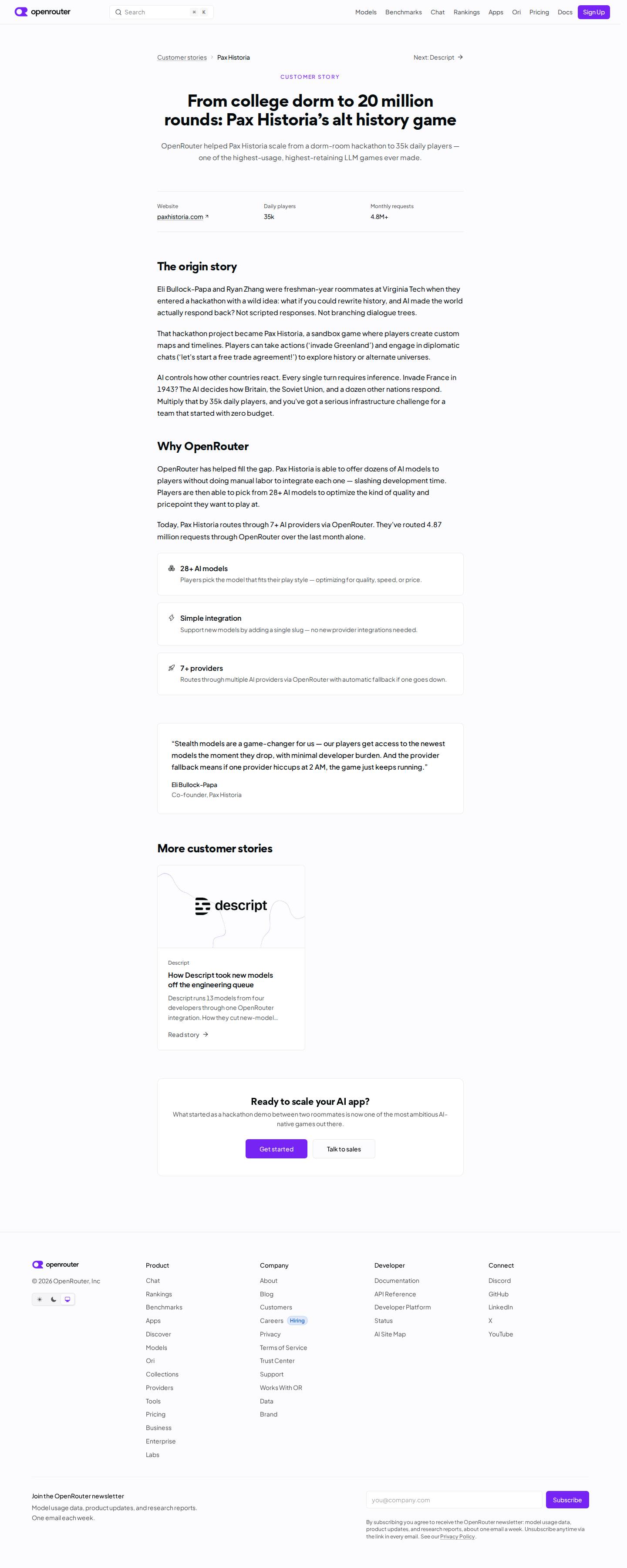 Open source capture
What the story claims, and what we checked
What we compared with the page.
- The figure: 35kChecked
Printed word for word on the page, near the name of Pax Historia.
- The passage quoted aboveChecked
Copied word for word from the page, near the name of Pax Historia.
- Pax Historia uses OpenRouterChecked
Confirmed line.
- The result itselfNot checked
We quote it; we did not measure it.
Today, Pax Historia routes through 7+ AI providers via OpenRouter. They've routed 4.87 million requests through OpenRouter over the last month alone.