
The use case: how Scaled Cognition deploys Together AI
Scaled Cognition trains its Large Action Models, including APT-1, on Together AI GPU Clusters. It uses bare-metal B200 nodes with direct SSH access to run custom Slurm orchestration and multi-node training.
More reported results
Figures published in Together AI’s case study. They are not independently measured by usedby.
~50% cost savings vs. other compute providers
In the customer’s words
We spent 3-4 months blocked by infrastructure failures with previous providers—debugging networking issues that had nothing to do with our models. Together AI's cluster has had zero training-blocking issues since we switched. That reliability, combined with significant cost savings compared to other providers, completely changed our development velocity. But honestly, the responsive support is what keeps us here: shared Slack channel, problems resolved within hours, smooth scaling of our training cluster as our needs have been expanding. Together AI lets us focus on building breakthrough models instead of fighting infrastructure.Other AI tools used by Scaled Cognition
Other public relationships recorded on usedby.
Explore Scaled Cognition’s AI stack

Together AI users in Artificial Intelligence
Companies in the same sector, with public evidence.
 Arcee AIConfirmed
 CartesiaConfirmed
 DecagonConfirmed
 Deep CogitoConfirmed
 Dippy AIConfirmed
 HedraConfirmed
Go straight to the source
Based on Together AI’s published case study. We check the public evidence; the results are reported by the vendor.
together.ai- Last checked
- Nov 21, 2026
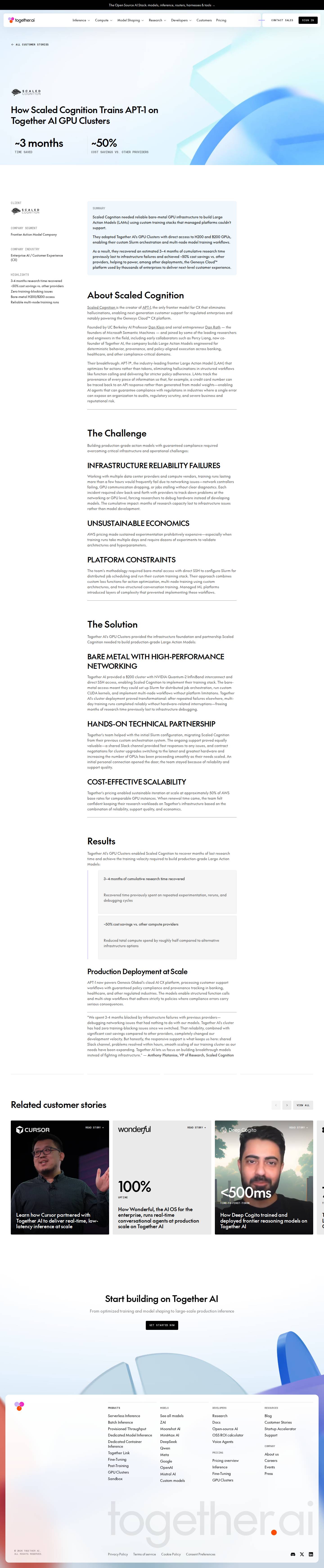 Open source capture
What the story claims, and what we checked
What we compared with the page.
- The figure: 3–4 monthsChecked
Printed word for word on the page, near the name of Scaled Cognition.
- The passage quoted aboveChecked
Copied word for word from the page, near the name of Scaled Cognition.
- Scaled Cognition uses Together AIChecked
Confirmed line.
- The result itselfNot checked
We quote it; we did not measure it.
As a result, they recovered an estimated 3–4 months of cumulative research time previously lost to infrastructure failures and achieved ~50% cost savings vs. other providers