
The use case: how United States Air Force deploys LILT
A USAF unit uses LILT's platform to translate large volumes of foreign technical content. Non-linguists use machine translation to flag high-value content, and USAF linguists then produce human-verified translations with LILT's predictive CAT tool.
More reported results
Figures published in LILT’s case study. They are not independently measured by usedby.
resulting in a more than 50% reduction in overall linguist ramp time
In the customer’s words
Our team completed more translation work in 4 months with LILT than the previous 2 years.Other companies using LILT
Customers across industries, with public evidence.
 American Meteorological SocietyConfirmed
 AnuvuConfirmed
 AsicsConfirmed
 CanvaConfirmed
 ChargePointConfirmed
 CricutConfirmed
Go straight to the source
Based on LILT’s published case study. We check the public evidence; the results are reported by the vendor.
lilt.com- Last checked
- Nov 25, 2026
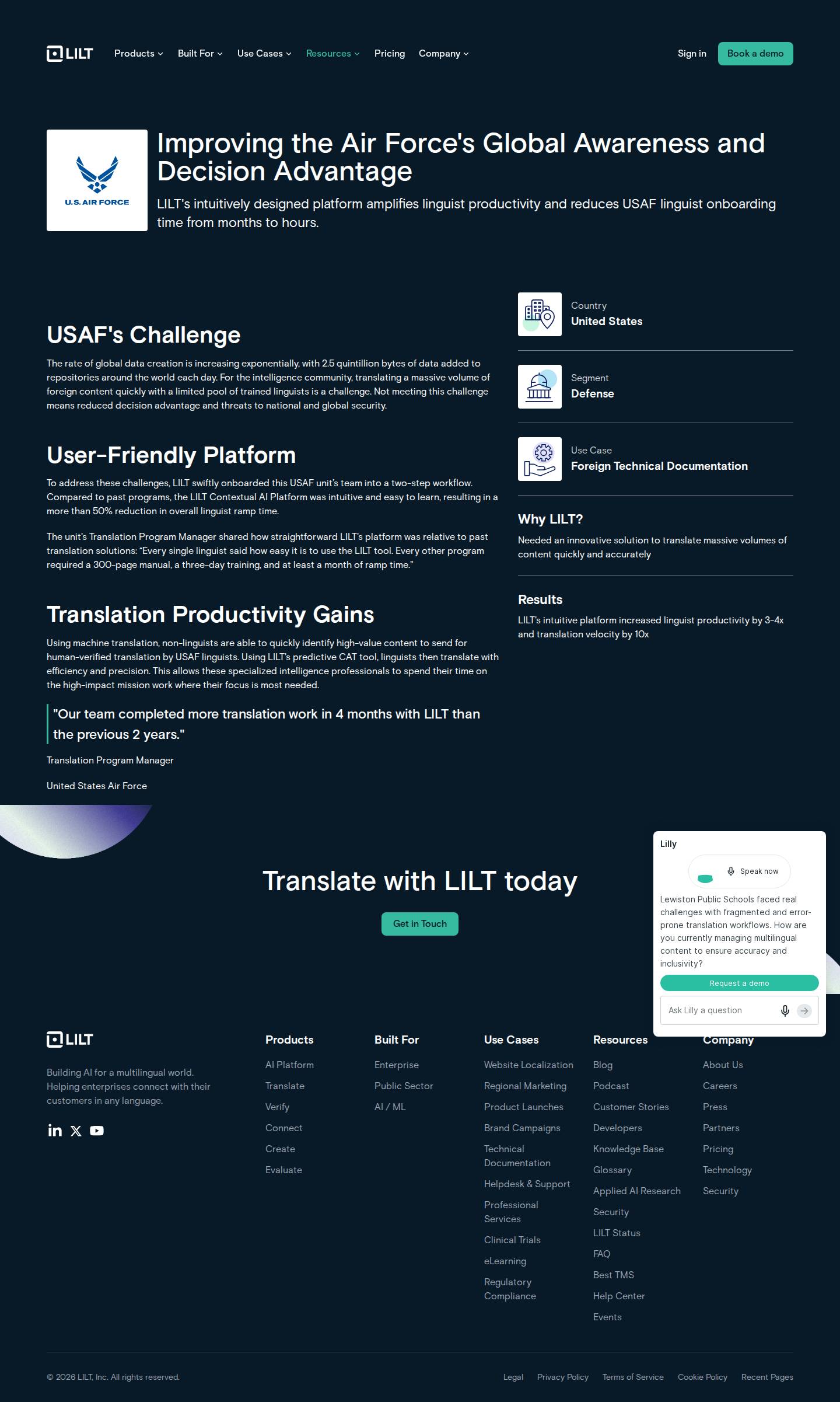 Open source capture
What the story claims, and what we checked
What we compared with the page.
- The figure: 10xChecked
Printed word for word on the page, near the name of United States Air Force.
- The passage quoted aboveChecked
Copied word for word from the page, near the name of United States Air Force.
- United States Air Force uses LILTChecked
Confirmed line.
- The result itselfNot checked
We quote it; we did not measure it.
Using machine translation, non-linguists are able to quickly identify high-value content to send for human-verified translation by USAF linguists. Using LILT's predictive CAT tool, linguists then translate with efficiency and precision.