

The use case: how HARMAN International deploys Darktrace
HARMAN uses Darktrace / NETWORK and Darktrace / EMAIL to detect and respond to threats across its network and email, replacing manual threat detection. Autonomous response handles most threats and alerts security analysts only to critical ones.
More reported results
Figures published in Darktrace’s case study. They are not independently measured by usedby.
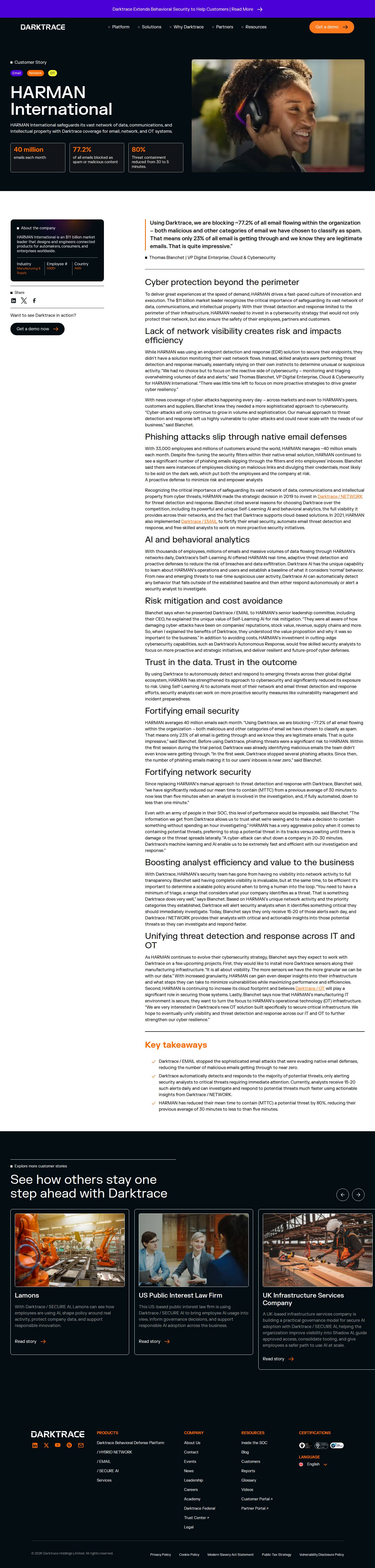
Using Darktrace, we are blocking ~77.2% of all email flowing within the organization – both malicious and other categories of email we have chosen to classify as spam.
Today, Blanchet says they only receive 15-20 of those alerts each day, and Darktrace / NETWORK provides their analysts with critical and actionable insights into those potential threats so they can investigate and respond faster.
HARMAN averages 40 million emails each month.
In the customer’s words
Using Darktrace, we are blocking ~77.2% of all email flowing within the organization – both malicious and other categories of email we have chosen to classify as spam. That means only 23% of all email is getting through and we know they are legitimate emails. That is quite impressive.Other AI tools used by HARMAN International
Other public relationships recorded on usedby.
Explore HARMAN International’s AI stack

Darktrace users in Automotive Manufacturing
Companies in the same sector, with public evidence.
See all Darktrace customers
Go straight to the source
Based on Darktrace’s published case study. We check the public evidence; the results are reported by the vendor.
darktrace.com- Last checked
- Oct 7, 2026
 Open source capture
What the story claims, and what we checked
What we compared with the page.
- The figure: 80%Checked
Printed word for word on the page, near the name of HARMAN International.
- The passage quoted aboveChecked
Copied word for word from the page, near the name of HARMAN International.
- HARMAN International uses DarktraceChecked
Confirmed line.
- The result itselfNot checked
We quote it; we did not measure it.
HARMAN has reduced their mean time to contain (MTTC) a potential threat by 80%, reducing their previous average of 30 minutes to less to than five minutes.