

The use case: how OpenRouter deploys Exa
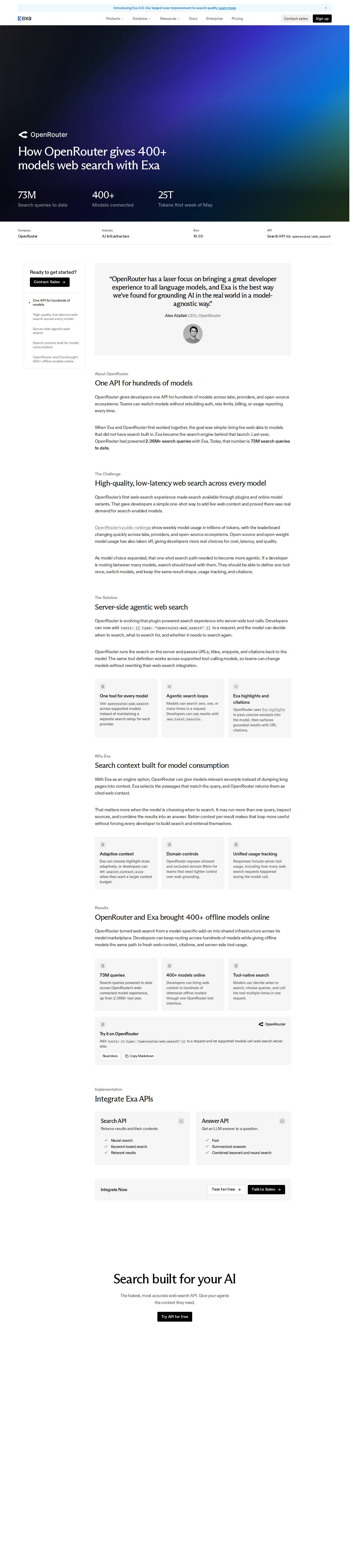
OpenRouter uses Exa as a search engine behind its server-side web search tool, giving models that lack built-in search access to live web results. The tool passes URLs, titles, snippets and citations back to the model, and works across supported tool-calling models.
More reported results
Figures published in Exa’s case study. They are not independently measured by usedby.
Last year, OpenRouter had powered 2.36M+ search queries with Exa.
In the customer’s words
OpenRouter has a laser focus on bringing a great developer experience to all language models, and Exa is the best way we've found for grounding AI in the real world in a model-agnostic way.Other AI tools used by OpenRouter
Other public relationships recorded on usedby.
Explore OpenRouter’s AI stack


Exa users in Artificial Intelligence
Companies in the same sector, with public evidence.
See all Exa customers
Go straight to the source
Based on Exa’s published case study. We check the public evidence; the results are reported by the vendor.
exa.ai- Last checked
- Nov 12, 2026
 Open source capture
What the story claims, and what we checked
What we compared with the page.
- The figure: 73MChecked
Printed word for word on the page, near the name of OpenRouter.
- The passage quoted aboveChecked
Copied word for word from the page, near the name of OpenRouter.
- OpenRouter uses ExaChecked
Confirmed line.
- The result itselfNot checked
We quote it; we did not measure it.
OpenRouter turned web search from a model-specific add-on into shared infrastructure across its model marketplace. Developers can keep routing across hundreds of models while giving offline models the same path to fresh web context, citations, and server-side tool usage.