From ticket to reviewed pull request: Cursor, Augment Code, Warp and Factory compared
Which of Cursor, Augment Code, Warp and Factory documents a path from a ticket to a human-reviewed pull request, and when each one fits. Vendor sources only.
Ticket-to-reviewed-PR points as each vendor documents them on its own product, pricing and security pages
| Criterion | Cursor | Augment Code | Warp | Factory |
|---|---|---|---|---|
| Repository context | Agent reads files and searches before editing; indexing and semantic search listed as research; mechanism not described.[1] | Context Engine at the core of Cosmos, plus shared organization knowledge across agents and teams.[2] | Factory file links repos, MCP servers and trackers; each run checks out code. Semantic indexing not described.[3] | AutoWiki per repository and Agent Readiness scores; indexing mechanism not detailed.[4] |
| Execution and environment | Desktop, CLI, Slack; cloud agents run in parallel. Self-hosting not stated.[1] | Laptops, dev VMs, Augment cloud or customer AWS/GCP; 50 concurrent sessions on Standard and Business.[2] [5] | Warp cloud or self-hosted VPC; any model or harness; Factories in early access.[3] | CLI install, Droid Computers for local runs, Mission Control; single-tenant VPC hosting per security page.[4] |
| Validation of the change | PR review in GitHub; automations for CI fixes and vulnerabilities. Default human approval not stated.[1] | Review fleet, Tester with screenshots, quality gates pausing for human approval of consequential actions.[2] | Approval gates in factory file, scored runs, screenshots or video captured by agents.[3] | Code review on every PR with inline comments; Droid Shield scans generated code; approval points not detailed.[4] |
| Permissions and deployment | SOC 2 Type II, ISO 27001, ISO 42001; Privacy Mode no-training; SSO, SCIM and CMEK documented.[6] [1] | SOC 2 Type II, ISO 42001; no training by default; Enterprise lists SSO/OIDC/SCIM and CMEK. SIEM, residency, audit trails listed, plan not shown.[7] [5] [2] | SOC 2 Type 2, US data storage, zero retention on Enterprise, DPA published; page covers the terminal.[8] [9] | SOC 2, ISO 27001, ISO 42001 listed; no training by default; DPA published; SIEM-exportable audit logs.[10] [11] [12] |
Sources
The shared job: a ticket in, a reviewed pull request out
All four vendors describe agents that take engineering work and hand back something a person can review. They get there by different routes. Cursor is a code editor with a CLI, a Slack integration and cloud agents. Augment Code sells Cosmos, an orchestration platform built on a context engine. Warp combines a terminal, an Agent CLI and Warp Factories, which are fleets of agents defined in code. Factory builds agents called Droids and surrounds them with code review, analytics and automations.
This comparison follows one job: a ticket in an existing repository, implemented by an agent, ending in a pull request that a human can read and approve. It is not a ranking and it contains no benchmark. Everything below rests on vendor product, pricing and security pages read on 15 October 2026, so it describes what vendors say. Where a page is silent, the point is unknown, not absent. Warp Factories is presented as early access, which matters if you plan a rollout.
Sources: cursor.com · augmentcode.com · warp.dev · factory.com
Repository context: what each page documents
Cursor's homepage shows its agent reading files and running searches before it edits, and lists secure codebase indexing and semantic search among its published research topics. How indexing works is not explained on that page. Cursor also lists marketplace connections such as Slack, Notion, Docker and Google Drive, which can bring non-code context into a session.
Augment Code puts a Context Engine at the core of Cosmos and describes shared organization knowledge, meaning memory shared across agents and teams. Its triggers cover GitHub, GitLab, Slack, Linear and Jira. In a case study published by Augment, the Handoff team said the tool respected its existing architecture and naming conventions, and that linking Linear and Figma through MCP gave it richer implementation detail.
Warp defines a factory in a configuration file that connects repositories, secrets, MCP servers, cloud accounts and Slack, Linear or Jira integrations; each run checks out the relevant code. The page does not describe semantic indexing, so that is an open question. Factory advertises AutoWiki, a living wiki per repository, and Agent Readiness, a score per repository, but does not detail how the code is indexed.
Sources: cursor.com · Marketplace (cursor.com) · augmentcode.com · Handoff scaling with augment code (augmentcode.com) · warp.dev · factory.com
Where the agent runs
Cursor runs as a desktop app, a CLI and a Slack app. Its cloud agents are described as using their own computers to build, test and demonstrate work in parallel. Marketplace automations include fixing bugs reported in a Slack channel with a pull request, and triaging Linear issues by opening pull requests for easy fixes. Self-hosting is not mentioned on the pages read.
Augment says Cosmos works on laptops, dev VMs, its own managed cloud or the customer's cloud on AWS or GCP, with isolated sandboxes. Its pricing page lists standard compute, daemon mode and 50 concurrent sessions on Standard and Business, and custom, multi-region compute on Enterprise. Standard costs $20 a month and Business $100, flat for up to 50 seats, with usage pooled. Model usage is billed at provider list price plus a 40 percent service fee, according to the vendor.
Warp says factories can run in its cloud or self-hosted in your own VPC, with any model or harness, and that nobody needs the Warp terminal to use them: work arrives from Slack, Linear, Jira, GitHub or GitLab. Pricing is described as usage-based, per agent run. Factory installs through a CLI and mentions Droid Computers, dedicated hardware that runs agents locally with persistent state, plus Mission Control for tracking runs. Its security page describes a sandboxed single-tenant environment with its own VPC; cloud execution of ticket work is not detailed on the homepage.
Sources: cursor.com · augmentcode.com · Pricing (augmentcode.com) · warp.dev · factory.com
How the change is checked before a human approves
Cursor says it reviews pull requests in GitHub, and its demo shows tasks marked ready for review. Its marketplace lists automations for fixing CI failures, addressing review comments and finding vulnerabilities, and one that assigns reviewers and auto-approves low-risk pull requests. Whether human approval is required by default is not stated, so the approval design depends on how you configure those automations.
Augment describes a code review fleet, a Tester that exercises the change end to end and posts results with screenshots, and quality gates where work pauses for review and consequential actions need a person's approval. That is the most explicit human-checkpoint language of the four. Its pricing FAQ separates standard Code Review for GitHub pull requests from an Enterprise version with analytics, allowlists and multi-organization support.
Warp's factory file sets triggers, agents, models and approval gates; it says every run is scored and that agents capture a screenshot or video as proof before a pull request. The numbers on its page are illustrations, not measurements. Factory offers code review on every pull request with inline comments, automations in which droids plan, execute and validate, and Droid Shield, which it says detects vulnerabilities, bugs and IP issues in generated code. Its approval points are not detailed.
Sources: cursor.com · augmentcode.com · warp.dev · factory.com
What customer workflows show
Rectangle Health, a healthcare payments company with a 30-person engineering team, offers the closest published ticket-to-pull-request story, in Warp's own case study. It is an Oz deployment: a senior engineer wired agents on Oz, Warp's cloud orchestration platform, into the Jira workflow so a ticket could reach a pull request, then added a Slack bot. The result, Rex, triages requests and routes them to research, development, review and QA agents. Warp reports about 100 cloud agent runs a week, typically 3 to 10 minutes from Slack mention to pull request, and 139 commits across 11 repositories in 60 active development days.
The story lists Oz, Warp Terminal and Slack and Jira triggers as the products used. It does not mention Warp Factories, so it does not validate Factories. What it does show is a customer-built ticket loop. The team said small backlog items such as slow SQL queries had sat untouched for months, and when the CTO tested the agents on such queries, they returned two pull requests across two repositories.
Augment's case studies describe a different shape of work. Handoff, a 13-person team using VS Code, delegated pieces such as screens from Figma and refined other parts in parallel. Augment's page reports pull request cycle time falling from 2.14 to 1.07 hours between August and November 2025 for that team. Peek, with about 25 engineers, ran a three-week trial each of GitHub Copilot, Cursor and Augment and reports test automation work dropping from two or three days to a few hours. The page gives no Cursor results, so it is not a head-to-head. Both stories are mostly about an assistant inside the developer's workflow, not a Cosmos ticket loop.
Cursor's customer page carries statements from companies such as Optiver, which describes a firm-wide rollout, and Mercado Libre, which describes features built in a day in some cases. These are adoption testimonials, not ticket-to-pull-request walkthroughs. Warp's Docker story concerns the terminal, not agents on tickets: a shared library of over 40 commands in Warp Drive, plus Warp AI questions, cut onboarding from about four weeks to three. For Factory, this article relies on product and trust pages, so its workflow is described in the vendor's own terms.
Sources: Rectangle health uses warp to build a self improving ai teammate (warp.dev) · warp.dev · Handoff scaling with augment code (augmentcode.com) · Peek (augmentcode.com) · augmentcode.com · Customers (cursor.com) · Docker (warp.dev) · factory.com
Security, permissions and data terms
Cursor lists SOC 2 Type II, ISO 27001 and ISO 42001, and its security page also names AIUC-1. It says that with Privacy Mode on, it will not train on your data, and that Privacy Mode can be enforced by team admins. Its documentation covers SSO and SCIM, CMEK, compliance logging and cloud agent network security. Augment lists SOC 2 Type II and ISO 42001 and says it does not train on customer data by default. Its pricing page summarizes Enterprise as including SSO, OIDC and SCIM support plus CMEK and ISO 42001 compliance. The same page's security comparison also names SIEM integration, data residency options, granular access controls and audit trails, but the text does not show which plan includes each of them.
Warp states it holds a SOC 2 Type 2 attestation, stores data in the United States on Google Cloud, encrypts with AES-256 and TLS 1.3, offers zero data retention for AI on Enterprise, and publishes a data processing agreement. That security page describes the terminal and its AI features, so confirm what applies to Factories, which Warp says can be self-hosted. Factory's trust portal lists SOC 2, ISO 27001 and ISO 42001 materials and published subprocessors; Factory says it does not train on customer data by default and publishes a DPA that notes primary processing in the United States. Its recent notices add Meta, Databricks, Snowflake and Mistral as subprocessors for AI model processing.
Sources: Security (cursor.com) · cursor.com · Security (augmentcode.com) · Pricing (augmentcode.com) · augmentcode.com · Security (warp.dev) · Data processing addendum (warp.dev) · trust.factory.com · Security (factory.com) · Data processing agreement (factory.com)
Which to shortlist, and what to ask in a demo
These are editorial suggestions, not vendor claims. Shortlist Cursor if your developers already live in an editor and you want one product for interactive work and cloud agents triggered from Slack and GitHub. Shortlist Augment Code if you want orchestrated loops with explicit human checkpoints, shared memory and the option to run in your own cloud. Shortlist Warp Factories if you want the whole setup defined as code, free choice of model and harness, and self-hosting, and you can accept early access; ask Warp for evidence specific to Factories, since the customer story read here covers Oz. Shortlist Factory if single-tenant hosting, SIEM-exportable audit logs and usage analytics matter most.
Four questions separate them in a demo. Where does the code run, and can it stay in our network? Who must approve before a pull request is opened or merged, and is that enforced or optional? What evidence is attached to the pull request, such as test output or screenshots? And which security documents cover the exact product surface we would use? Public customer counts are not a preference signal, and the customer figures above are vendor-reported on different teams, so they cannot be compared with each other.
Sources: cursor.com · augmentcode.com · warp.dev · factory.com
Method and limits
2026-10-15
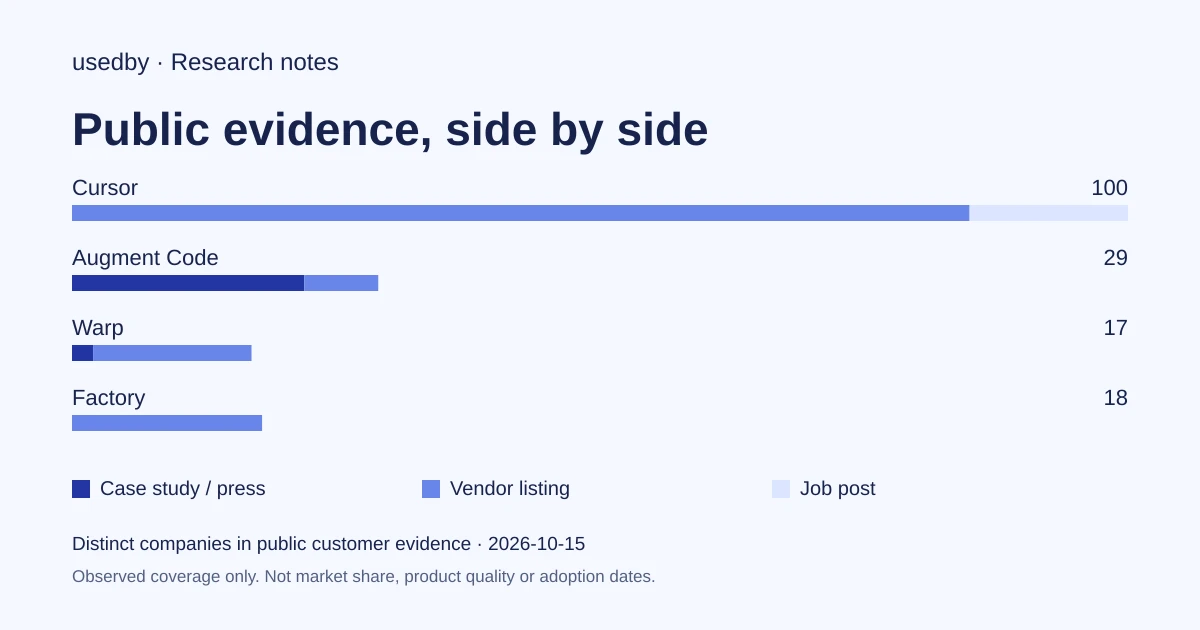
This dated snapshot counts distinct companies in public customer evidence. CONFIRMED means a case study, named testimonial or press source; OBSERVED means a vendor listing; SIGNAL means a job post. All three count, but their strength differs. Removed and unlevelled lines are excluded. Examples are a capped selection verified within 90 days. Vendor facts are sourced records checked within 60 days. Coverage is uneven and missing evidence is unknown. These figures measure neither market share nor product performance; capture dates are not adoption dates.
Sources
- cursor.comcursor.com
- augmentcode.comaugmentcode.com
- warp.devwarp.dev
- factory.comfactory.com
- Pricing (augmentcode.com)augmentcode.com
- Security (cursor.com)cursor.com
- Security (augmentcode.com)augmentcode.com
- Security (warp.dev)warp.dev
- Data processing addendum (warp.dev)warp.dev
- trust.factory.comtrust.factory.com
Questions
Do all four tools start work from a ticket or chat message?
Three name their trigger routes. Augment names GitHub, GitLab, Slack, Linear and Jira. Warp names Slack, Linear, Jira, GitHub and GitLab. Cursor shows Slack and marketplace automations for Linear and GitHub Actions. Factory's homepage describes automations in which droids plan, execute and validate, but does not list trigger sources, so confirm them with Factory.
Is my code used to train models?
Augment and Factory say customer data is not used for training by default. Cursor says it will not train on your data when Privacy Mode is enabled, which admins can enforce. Warp's page describes zero data retention for AI on its Enterprise plan; it does not use the same wording about training.
Is Warp Factories the same product as the Warp terminal?
No. Warp says Factories is a separate product and that nobody needs the terminal to use it. Factories is shown as early access, and the security page read here describes the terminal and its AI features, so check which terms apply to Factories.
Do the customer results prove one tool is faster?
No. The figures come from vendor-published stories about different teams, metrics and periods, such as Rectangle Health with Warp's Oz or Handoff and Peek with Augment. Cursor and Factory material read here offers testimonials or product claims, not comparable workflow data.
What do the tools cost?
Augment publishes Standard at $20 a month and Business at $100, each flat for up to 50 seats, with Enterprise on request. Warp describes Factories pricing as usage-based per agent run. Cursor and Factory prices were not on the pages read, so treat them as unknown.
Tools in this article
 Augment CodeAgent platform (Cosmos) and context engine that automate code review, ticket-to-PR and fixes across the SDLC.
 CursorAI code editor and coding agent that turns ideas into code
 WarpAgentic development environment: a modern terminal, a coding agent CLI and fleets of cloud coding agents.
 FactoryAI agents for software development
Explore the data
Who uses which AI tool, and how each line was found.