Gem or SeekOut for building a candidate pool: sourcing, CRM or ATS first?
Gem documents a CRM and native ATS; SeekOut documents contextual search over 1B+ profiles and your ATS. Which fits the hiring process you already run?
Sourcing, CRM and ATS are three different jobs
A candidate pool needs three things: a way to find people, a place to keep their details and conversation history, and a system that tracks applications. Product pages tend to blur these. Gem describes sourcing, candidate review, hiring workflows and analytics in one system. SeekOut describes contextual search, scorecards, screening interviews and outreach for recruiters, sourcers and talent leaders.
That is why this is not a ranking. The useful question is which role you want the tool to play next to the ATS you already have. Gem's homepage documents sourcing, a CRM and an ATS. SeekOut's pages centre on search, evaluation, screening and outreach, and say it works alongside the ATS you already run.
Sources: gem.com · seekout.com
Finding profiles: 800M+ versus 1B+ plus your ATS
Gem's AI Sourcing Agent searches 800M+ profiles, surfaces past candidates and reaches people with verified contact details, according to Gem. SeekOut says its AI searches 1B+ external profiles and your ATS at once, by context rather than keywords, ranks results by fit and offers role-specific workflows with automated rubrics.
Index sizes are vendor figures and say nothing about how well either index covers your roles. Both vendors also claim that past candidates are a rich source. Gem says 46% of hires now come from candidates already in a company's own systems. SeekOut says 44% of great hires already sit in your ATS. These are different claims with different definitions, so do not set them against each other.
Sources: gem.com · seekout.com
Data and enrichment: what each vendor says
Gem promises verified contact information and says it offers 2x better email coverage than competing tools with a 98% delivery rate. That is a vendor claim, not an independent test. Gem also says its agents draw on a company's full ATS and CRM history, including past applications, interviews and outreach.
SeekOut describes one search across the ATS and 1B+ profiles, auto-enriched, and adds a Talent Insights view of talent pools and labour-market data. It also states there is no third-party augmentation and that a DPA is supported. How contact data is obtained is not spelled out, which is worth asking about if reachable email addresses matter to you.
Sources: gem.com · seekout.com
Tracking conversations: where Gem has the clearer documentation
Gem presents a CRM with always-on candidate profiles and automated nurture sequences. Its security page explains the mechanics: sequence emails are sent from the user's own inbox, and read access lets Gem stop follow-ups when a candidate replies. Gem says it stores email addresses and timestamps to avoid duplicate outreach, plus sent sequence emails and a candidate's first reply.
Gem's case studies show the workflow. One Medical, a primary care provider using Greenhouse, uses Gem's CRM and branded email campaigns to nurture clinicians over a very long horizon. It reports consolidating 3+ tools and saving about $15,000 a year. Octave, also on Greenhouse, tracks prospects in Gem so its ATS holds only viable candidates, and reports a 112% rise in reply rates with automated sequences and 280+ hires from Gem outreach. These are vendor-published results for those customers, not a benchmark.
Carta shows the reporting side: recruiters message candidates from Gem and the actions update the ATS, while a pipeline view lets hiring managers see the whole funnel.
SeekOut documents multi-touch outreach to passive candidates, with AI-written messages. A customer quoted on its homepage, Shaped, reports four hires in four months. SeekOut's homepage does not describe a CRM or an equivalent conversation history, so confirm that in a demo if ongoing nurture is your core need.
Sources: gem.com · Security (gem.com) · Onemedical (gem.com) · Octave (gem.com) · Carta (gem.com) · seekout.com
Integrations, security and price signals
Gem says it integrates natively with Greenhouse, Workday, Lever and iCIMS. Its ATS is described as best for teams of up to a few thousand employees, while larger enterprises can layer Gem's agents on their existing ATS. SeekOut lists Workday, iCIMS, Greenhouse, Bullhorn, Lever, Avature, Beamery, SmartRecruiters, Ashby, Phenom, SAP SuccessFactors and Gem. SeekOut also runs inside assistants such as Copilot, ChatGPT and Claude, acting with the signed-in user's permissions.
Both vendors list SOC 2 Type II and offer a data processing agreement. These are vendor statements about attestations and contract terms, not proof of compliance for your use. On price, SeekOut publishes a 14-day free trial and a self-serve plan at $149 a month billed annually, with other plans custom. Gem's homepage mentions a startup programme and custom pricing for enterprises on Greenhouse or Workday, so get a quote.
Sources: gem.com · Partners (seekout.com) · seekout.com · trust.gem.com · Security (gem.com) · Pricing (seekout.com)
Which fits which hiring process
Choose Gem if the main gap is a CRM: keeping passive and past candidates warm, running sequences and reporting on the funnel, either alongside Greenhouse, Workday, Lever or iCIMS or by replacing a smaller ATS. Choose SeekOut if the main gap is searching the ATS and a large external index together, then scoring applicants and screening them, with outreach on top.
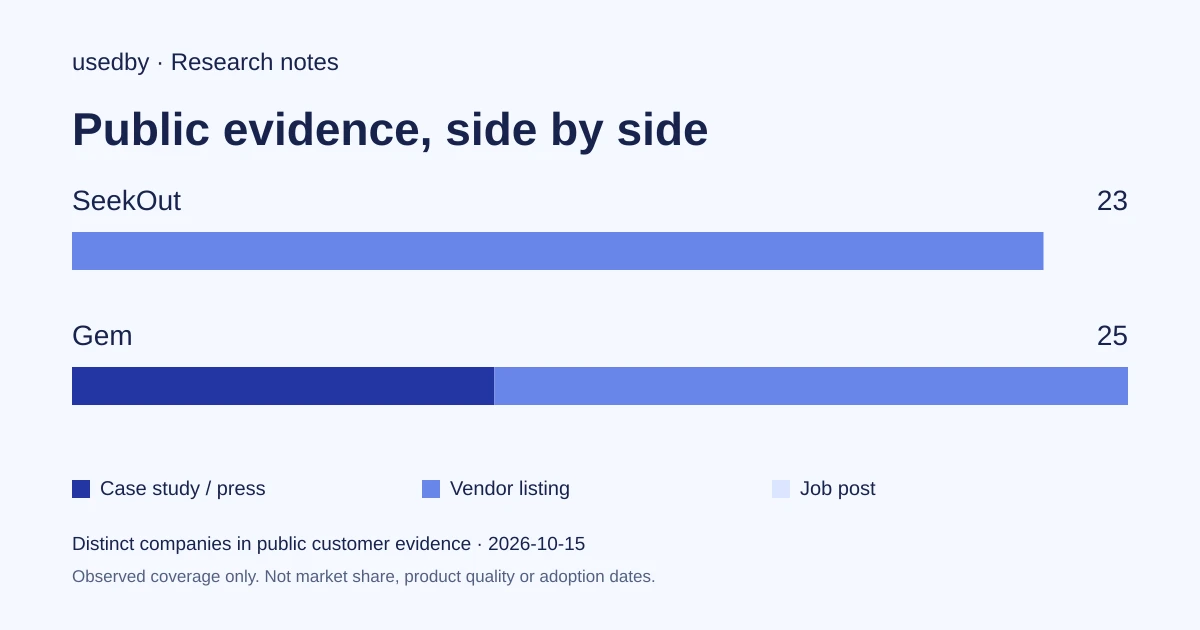
They are not mutually exclusive. SeekOut lists Gem as a technology partner, although the pages do not describe what the connection syncs. As an editorial suggestion, bring one real role to both demos and ask where candidate history lives afterwards and who owns it. Public customer counts, 25 for Gem and 23 for SeekOut with no overlap, are not market share.
Sources: gem.com · seekout.com · Gem (usedby.ai) · Seekout (usedby.ai)
Method and limits
2026-10-15
This dated snapshot counts distinct companies in public customer evidence. CONFIRMED means a case study, named testimonial or press source; OBSERVED means a vendor listing; SIGNAL means a job post. All three count, but their strength differs. Removed and unlevelled lines are excluded. Examples are a capped selection verified within 90 days. Vendor facts are sourced records checked within 60 days. Coverage is uneven and missing evidence is unknown. These figures measure neither market share nor product performance; capture dates are not adoption dates.
Sources
- gem.comgem.com
- seekout.comseekout.com
- Security (gem.com)gem.com
- Onemedical (gem.com)gem.com
- Octave (gem.com)gem.com
- Carta (gem.com)gem.com
- Partners (seekout.com)seekout.com
- trust.gem.comtrust.gem.com
- Pricing (seekout.com)seekout.com
Questions
Does Gem replace an ATS?
It can. Gem says its ATS suits teams of up to a few thousand employees. Larger enterprises can keep their ATS, such as Greenhouse or Workday, and add Gem's agents, CRM and analytics on top.
Does SeekOut search candidates already in my ATS?
SeekOut says its AI searches 1B+ profiles and the company ATS together, ranks them by fit and supports rediscovering past applicants. It lists integrations with many ATS platforms, including Greenhouse, Workday and Lever.
Which tool documents a CRM for nurturing candidates?
Gem documents a CRM with candidate profiles and automated nurture sequences. SeekOut documents multi-touch outreach but no CRM, so confirm the conversation history in a demo.
Do both vendors hold SOC 2 Type II and offer a DPA?
Both list SOC 2 Type II and a data processing agreement. Treat these as vendor statements and review the reports and contract terms yourself before sending candidate data.
Tools in this article


Explore the data
Who uses which AI tool, and how each line was found.