Lovable or Replit for a business app with screens, data and logins: who maintains it?
Lovable or Replit for a business app with a UI, a database and user logins? A walk through both vendors' documentation, by technical autonomy and upkeep.
The short answer: it depends on who will look after the app
Both tools turn a plain-language request into a working web application with a database, sign-in and publishing. The difference is less about what they can produce and more about how much of the surrounding work lands on your team.
Lovable documents a managed built-in backend, called Cloud, plus code sync to external Git providers. That suits a business team that wants a guided setup and may hand the code to developers later. Replit documents a prompt, preview and publish loop with managed Postgres, separate development and production environments and several deployment types. That suits a team that is willing to read generated code and tune configuration. This is a reading of vendor documentation, not a hands-on test.
Sources: Welcome (docs.lovable.dev) · Your first app (docs.replit.com) · Cloud (docs.lovable.dev) · Add database (docs.replit.com)
Building and editing: describe, preview, refine
Lovable's introduction says you describe what you want and it generates an application with frontend, backend, database, authentication and integrations, backed by editable code. Work happens in projects inside shared workspaces, with a project chat, a preview and version history.
Replit's first-app guide teaches a deliberate loop. You state one outcome, add observable success criteria, set limits on what not to build yet, let Agent build, test in Preview and ask for one focused improvement at a time. The guide postpones login, database, payments and integrations until the core screen works. For a business owner this is a useful discipline, but it also means the first build is a prototype, not the finished app.
On the Replit side, the shared responsibility page is explicit that you own the code Agent generates and should review it, especially around authentication and data handling. Plan that review time before you start.
Sources: Welcome (docs.lovable.dev) · Your first app (docs.replit.com) · Shared responsibility model (docs.replit.com)
Data and user access
Lovable's Cloud bundles a database, user management and sign-in methods, storage, secrets, scheduled jobs, edge functions and logs. Its tutorial builds a small CRM by prompting each capability in turn: tables, then login, then file uploads, then automations. The documentation notes that Cloud is built on Supabase's open-source foundation. One constraint matters early: once Cloud is enabled, the data region cannot be changed and projects cannot be moved between regions. Lovable's security page lists EU, US and Asia Pacific hosting.
Lovable also lets you control what its agent may do to your database. Changes that could break a published app, such as dropping or renaming a table, are set to never allow by default, with an option to approve each one after seeing the SQL. For a non-developer owner, that is a practical guardrail.
Replit's database guide uses Neon, a managed Postgres service that Agent provisions, with separate development and production environments. Its example attaches each reservation to the signed-in customer and blocks overlapping bookings. For access to the published app, the publishing guide offers four levels: public, password protected, workspace only and invite only. Replit's responsibility page says user management, access rules and regulatory compliance of the published app are yours.
Sources: Cloud (docs.lovable.dev) · Security (lovable.dev) · Add database (docs.replit.com) · Publish your app (docs.replit.com) · Shared responsibility model (docs.replit.com)
Publishing and what happens after
Lovable hosts the app and manages the backend infrastructure, with hosting that scales with traffic automatically. Its pricing page lists lovable.app domains on the free plan and custom domains from Pro. Its security page says a basic scan runs at each publish and that workspace admins can block publishing on critical findings.
Replit separates the private, temporary development preview from a production deployment at its own URL. You choose the domain, the access level and optionally a deep security scan, then verify the live app. Deployment types include Autoscale, Reserved VM, Static and Scheduled, and a monitoring view shows requests, response times, CPU and memory. Changes do not reach visitors until you republish, which keeps the same URL. More machine resources can raise usage costs.
Editorial reading of Replit's options list: machine power, maximum machine count, deployment geography and deployment type are all adjustable, though the guide says you need not change them to share a typical app. That is an advantage if someone on the team can make those calls, and a burden if nobody can. Lovable has decisions of its own, such as region, domain, Cloud permissions and publish approvals, so on either side someone should own them.
Sources: Cloud (docs.lovable.dev) · Pricing (lovable.dev) · Security (lovable.dev) · Publish your app (docs.replit.com)
Taking over the code, and what it costs
Lovable documents that each project produces a codebase you can sync to GitHub, GitLab or Bitbucket and bring into an existing engineering pipeline. Plans are priced in credits: Free at $0 per month, Pro at $25, Business at $50, with Enterprise on request. A single credit balance covers building, hosting, the built-in backend and AI features in deployed apps, so the real running cost of a live app is something to estimate during a pilot.
For Replit, this comparison does not cover plan pricing or code export. What the documentation does set out is the split of duties: Replit runs the platform and infrastructure and backs up the code of published apps and Replit-managed databases, while you handle code review, secrets, privacy notices and compliance. Replit's responsibility page also documents data residency: you select a region for published app data at publish time, and that choice is permanent after publishing. Pro customers can choose a Workspace location when creating it. Which plans and regions apply to you still needs checking.
On attestations, Replit's responsibility page names SOC 2 Type II as one Replit maintains. Lovable's trust center lists SOC 2 Type II and ISO 27001:2022, and offers a data processing agreement.
Sources: Welcome (docs.lovable.dev) · Pricing (lovable.dev) · Cloud (docs.lovable.dev) · Shared responsibility model (docs.replit.com) · Publish your app (docs.replit.com) · trust.lovable.dev
What Lovable customers show about maintenance
Vendor-published Lovable stories illustrate the handover question. Productiv, a logistics company, describes an operations director with no coding background building first versions, while two experienced developers finish them for production, handling optimization, security and API connections. This is the vendor's account of one company, not a benchmark.
Creandum, a venture firm, reports firm-wide access to a common workspace, with role-based access controls and authentication for apps that handle sensitive financial and legal information. Its legal team replaced forms with a link-based compliance flow. The lesson for a buyer is that the builder and the maintainer can be different people, and that a shared workspace helps only if someone owns access rules.
Sources: Productiv (lovable.dev) · Creandum (lovable.dev)
Which team should choose which
Lean toward Lovable if business staff will build and iterate, you want backend, hosting and sign-in handled in one managed place, and you may want developers to take over through Git later. Lean toward Replit if someone can review generated code and configure deployment, you want a stated split between preview and production with explicit deployment types, and you value its managed Postgres with separate environments.
Editorial recommendation, not a vendor capability: build the same small tracker in both, with one table, two user roles and one publish, and note who had to intervene and how often. Before real data goes in, confirm Replit pricing and code export, the plan and region options for Replit data residency, and the real usage cost on each side.
Sources: Cloud (docs.lovable.dev) · Welcome (docs.lovable.dev) · Add database (docs.replit.com) · Publish your app (docs.replit.com) · Your first app (docs.replit.com) · Shared responsibility model (docs.replit.com)
Method and limits
2026-10-15
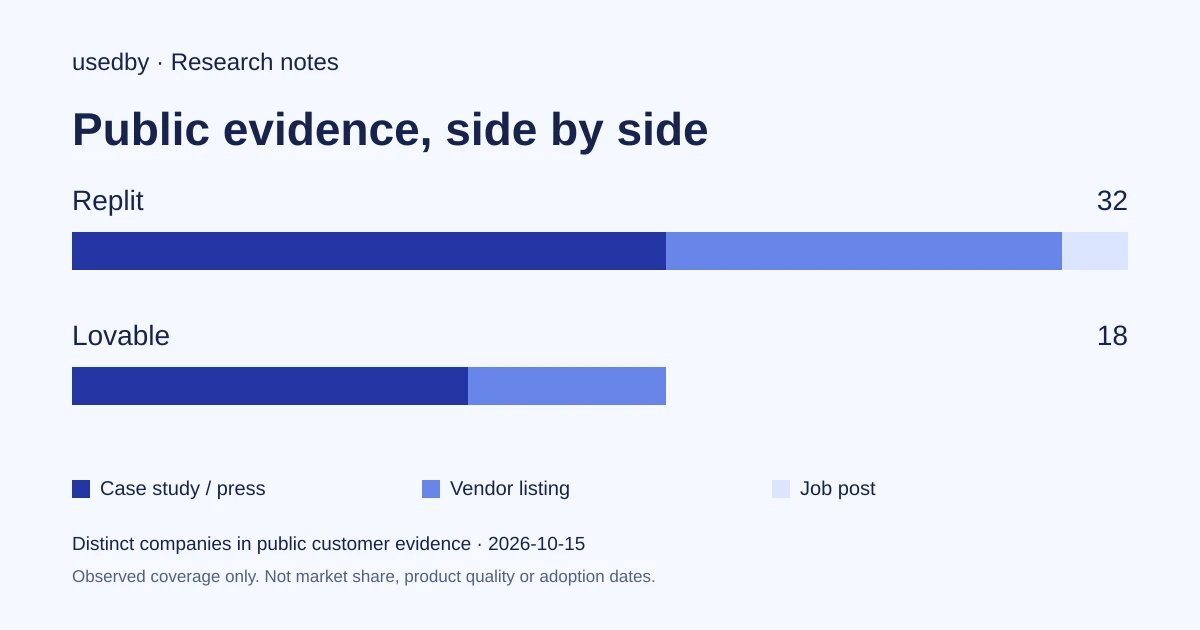
This dated snapshot counts distinct companies in public customer evidence. CONFIRMED means a case study, named testimonial or press source; OBSERVED means a vendor listing; SIGNAL means a job post. All three count, but their strength differs. Removed and unlevelled lines are excluded. Examples are a capped selection verified within 90 days. Vendor facts are sourced records checked within 60 days. Coverage is uneven and missing evidence is unknown. These figures measure neither market share nor product performance; capture dates are not adoption dates.
Sources
- Welcome (docs.lovable.dev)docs.lovable.dev
- Your first app (docs.replit.com)docs.replit.com
- Cloud (docs.lovable.dev)docs.lovable.dev
- Add database (docs.replit.com)docs.replit.com
- Shared responsibility model (docs.replit.com)docs.replit.com
- Security (lovable.dev)lovable.dev
- Publish your app (docs.replit.com)docs.replit.com
- Pricing (lovable.dev)lovable.dev
- trust.lovable.devtrust.lovable.dev
- Productiv (lovable.dev)lovable.dev
Questions
Can a non-developer team run a business app on Replit?
Replit's guide is written for prompting and testing in Preview without diagnosing code yourself. Its responsibility page, however, makes you accountable for reviewing generated code, access rules and compliance, so someone should be able to do that review.
Does Lovable include a database and user logins?
Yes. Lovable's documentation describes a built-in backend, Cloud, with database, user management and sign-in, storage, secrets, functions and logs, managed by Lovable. The data region is fixed once Cloud is enabled.
Can developers take over a Lovable project later?
Lovable documents that each project produces a codebase that can sync to GitHub, GitLab or Bitbucket, so developers can review and extend it in an existing workflow. Replit code export is not covered in this comparison.
Which tool is cheaper?
The comparison cannot say. Lovable lists Free, Pro at $25 and Business at $50 per month, with one credit balance for building and running. Replit pricing is not covered here, and real usage costs on both sides should be estimated in a pilot.
Tools in this article


Explore the data
Who uses which AI tool, and how each line was found.