Lovable, Replit or Bubble for a business app without developers: data, changes and running costs
No technical team? Compare Lovable, Replit and Bubble on interface, data, control of changes and running costs, with a starting point for each situation.
Lovable, Replit and Bubble on four documented criteria, based on vendor documentation
| Criterion | Lovable | Replit | Bubble |
|---|---|---|---|
| Building the interface | Describe the app in natural language, iterate in chat, publish to a live URL. Editable code underneath.[1] | Prompt with success criteria, Agent builds, test in Preview, ask for focused fixes.[2] | AI-generated start, then visual editing of design; web and native mobile presented.[3] |
| Logic and data | Built-in Cloud backend: database, auth, storage, realtime, functions, jobs and SQL editor.[4] | Neon Postgres provisioned by Agent, with separate Development and Production environments.[5] | Built-in database, visual workflows and editable privacy rules with a checker.[3] [6] |
| Control and export | Git sync to GitHub, GitLab or Bitbucket; data export in Cloud settings; region fixed once chosen.[1] [4] | User reviews generated code, sets access and approves sensitive actions. Code export is not described.[7] | Point-in-time backups; region choice on Enterprise Dedicated; 2FA plan scope differs between security and pricing pages. Code export not described.[6] [8] |
| Operation and pricing | One credit balance for building, hosting and AI features. Free, $25 Pro, $50 Business per month.[9] [4] | Preview separate from production; four access levels and four deployment types. Prices not covered here.[10] | Free, $29, $119, $349 per month, with AI credits and workload units; overages can be disabled.[8] |
Sources
The short answer: two approaches, not one ranking
If nobody on your team writes code, the useful question is not which tool is best. It is how you will change the app six months from now, and who will be able to understand what it does. Lovable and Replit start from a prompt and produce code. Bubble starts from an AI-generated app and then asks you to edit design, database, logic and privacy rules visually.
Lovable describes itself as generating a working app with frontend, backend, database and authentication, backed by editable code. Replit's first-app guide builds with its Agent and tests in a Preview. Bubble says its apps stay in a visual programming language, and its own FAQ argues that this is the main difference from code-generating tools. That is Bubble's positioning of its rivals, not an independent finding.
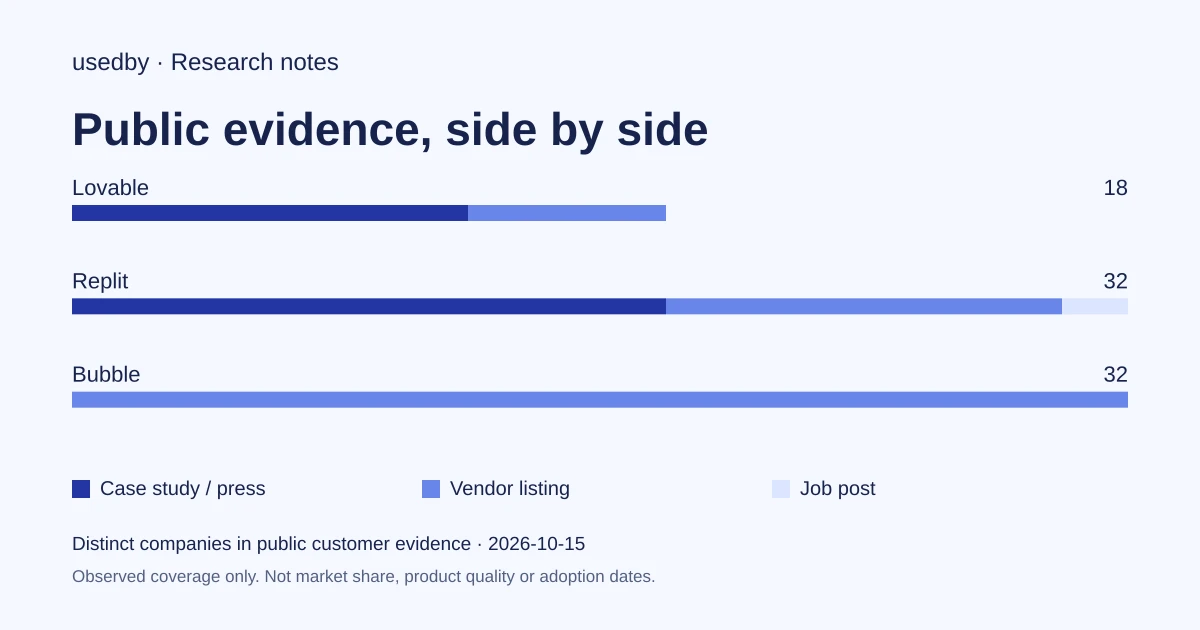
Public customer counts do not settle the choice. The usedby listings show 18 companies for Lovable, 32 for Replit (two of them proven only by job posts) and 32 for Bubble (all observed, none confirmed by a case study). These are counts of companies named on public pages, not market share or satisfaction.
Sources: Welcome (docs.lovable.dev) · Your first app (docs.replit.com) · bubble.io
Building the interface: prompt and preview, or prompt then visual editing
Lovable's documentation follows a simple loop: describe what you want, review and iterate, then publish to a live URL. Work lives in shared workspaces, where each project is one application with its own chat, preview, code and version history. That suits a business team where several people contribute to separate small apps.
Replit's guide is more prescriptive. It tells you to state one outcome, add observable success criteria, set boundaries on what not to build yet, test in Preview and ask for one focused improvement at a time. Login, data and payments are deliberately postponed. When something breaks, you describe the symptom to Agent instead of diagnosing the code yourself. This works if you can test like a visitor, but it also means you depend on the Agent to diagnose.
Bubble's homepage lets you switch between AI prompting and visual editing. Design can be generated by AI, imported or taken from templates. Bubble also presents native iOS and Android publishing alongside web. Among the sources read for this comparison, only Bubble's describes native mobile publishing as a core feature, so check mobile needs against all three vendors before deciding.
Sources: Welcome (docs.lovable.dev) · Your first app (docs.replit.com) · bubble.io
Logic and data: what happens when real records arrive
Lovable's built-in backend, called Cloud, includes a database, authentication, storage, realtime and server functions, with scheduled jobs, a SQL editor and logs. The documented CRM tutorial shows the pattern: describe the tables in plain language, add login, add file uploads, then automate one task at a time. Lovable also exposes permissions for what its agent may do. Schema changes are allowed by default, but changes that could break a published app, such as dropping a table or column, are set to never allow by default, and can be set to ask for approval with the SQL shown.
Replit's database guide uses Neon, a managed Postgres, which Agent provisions with separate Development and Production environments. The suggested prompt asks Agent to attach each reservation to the signed-in customer and to block overlapping bookings. The guide then tells you to test: refresh, restart the app, try a second account, and finally confirm everything on the public URL. For a quick prototype it points to a simpler built-in Replit Database.
Bubble describes a built-in database, visual workflows, and connections to services such as Stripe and Google Maps. On privacy, its security page highlights customizable privacy rules, defined in natural language, and a checker that reviews them for gaps. Data access rules are therefore something a non-developer can read and edit in the product itself.
Sources: Cloud (docs.lovable.dev) · Add database (docs.replit.com) · bubble.io · Security (bubble.io)
Control and export: who can change what, and what you can take with you
Lovable's code can be synced to GitHub, GitLab or Bitbucket, and the data can be exported from the Cloud advanced settings. Region matters: once Cloud is enabled for a project, its region cannot be changed, and projects cannot be moved between regions. On Business and Enterprise plans, admins can set a default hosting region for new projects. Lovable lists SOC 2 Type II and ISO 27001 among its attestations and offers a data processing agreement. These are vendor statements to check against your own requirements.
Replit's shared-responsibility page is the clearest on duties. Replit covers the platform, the Agent harness and published-app infrastructure. You are responsible for reviewing generated code, the app's access control, the visibility you choose when publishing, the data it handles and its regulatory compliance. You must also approve sensitive Agent actions such as deploys and secret changes. For a team without developers, the code review duty is the practical issue: someone must be able to judge authentication and data handling. The page does not describe code export.
Bubble's security page documents point-in-time backups, error tracking and SSO on Enterprise. On two-factor authentication, the security page says all users can enable it on their own account, while the pricing page lists it as a Growth-plan feature. The pages do not explain the difference, so confirm which applies to your plan. Hosting is on AWS, in a West region unless you buy an Enterprise Dedicated plan, which allows choosing a region. Bubble states SOC 2 Type II compliance and offers a data processing agreement. The pages read do not explain how to export an app out of Bubble, so treat that as an open question to put to the vendor.
Sources: Welcome (docs.lovable.dev) · Cloud (docs.lovable.dev) · trust.lovable.dev · Shared responsibility model (docs.replit.com) · Security (bubble.io) · Pricing (bubble.io) · bubble.io
Running the app: credits, deployments and workload units
Lovable prices by credits, not seats or projects. The listed plans are Free at $0, Pro at $25 and Business at $50 per month, with Enterprise on request. One credit balance covers building, hosting, the built-in backend and AI features inside deployed apps. So an app that many people use can consume the same pool you use to build.
Replit separates the temporary Preview from the published production deployment. Publishing offers public, password-protected, workspace-only or invite-only access. You choose a deployment type: Autoscale, Reserved VM, Static or Scheduled. Monitoring shows requests, errors and resource use. The guide notes that more machine resources can raise usage costs. Replit's price list was not among the sources used here, so no cost comparison is possible.
Bubble lists Free at $0, Starter at $29, Growth at $119 and Team at $349 per month with annual billing, plus Enterprise on request. Plans include AI credits and workload units, which measure server processing such as database operations and workflows. Overages can be disabled to cap usage. Bubble also notes that a paid plan is needed to deploy a live mobile app. Because usage-based units are less intuitive than seats, test a realistic month of activity before committing.
Sources: Pricing (lovable.dev) · Cloud (docs.lovable.dev) · Publish your app (docs.replit.com) · Pricing (bubble.io)
What customer workflows show
The most detailed customer page available is Lovable's Creandum story, a vendor-published case study. One context matters: the page says Creandum led Lovable's Seed round in January 2025, so this is an investor describing a company it backs. According to the story, Creandum's fund partner built an AI-enabled tool that has grown to run the firm's investment process, portfolio and fund management. Separately, Operating Partner Peter Stilwell built an investment-voting app: team members vote through a shared link and record their reasoning, not just a score. The legal team built a mobile-first due diligence app to replace manual forms, later triggering compliance work such as drafting, signatures and filing. The London office manager built a visitor and space-tracking tool, and the events team built a Founder Summit app with a live agenda, a map and QR codes. Creandum reports 100+ apps in a little over a year and an estimated $250K+ in software and development savings. Role-based access and authentication were used for sensitive financial and legal information.
The lesson is about who builds, not just speed. The people closest to the problem built the apps, and the story describes some of them moving from prototypes to integrated parts of the firm's operations. As apps take on that role, someone must decide who reviews access rules and data. The savings figure is Creandum's own estimate, published by a vendor it invested in, and cannot be compared with other vendors' numbers.
For the other two, the sources read give less. Replit's documentation uses worked examples, a workshop RSVP site and a car-reservation app, rather than customer stories. For Bubble, the founder of Dyspute.ai says on Bubble's homepage that an AI mediation function took eight weeks instead of the year expected. That is a testimonial, not a test, and the vendors report different metrics.
Sources: Creandum (lovable.dev) · bubble.io · Add database (docs.replit.com) · Your first app (docs.replit.com)
Which starting point fits, and what to ask before real data goes in
These are editorial recommendations, not vendor claims. Start with Lovable if you want fast prompt-driven apps, a bundled backend, one credit balance and a code copy in GitHub, GitLab or Bitbucket that a future engineer could take over. Start with Replit if you want a prompt, preview and publish loop with a managed Postgres database and adjustable deployment types, and you can find someone to review generated code. Start with Bubble if you want non-developers to read and edit logic, data structure and privacy rules visually, and you accept a usage-based plan.
Before real data goes in, run the same small test in each tool: a request tracker with two user roles. Check that a user cannot see another user's records, that data survives a restart and a republish, and that you can find where access rules are written. Then make one change to the data model and see what the tool warns you about. Finally, ask each vendor where data is stored, what can be exported, and what a realistic month costs. Bubble's export and Replit's pricing remain the main gaps in the sources used here.
Sources: Welcome (docs.lovable.dev) · Your first app (docs.replit.com) · Shared responsibility model (docs.replit.com) · bubble.io · Cloud (docs.lovable.dev) · Add database (docs.replit.com) · Security (bubble.io)
Method and limits
2026-10-15
This dated snapshot counts distinct companies in public customer evidence. CONFIRMED means a case study, named testimonial or press source; OBSERVED means a vendor listing; SIGNAL means a job post. All three count, but their strength differs. Removed and unlevelled lines are excluded. Examples are a capped selection verified within 90 days. Vendor facts are sourced records checked within 60 days. Coverage is uneven and missing evidence is unknown. These figures measure neither market share nor product performance; capture dates are not adoption dates.
Sources
- Welcome (docs.lovable.dev)docs.lovable.dev
- Your first app (docs.replit.com)docs.replit.com
- bubble.iobubble.io
- Cloud (docs.lovable.dev)docs.lovable.dev
- Add database (docs.replit.com)docs.replit.com
- Security (bubble.io)bubble.io
- Shared responsibility model (docs.replit.com)docs.replit.com
- Pricing (bubble.io)bubble.io
- Pricing (lovable.dev)lovable.dev
- Publish your app (docs.replit.com)docs.replit.com
Questions
Can a team with no developers use Lovable, Replit or Bubble for a business app?
All three target this use. Lovable and Replit generate code from prompts, so someone should be able to review it, which Replit's responsibility page makes explicit. Bubble lets non-developers edit logic, data and privacy rules visually. Fit depends on how much you need to understand and change later.
Which tool gives the most control over my data?
They differ in kind, not in rank. Lovable offers Git sync, data export and a fixed region per project. Bubble offers editable privacy rules and point-in-time backups, with region choice only on Enterprise Dedicated. Replit puts access control and code review on you. Bubble's code export is not described in the pages read.
How do the pricing models differ?
Lovable charges by credits, with Pro at $25 and Business at $50 per month. Bubble charges per plan, from $29 to $349 per month on annual billing, plus workload units and AI credits. Replit's price list was not in the sources used, so it is not compared here.
Do customer case studies prove one tool is better?
No. They are vendor-published or observed listings with different metrics and populations. Creandum's 100+ apps and estimated savings illustrate Lovable use at one firm, and Creandum led Lovable's Seed round, so weigh it accordingly. Bubble's customer listing is observed only. Use them as examples of workflows, not benchmarks.
Tools in this article



Explore the data
Who uses which AI tool, and how each line was found.