Dust or Writer: which platform for internal AI agents connected to company knowledge and tools?
Dust and Writer both offer agents tied to company data. How they differ on connectors, agent building, permissions and cost, and who should pick which.
Dust and Writer on four deployment criteria, based on each vendor's current public pages
| Criterion | Dust | Writer |
|---|---|---|
| Connections and context | Home page says 70+ connectors; pricing page says 20+ data sources plus MCP. Business: up to 3 connectors, 5 remote MCP servers. Enterprise: unlimited.[1] [2] | Knowledge Graph plus basic to enterprise connector tiers. Starter: up to 3 active connectors. Enterprise: unlimited.[3] [4] |
| Building assistants | Custom agents with skills and tools, multi-agent triggers and schedules, 20+ models chosen per agent.[1] [2] | Agent Builder, workflow engine, Playbooks (5 on Starter), routines, 100+ prebuilt agents. Default models on Starter, preferred LLMs on Enterprise.[3] [4] |
| Actions and permissions | Dual-layer model separating agent data access from user access; roles, private spaces, SCIM groups, audit logs on Enterprise.[1] [5] | Governed execution layer checks identity and permissions and records activity; role-based access, approvals, audit logs.[3] [6] |
| Administration and cost | Published: Free, Pro $24 and Max $120 per seat per month (yearly), with credits. Enterprise by quote. US and EU residency.[7] [5] | Starter with 14-day trial and fixed credit limits (amounts not on the page); Enterprise by quote. DPA available. Regions not listed on pages read.[3] [8] [9] |
Sources
The short answer: same need, different framing
Both vendors sell agents that work on company data, with permissions and an Enterprise tier. The difference is in how each one frames the product. Dust describes a platform where teams create, share and run agents on company knowledge, using models from several providers. Writer describes an enterprise agent platform built around brand, compliance and content work for marketing, sales and operations.
So the choice is conditional. Lean toward Dust if you want many teams to build their own agents, pick models agent by agent, and see per-seat credit prices before talking to sales. Lean toward Writer if your first use cases are on-brand content, sales preparation and governed workflows, and you accept a quote-based Enterprise conversation. Neither is a universal winner, and the two vendors list no shared customers, which tells you nothing about which one suits you.
Sources: dust.tt · writer.com · Dust (usedby.ai) · Writer (usedby.ai)
Connections and context
Dust's home page speaks of 70+ connectors, including Slack, Notion, Google Drive, GitHub, Salesforce and Zendesk. Its pricing page, however, says connectors to 20+ data sources, plus any tool through MCP. Those two figures do not match, so ask Dust which one applies to your plan. On the self-serve Business plan, the pricing page lists up to 3 connectors and 5 remote MCP servers; Enterprise is listed as unlimited.
Writer pairs a Knowledge Graph with connectors in basic, advanced, industry-specific and enterprise tiers. Its Plans page caps Starter at 3 active connectors and lists Enterprise as unlimited. Its home page names Salesforce, Snowflake, Adobe, Gong, HubSpot, Microsoft 365 and Google Workspace. Editorial note: a 3-connector cap is easy to hit. A support agent that reads tickets, runbooks and chat already uses three sources, so count your sources before choosing a tier.
Sources: Dust (usedby.ai) · dust.tt · Writer (usedby.ai) · writer.com
Building the assistants
On Dust, builders create custom agents with skills, knowledge and tools. The platform also offers multi-agent workflows on schedules and triggers, and more than 20 models from OpenAI, Anthropic, Google, Mistral and DeepSeek, chosen per agent. Dust states that no model is locked behind a higher plan, though stronger models can use more credits per message.
Writer's Plans page lists an Agent Builder, a workflow engine, Playbooks, scheduled routines and a library of 100+ prebuilt agents. Starter allows 5 Playbooks and up to 3 scheduled routines; Enterprise is unlimited. Starter runs on Writer's default models, while Enterprise works with preferred LLMs. The home page ties these pieces to Voice, Terms and Style Guide features, which suits content teams that need consistent output.
Sources: Dust (usedby.ai) · Pricing (dust.tt) · Writer (usedby.ai) · writer.com
What customers built: workflows as illustrations
Dust's published stories lean toward operations and revenue teams. Wayflyer, a fintech, built a triage agent that starts when a Jira ticket opens, searches ticket history, Notion runbooks and Slack, and posts a summary with sources. A second agent drafts runbook updates after resolution. Dust's case study reports over 90% less runbook maintenance time and near 100% monthly workspace adoption within six months. Apiday reports prospect enrichment falling from 7 days to 2 hours, plus a morning agent that scores sales calls against a sales framework.
Alma describes a product agent that reads project briefs and proposes documentation updates in Slack, which a product manager reviews before publishing to Notion; Dust's story reports up-to-date documentation rising from 55% to 87% in a quarter. On the Writer side, Commvault's interview with its Chief Market Officer describes Ask Commvault Cloud, a chat app on Writer's Knowledge Graph that gives sales reps answers by buyer persona. Commvault reports it was deployed in weeks and that daily use in marketing grew from 30% to 80% over a year. These are vendor-published results from different companies and metrics, not a head-to-head test.
Sources: How wayflyer built a self tuning support flywheel with dust (dust.tt) · How apiday cut prospect enrichment from 7 days to 2 hours with dust and and idoption (dust.tt) · Alma scaled ai personal productivity to company infrastructure (dust.tt) · Commvault customer story (writer.com)
Actions and permissions
Dust describes a dual-layer permission model that separates what agents can access from who can use them, with SCIM-synced groups and audit logs. Its security page adds SSO, user, builder and admin roles, and private spaces. On Business, Spaces are limited to 5; SCIM and audit logs are Enterprise features. Dust states that customer data is not used to train models by default.
Writer states that agent requests to connected systems pass through a governed execution layer that validates identity, checks permissions and records activity. Its Trust page also lists role-based access, approval flows, audit logs and activity traces. Writer says it does not train on customer data and offers a data processing agreement. Both vendors state SOC 2 Type II; Writer also states ISO 27001. These are vendor claims, so request the reports.
Sources: Dust (usedby.ai) · Security (dust.tt) · Writer (usedby.ai) · Trust (writer.com) · Data processing (writer.com)
Administration and cost
Dust publishes prices: Free at $0 with 500 lifetime credits, Pro at $24 per seat per month billed yearly with 8,000 credits, and Max at $120 with 40,000 credits. Enterprise is by quote. Credits depend on the model and the actions an agent takes, and they do not roll over. A Free plan lets you test, and Dust lists US and EU data residency.
Writer offers a 14-day free trial on Starter, for up to 5 users, with per-seat plans and fixed credit limits; the Plans page does not state the amounts. Enterprise is sold through sales and lists unlimited users plus granular agent governance, observability and auditability. The Plans comparison table also lists SAML SSO, SCIM provisioning and audit logs among its features. The Trust page describes managed, multi-cloud options, including dedicated private cloud deployment, but the pages read do not list data regions, so confirm residency before any regulated rollout.
Sources: Pricing (dust.tt) · Security (dust.tt) · Writer (usedby.ai) · Plans (writer.com)
How to choose and what to ask
Choose Dust to shortlist if your use cases span support, sales and operations, you want each team to build and share agents, and published credit pricing helps you budget a pilot. Choose Writer to shortlist if content quality, brand voice and governed approvals are the first problem and you want the Knowledge Graph and Playbooks approach. If both needs are real, run the same small workflow on each rather than comparing feature lists.
Editorial suggestions for demos, not vendor capabilities: ask Dust which connector count applies to your plan and what a realistic month of credits costs for your agents. Ask Writer for Starter credit amounts, Enterprise pricing and available data regions. Ask both how many connectors your target workflow needs and which tier unlocks them.
Sources: Dust (usedby.ai) · Writer (usedby.ai)
Method and limits
2026-10-15
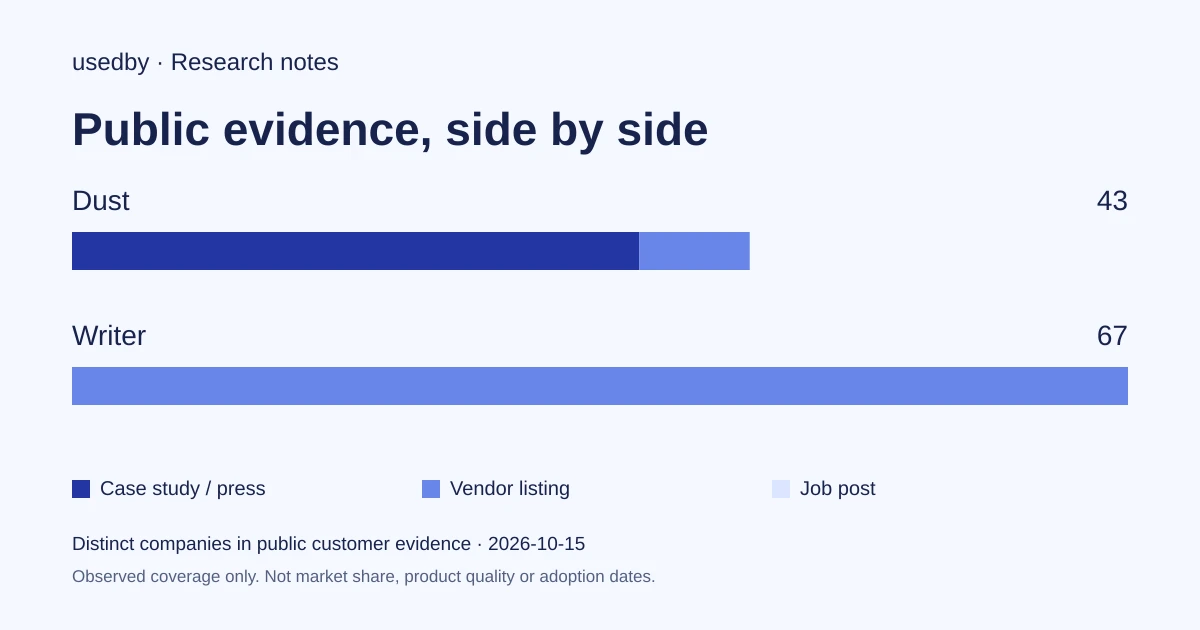
This dated snapshot counts distinct companies in public customer evidence. CONFIRMED means a case study, named testimonial or press source; OBSERVED means a vendor listing; SIGNAL means a job post. All three count, but their strength differs. Removed and unlevelled lines are excluded. Examples are a capped selection verified within 90 days. Vendor facts are sourced records checked within 60 days. Coverage is uneven and missing evidence is unknown. These figures measure neither market share nor product performance; capture dates are not adoption dates.
Sources
- dust.ttdust.tt
- writer.comwriter.com
- Security (dust.tt)dust.tt
- Trust (writer.com)writer.com
- Pricing (dust.tt)dust.tt
- Plans (writer.com)writer.com
- Data processing (writer.com)writer.com
- How wayflyer built a self tuning support flywheel with dust (dust.tt)dust.tt
- How apiday cut prospect enrichment from 7 days to 2 hours with dust and and idoption (dust.tt)dust.tt
- Alma scaled ai personal productivity to company infrastructure (dust.tt)dust.tt
Questions
Can I try Dust or Writer before talking to sales?
Yes, on both. Dust lists a Free plan with 500 lifetime credits and self-serve Pro and Max seats. Writer lists a 14-day free trial on Starter, for up to 5 users. Enterprise tiers on both go through sales.
Do Dust and Writer train models on my company data?
Both vendors state that customer data is not used to train models by default. Treat that as a vendor statement and check the contract terms. Writer offers a data processing agreement; Dust lists custom legal terms including a DPA on Enterprise.
Which platform is cheaper for a pilot?
Only Dust publishes seat prices and credit amounts, so a pilot can be budgeted from its pricing page. Writer's Starter has a trial and fixed credit limits whose amounts are not on the Plans page, and Enterprise is by quote. A fair cost comparison needs Writer's quote.
Which one suits teams outside marketing?
Dust's published stories cover support engineering, sales and product operations, while Writer's described workflows centre on marketing, sales and content. That reflects each vendor's own materials, not a limit on either product, so test your own workflow.
Tools in this article


Explore the data
Who uses which AI tool, and how each line was found.