From a business idea to a working Lovable app: what to check before real data goes in
How a business team goes from a chat prompt to a published Lovable app, and which access, data and publishing controls to settle before real data goes in.
From idea to first screen
Lovable is described as an AI app builder that creates full-stack web apps and websites from a chat prompt. You describe what you want, refine it in conversation, then publish. The listed features include visual edits, a built-in backend and database, GitHub sync and one-click publishing.
The tool turns a description into a working screen. It does not decide the business framing for you. Before the first prompt, it helps to write down who will use the app, which data it will touch and which tool or spreadsheet it replaces. That is an editorial suggestion, not a Lovable feature.
Sentry's case study shows how small a first version can be. According to Lovable's account, its chief revenue officer fed a screenshot of a pricing spreadsheet into Lovable and had a first ROI calculator in about an hour, plus another hour of fine-tuning. It is a vendor-published story, and it concerns a sales tool, not one holding customer records.
Sources: Lovable (usedby.ai) · Sentry (lovable.dev)
Interface and data: where things are stored
Lovable's security page says Lovable Cloud supports regional hosting in the EU, the US and Asia Pacific, and that customer data stays in the chosen region by default. The Trust Center lists subprocessors, including Supabase for customer databases and authentication data (EU by default) and Google Cloud for applications, databases and platform infrastructure.
Storage and model processing are separate questions. The same subprocessor list shows AI inference through AWS Bedrock in the US (Oregon) and Microsoft Azure AI Foundry in EU and US regions. The pricing page lists EU inference under Enterprise. If your data must stay in one region, ask which plan and setting apply to inference as well as to the database.
On training, the security page says Business and Enterprise data is not used to train models, while Free and Pro subscribers can opt out in account settings. A data processing agreement is available through the Trust Center. Which data classes your app will hold (public, internal, personal, regulated) is still your team's decision.
Sources: Security (lovable.dev) · trust.lovable.dev · Pricing (lovable.dev)
Authentication and access
The security page says Lovable works with SAML and OIDC providers such as Okta, Azure AD and Google, and supports SCIM provisioning. Permissions are role-based and enforced server-side. Editing, approval and publishing are separate permissions, so the person who builds is not automatically the person who ships.
The plan tiers matter here. Per the pricing page, Pro ($25 a month) adds user roles and permissions and custom domains. Business ($50 a month) adds role-based access, SSO, internal publish and a security center. Enterprise adds SCIM, audit logs, restrictions on who publishes and invites, and sensitive data detection.
Creandum's case study says role-based access controls and authentication let its teams build apps that handle sensitive financial and legal information. That shows the pattern in use at a venture firm. It does not tell you how those controls were configured or reviewed.
Sources: Security (lovable.dev) · Pricing (lovable.dev) · Creandum (lovable.dev)
Integrations: what the sources show
The product description lists GitHub sync and front ends for existing APIs among common uses. The pricing page adds GitHub Enterprise (cloud or self-hosted) and a private npm registry on Enterprise. The Trust Center links a connectors explainer, but this article does not cover connector-by-connector detail.
Productiv shows one operating model. Its warehouse operations director builds the first version of each app, and two developers turn the prototypes into production applications, handling optimization, security and API connections. Per the case study, apps connect to existing systems through APIs, and the ProQuality phone app links to its warehouse management system.
Sentry describes a layer on top of an existing tool rather than a replacement. Its sales dashboard is not yet in production; the stated plan is to connect it to Salesforce through an API or MCP. Treat that as an intention, not a delivered integration.
Sources: Lovable (usedby.ai) · Pricing (lovable.dev) · trust.lovable.dev · Productiv (lovable.dev) · Sentry (lovable.dev)
Publishing and maintenance
According to the security page, a basic scan runs on every publish and checks database configuration, RLS rules and cloud project settings in about 10 to 15 seconds. A deeper scan runs on demand and takes about three minutes. Workspace admins can enable auto-fix for non-breaking findings and block publishing on critical ones.
One detail is inconsistent across pages. The security page says Business and Enterprise workspaces can schedule recurring deep scans, while the pricing page lists scheduled deep scans under Enterprise only. Confirm which applies to your plan.
Maintenance is mostly an ownership question. Pro includes 100 monthly credits with rollover, custom domains and badge removal; Enterprise lists auto-retiring abandoned apps. Creandum reports more than 100 apps built in a little over a year, which is the kind of growth that needs a named owner per app.
Sources: Security (lovable.dev) · Pricing (lovable.dev) · Creandum (lovable.dev)
A decision grid: prototype, internal tool or production
This grid is an editorial recommendation, not a vendor capability. For a prototype with no real data, the Free plan is enough to explore; the pricing page says no credit card is needed. For a limited internal tool, look at Business-level controls, name an owner, and have someone read the database access rules before staff log in.
For production or personal data, follow the Productiv pattern: business builder first, technical review before release. Weigh Enterprise if you need audit logs, SCIM or sensitive data detection. Lovable lists SOC 2 Type II and ISO 27001, and says its SOC 2 audit covered February to August 2026 with no exceptions noted. Those describe Lovable as a company, not your app.
Customer savings figures, such as $250K+ at Creandum or $100K+ a year at Productiv, are reported by Lovable and its customers. They cover different populations and metrics and should not be read as a benchmark between companies.
Sources: Pricing (lovable.dev) · trust.lovable.dev · Productiv (lovable.dev) · Creandum (lovable.dev)
Method and limits
2026-10-15
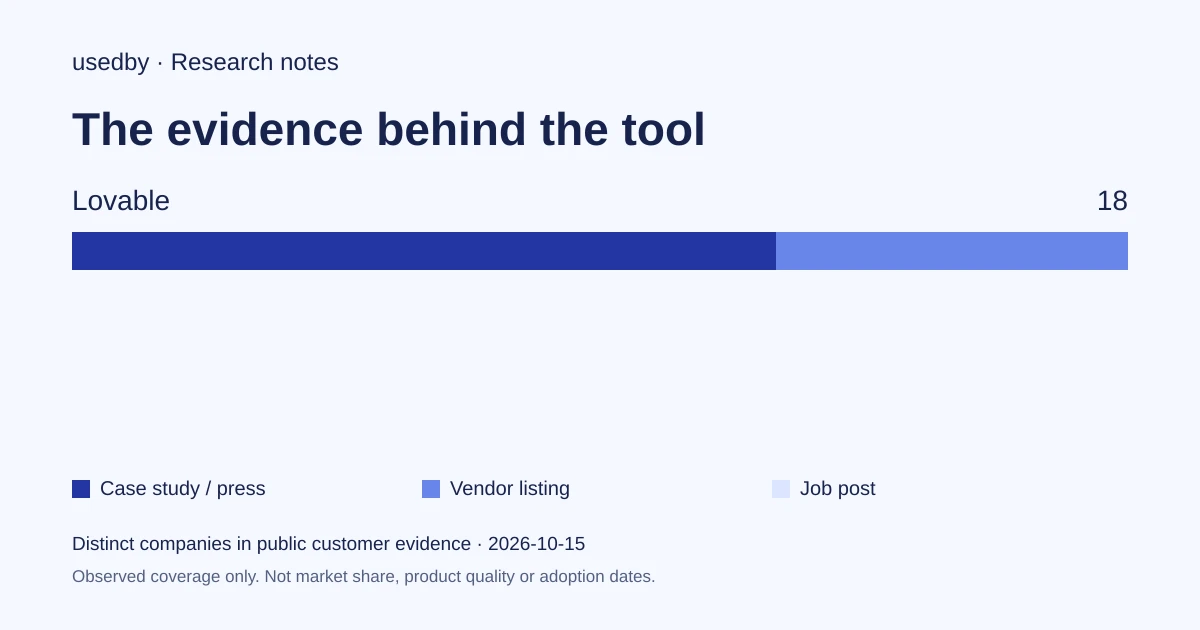
This dated snapshot counts distinct companies in public customer evidence. CONFIRMED means a case study, named testimonial or press source; OBSERVED means a vendor listing; SIGNAL means a job post. All three count, but their strength differs. Removed and unlevelled lines are excluded. Examples are a capped selection verified within 90 days. Vendor facts are sourced records checked within 60 days. Coverage is uneven and missing evidence is unknown. These figures measure neither market share nor product performance; capture dates are not adoption dates.
Sources
- Sentry (lovable.dev)lovable.dev
- Security (lovable.dev)lovable.dev
- trust.lovable.devtrust.lovable.dev
- Pricing (lovable.dev)lovable.dev
- Creandum (lovable.dev)lovable.dev
- Productiv (lovable.dev)lovable.dev
Questions
Can I put real customer data into a Lovable app?
Lovable documents regional hosting, role-based access, publish-time security scans and a data processing agreement. Whether your data class suits an app is your team's call. For personal or regulated data, plan a technical review first. That is an editorial recommendation.
Which plan adds SSO and publishing controls?
Per the pricing page, Business ($50 a month) lists SSO, role-based access, internal publish and a security center. Enterprise adds SCIM, audit logs and limits on who can publish and invite.
Is my data used to train models?
The security page says Business and Enterprise data is not used to train models. Free and Pro subscribers can opt out in account settings.
Does Lovable run a security check before I publish?
Yes, per its security page: a basic scan on every publish and a deeper on-demand scan. Admins can block publishing on critical findings. These scans are the vendor's description, not an independent test.
Tools in this article

Explore the data
Who uses which AI tool, and how each line was found.