From a visual brief to an edited Runway sequence: steps, credits and rights questions
How to split a video project into brief, generation, selection, editing and finishing with Runway, where credits go, and what to ask about rights and security.
Separate generation, editing and finishing before you buy
Runway presents itself as a company building general world models, and it sells three platforms on top of them: Runway Creative, a cloud workspace to generate and edit video, images and audio; Runway Dev, an API platform for developers; and Runway Robotics. For a marketing or brand team, the relevant surface is Creative. The API and robotics offers are different products with their own buying questions.
A practical way to plan is to cut a video project into five steps: brief and references, generation and variations, selection, editing and assembly, and finishing. Runway documents the generation side and a workspace for editing. The customer stories below show that the last mile, such as 3D motion design or ad testing, is often done by the team or in other tools. These stories are vendor-published examples of use, not measured comparisons.
Sources: runway.com · Runway (usedby.ai) · Miro (runway.com) · Skyscanner (runway.com) · Bonjour (runway.com)
Step 1: the brief travels through reference images
Miro's brand team of 11 people built the intro video for its Canvas26 event, shown in four cities, with every underlying shot generated in Runway. According to the case study, the team used photos of each venue as reference images so the final shot of people entering the building matched the real location. The motion designer also describes running tens of still-image iterations before moving to video for each shot.
Skyscanner used a similar logic for a photo shoot. The team took talent and reference images, pushed the composition, and generated the environments from the commercial scripts: a bar, a spa, a beach and a hotel balcony. The aim was to show the photographer the light and colour wanted before arrival. The lesson for a buyer: the brief is only as precise as the references you can supply, so gather them before you spend credits.
Sources: Miro (runway.com) · Skyscanner (runway.com)
Step 2: generation, variations and where credits go
Runway's pricing page works in credits. Gen-4.5 video costs 60 credits for 5 seconds. The Standard plan lists 625 credits a month, which the page equates to 52 seconds of Gen-4.5. Pro lists 2,250 credits and Max 9,500. The Free plan gives 125 one-time credits to test. Annual pricing shown is $12, $28 and $76 a month for Standard, Pro and Max.
Credit rules matter for iterative work. On Standard and Pro, monthly credits do not roll over. On Max, up to one month of unused credits does. Extra credits can be bought, with a 1,000-credit minimum, and purchased credits do not expire. Pro and Max add features such as Brand Kits and custom voice clones, and the page counts one Brand Kit and one clone on Pro, up to three of each on Max.
Bonjour shows what heavy iteration looks like. Its 15-person creative pod, according to the case study, turns one script into several animated styles (claymation, a Pixar-inspired format and a cartoon format) and sends each variant to Meta Ads Manager. The Head of Creative estimates a batch takes 24 to 48 hours and the script-to-verdict loop four to five days. The team said it hit credit limits and moved to an enterprise plan. Those are the company's own estimates.
Sources: Runway (usedby.ai) · Pricing (runway.com) · Bonjour (runway.com)
Step 3: selection, editing and assembly
Runway describes Creative as one workspace for generating and editing, and paid plans list an agentic creative collaborator. Max also lists studio-grade output: HDR, ProRes and image sequences. Those formats are relevant if your footage must go to an external editing or grading team, though how well they fit your pipeline is something to test on a real clip. That is an editorial suggestion, not a vendor claim.
Miro shows a hybrid. The motion designer built a 3D version of the Flows nodes and connector lines and layered it, with white line effects and a countdown, on top of the generated shots. The team also generated footage natively at the wide, non-standard aspect ratios its projection screens needed, instead of cropping stock. Miro adds that Runway's forward-deployed creatives ran sessions on model selection and reference images.
Sources: runway.com · Runway (usedby.ai) · Miro (runway.com)
Step 4: rights, security and access questions
On security, Runway states that it maintains SOC 2 Type II and ISO/IEC 27001, that enterprise customers can request the reports through its trust process, and that it keeps customer content storage technically separate from model-training systems. It also says customer content is never used to test new features. It lists a subprocessor page and describes GDPR readiness, which is the vendor's wording and not a legal compliance guarantee.
Rights are thinner. The security page mentions intellectual property guidelines that define ownership of AI-generated outputs, but it does not set out the terms. Commercial use, credit lines and indemnification therefore need confirming in the contract or terms. Ask the same of any reference photos or talent images you upload.
Paramount's CTO says the company made Runway available to anyone who wanted it, paired it with training and internal communities, and measures business outcomes. It is a useful governance model, not a security assurance.
Sources: Data security (runway.com) · Runway (usedby.ai) · Paramount nyc summit 2026 (runway.com)
Step 5: when AI stays out of the deliverable
Skyscanner kept generated imagery out of the final ads. It used Runway in pre-production and on set: temporary blue-screen backgrounds helped check wardrobe and props while talent was present, and raw images were dropped into pre-approved layouts to check them in real time. The team said the gap between planned and captured images was small, and that on-set time was about 20 minutes a day over four days.
The team also says that, as a travel brand, it does not want to mislead people about destinations, so AI informs art direction rather than the published creative. If rights or brand risk are your main worry, this is the lowest-exposure way to start. If you need final footage, as Miro did, the rights and review questions above move to the front.
Sources: Skyscanner (runway.com) · Miro (runway.com)
Method and limits
2026-10-15
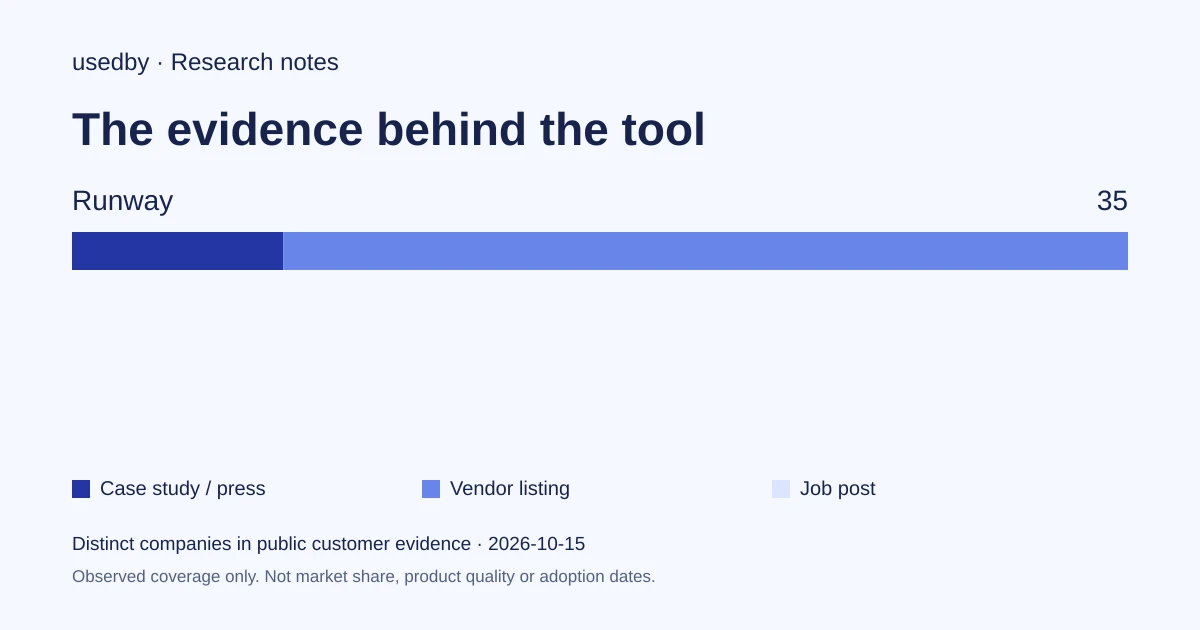
This dated snapshot counts distinct companies in public customer evidence. CONFIRMED means a case study, named testimonial or press source; OBSERVED means a vendor listing; SIGNAL means a job post. All three count, but their strength differs. Removed and unlevelled lines are excluded. Examples are a capped selection verified within 90 days. Vendor facts are sourced records checked within 60 days. Coverage is uneven and missing evidence is unknown. These figures measure neither market share nor product performance; capture dates are not adoption dates.
Sources
- runway.comrunway.com
- Miro (runway.com)runway.com
- Skyscanner (runway.com)runway.com
- Bonjour (runway.com)runway.com
- Pricing (runway.com)runway.com
- Data security (runway.com)runway.com
- Paramount nyc summit 2026 (runway.com)runway.com
Questions
Can Runway take a brief all the way to a finished video?
Runway describes a workspace for generating and editing video, images and audio. The customer cases show teams adding finishing elsewhere, such as Miro's 3D motion design layered over generated shots. Treat finishing as a team responsibility until you test your own pipeline.
How many seconds of video does a paid plan give?
The pricing page says Gen-4.5 costs 60 credits per 5 seconds. Its own conversion for Standard's 625 monthly credits is 52 seconds of Gen-4.5. Other models cost different amounts, and variations multiply the spend.
Does Runway use my uploads to train its models?
The vendor's security page states a technical separation between customer content storage and model-training systems, and says customer content is not used to test new features. Confirm training and retention terms in your contract.
Who owns the generated outputs?
The security page refers to intellectual property guidelines on ownership of AI-generated outputs but gives no detail. Ask for the written terms covering commercial use, credits and indemnification before publishing client work.
Tools in this article
Explore the data
Who uses which AI tool, and how each line was found.