

The use case: how Decagon deploys Together AI
Decagon builds conversational AI agents for customer experiences, with voice as a core product. It runs production inference for its multi-model voice stack on Together AI, using fine-tuned open-source models, custom speculative decoding draft models, prompt caching, and NVIDIA B200 GPUs to meet strict latency budgets.
More reported results
Figures published in Together AI’s case study. They are not independently measured by usedby.
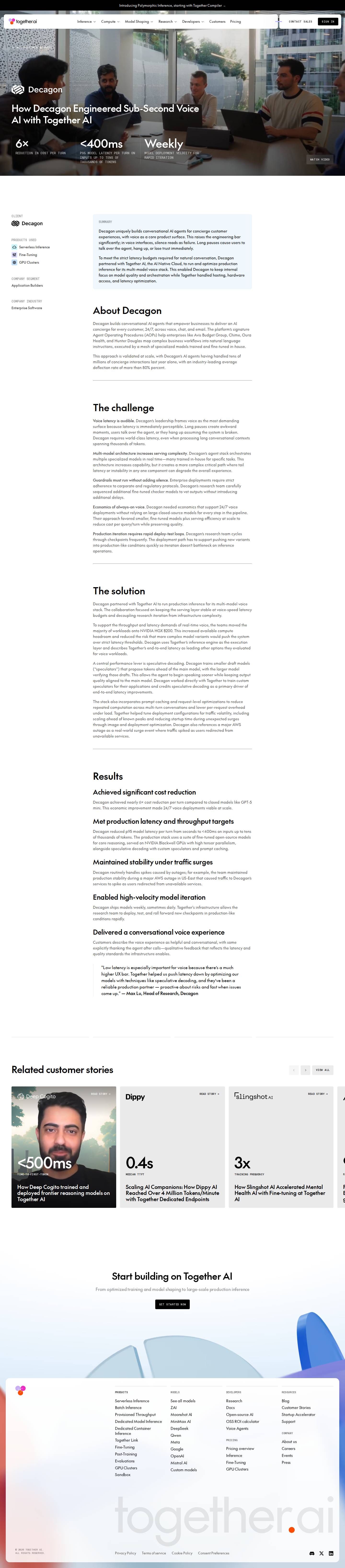
Decagon reduced p95 model latency per turn from seconds to <400ms on inputs up to tens of thousands of tokens.
In the customer’s words
Low latency is especially important for voice because there’s a much higher UX bar. Together helped us push latency down by optimizing our models with techniques like speculative decoding, and they’ve been a reliable production partner — proactive about risks and fast when issues come up.Other AI tools used by Decagon
Other public relationships recorded on usedby.
Explore Decagon’s AI stack





Together AI users in Artificial Intelligence
Companies in the same sector, with public evidence.
 Arcee AIConfirmed
 CartesiaConfirmed
 Deep CogitoConfirmed
 Dippy AIConfirmed
 HedraConfirmed
 LegionEdgeConfirmed
Go straight to the source
Based on Together AI’s published case study. We check the public evidence; the results are reported by the vendor.
together.ai- Last checked
- Nov 5, 2026
 Open source capture
What the story claims, and what we checked
What we compared with the page.
- The figure: 6×Checked
Printed word for word on the page, near the name of Decagon.
- The passage quoted aboveChecked
Copied word for word from the page, near the name of Decagon.
- Decagon uses Together AIChecked
Confirmed line.
- The result itselfNot checked
We quote it; we did not measure it.
Decagon achieved nearly 6× cost reduction per turn compared to closed models like GPT-5 mini. This economic improvement made 24/7 voice deployments viable at scale.