
The use case: how DSM deploys Celonis
DSM uses Celonis Execution Management System to run root-cause analysis on its Order-to-Cash process, find avoidable credit and delivery blocks, and receive alerts on orders at risk of late delivery. It is also piloting automation prototypes in SAP to remove blocks and monitors first-time-right sales orders.
Figures in the source
Figures published in Celonis’s case study. They are not independently measured by usedby.
DSM decreased delivery blocks by 10% and reduced cycle times for blocked orders by several days.
Manual changes to sales orders have also dropped by 10%.
In APAC, DSM has improved its first-time-right (FTR) ratio from 18% to 42% (an increase of more than 100%) and in North America the OTIF rate grew from 84% to 90% within just six months.
In the customer’s words
We have significantly improved our capability to identify the best opportunities for automation to fix O2C processes and make them happen.Other companies using Celonis
Customers across industries, with public evidence.
 ABBConfirmed
 AccentureConfirmed
 Alstom transportConfirmed
 AstraZenecaConfirmed
 AutodeskConfirmed
 B3Confirmed
Go straight to the source
Based on Celonis’s published case study. We check the public evidence; the results are reported by the vendor.
celonis.com- Last checked
- Nov 4, 2026
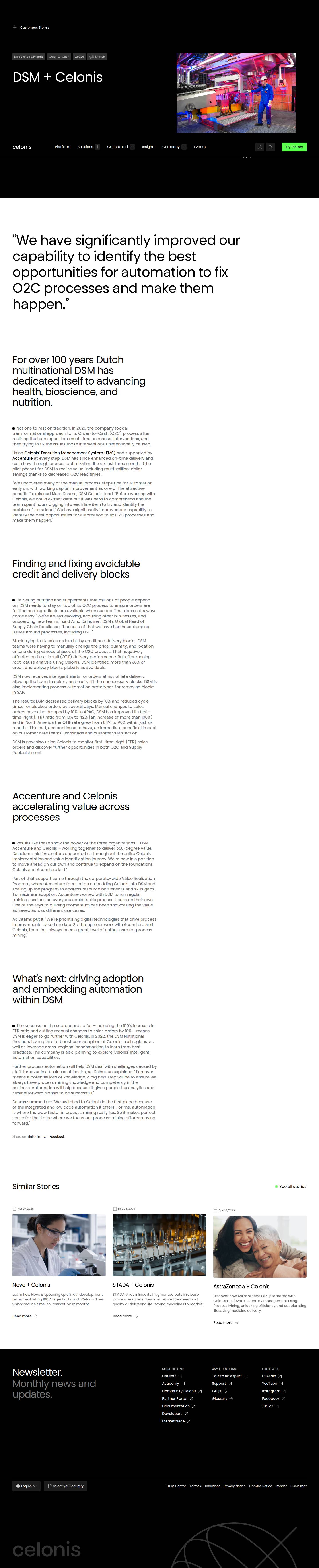 Open source capture
What the story claims, and what we checked
What we compared with the page.
- The passage quoted aboveChecked
Copied word for word from the page, near the name of DSM.
- DSM uses CelonisChecked
Confirmed line.
- The result itselfNot checked
We quote it; we did not measure it.
Stuck trying to fix sales orders hit by credit and delivery blocks, DSM teams were having to manually change the price, quantity, and location criteria during various phases of the O2C process.