

The use case: how EasyKind deploys Lorikeet
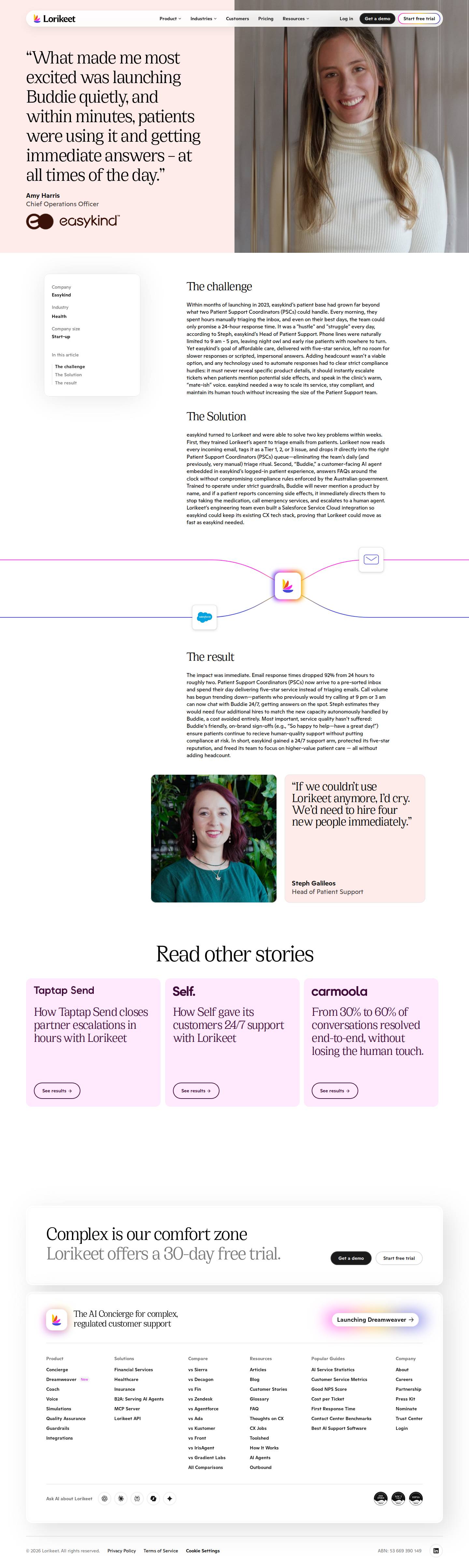
easykind, a patient-care clinic, uses Lorikeet's AI agent to read and triage incoming patient emails into the right support queues. It also runs a patient-facing AI agent called Buddie that answers FAQs around the clock within compliance rules and escalates side-effect reports to humans.
More reported results
Figures published in Lorikeet’s case study. They are not independently measured by usedby.
Steph estimates they would need four additional hires to match the new capacity autonomously handled by Buddie, a cost avoided entirely.
In the customer’s words
If we couldn’t use Lorikeet anymore, I’d cry. We’d need to hire four new people immediately.Lorikeet users in HealthTech & Digital Health
Companies in the same sector, with public evidence.
See all Lorikeet customers


Go straight to the source
Based on Lorikeet’s published case study. We check the public evidence; the results are reported by the vendor.
lorikeetcx.ai- Last checked
- Nov 19, 2026
 Open source capture
What the story claims, and what we checked
What we compared with the page.
- The figure: 92%Checked
Printed word for word on the page, near the name of EasyKind.
- The passage quoted aboveChecked
Copied word for word from the page, near the name of EasyKind.
- EasyKind uses LorikeetChecked
Confirmed line.
- The result itselfNot checked
We quote it; we did not measure it.
The impact was immediate. Email response times dropped 92% from 24 hours to roughly two. Patient Support Coordinators (PSCs) now arrive to a pre-sorted inbox and spend their day delivering five-star service instead of triaging emails.