

The use case: how Fynd deploys New Relic
Fynd uses New Relic to monitor its microservices-based retail platform, including load testing before releases, alerting on traffic spikes, tracing service dependencies, and diagnosing API latency. This helps engineers detect and locate issues faster and ship changes with more confidence.
More reported results
Figures published in New Relic’s case study. They are not independently measured by usedby.
we identified the service causing slowness in less than 15 minutes
In the customer’s words
With New Relic, we can detect issues in minutes, even under sudden load. For example, during a recent spike on a major customer’s storefront, we identified the service causing slowness in less than 15 minutes. New Relic gave us early insights to mitigate the impact and keep our systems stableOther companies using New Relic
Customers across industries, with public evidence.
See all New Relic customers





Go straight to the source
Based on New Relic’s published case study. We check the public evidence; the results are reported by the vendor.
newrelic.com- Last checked
- Nov 13, 2026
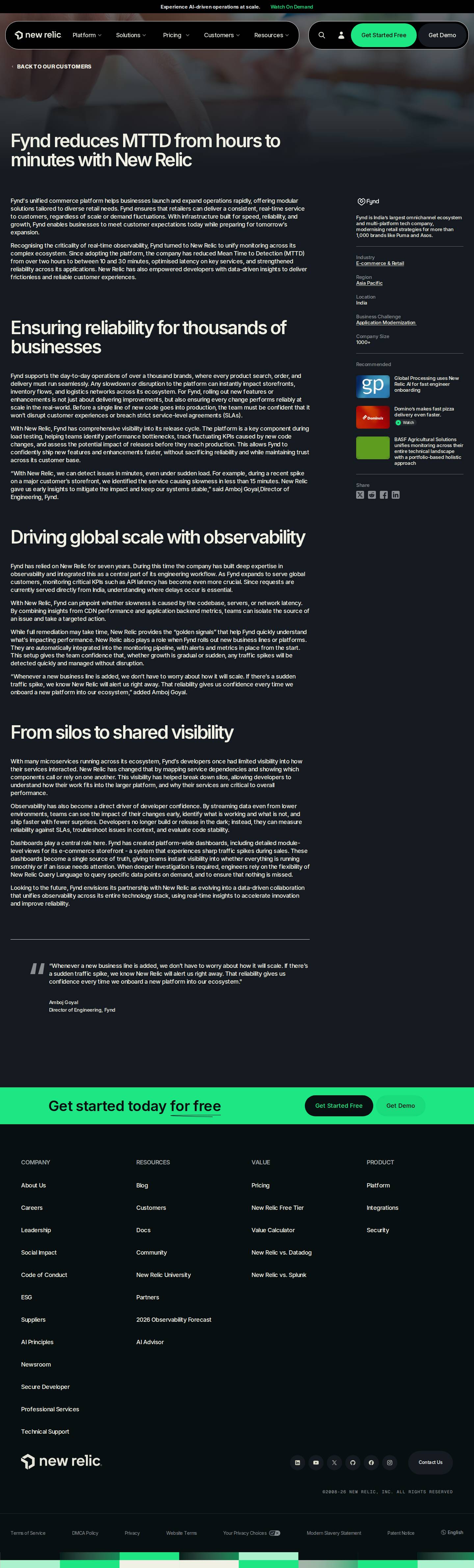 Open source capture
What the story claims, and what we checked
What we compared with the page.
- The figure: 10 and 30 minutesChecked
Printed word for word on the page, near the name of Fynd.
- The passage quoted aboveChecked
Copied word for word from the page, near the name of Fynd.
- Fynd uses New RelicChecked
Confirmed line.
- The result itselfNot checked
We quote it; we did not measure it.
Since adopting the platform, the company has reduced Mean Time to Detection (MTTD) from over two hours to between 10 and 30 minutes, optimised latency on key services, and strengthened reliability across its applications.