

The use case: how InpharmD deploys Pinecone
InpharmD uses Pinecone as the vector database behind its AI Assistant, Sherlock, storing embeddings of medical literature documents for retrieval augmented generation. Sherlock retrieves relevant information to answer clinical questions from healthcare professionals.
More reported results
Figures published in Pinecone’s case study. They are not independently measured by usedby.
The response time to user inquiries has seen a remarkable 75% reduction, with the first response time now 95 times faster.
The adoption of Pinecone has led to a significant 70% improvement in result accuracy, providing more precise and contextually relevant answers.
Pinecone indexing and search for over 2 billion vectors simultaneously provides InpharmD with the necessary long-term memory to continue expanding and incorporating additional medical literature into their dataset.
In the customer’s words
Pinecone is integral to our data-driven operations. Its seamless scalability, rapid query results, and impressive low latency make it an indispensable asset in enhancing efficiency and productivityPinecone users in HealthTech & Digital Health
Companies in the same sector, with public evidence.
See all Pinecone customers
Go straight to the source
Based on Pinecone’s published case study. We check the public evidence; the results are reported by the vendor.
pinecone.io- Last checked
- Nov 17, 2026
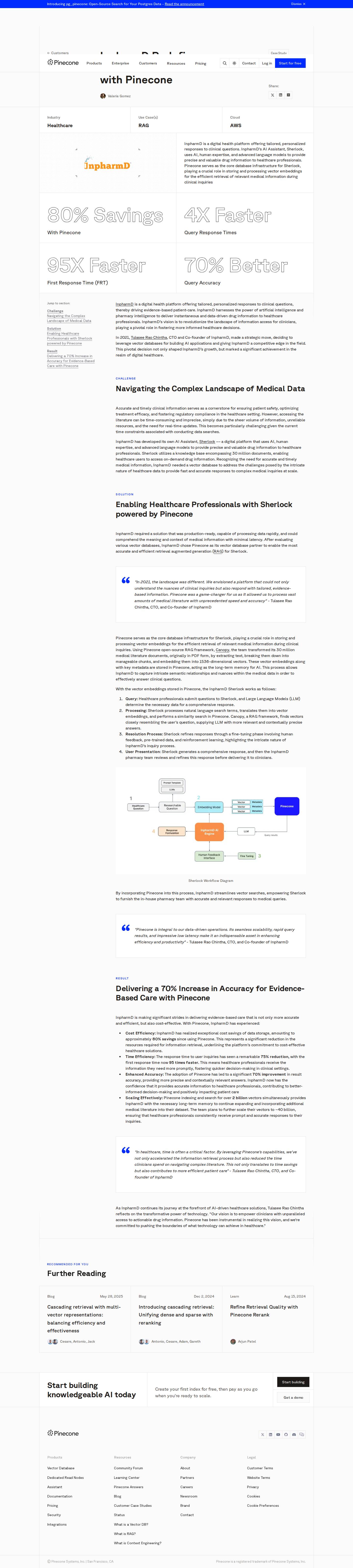 Open source capture
What the story claims, and what we checked
What we compared with the page.
- The figure: 80%Checked
Printed word for word on the page, near the name of InpharmD.
- The passage quoted aboveChecked
Copied word for word from the page, near the name of InpharmD.
- InpharmD uses PineconeChecked
Confirmed line.
- The result itselfNot checked
We quote it; we did not measure it.
Pinecone serves as the core database infrastructure for Sherlock, playing a crucial role in storing and processing vector embeddings for the efficient retrieval of relevant medical information during clinical inquiries.