

The use case: how Kissht deploys New Relic
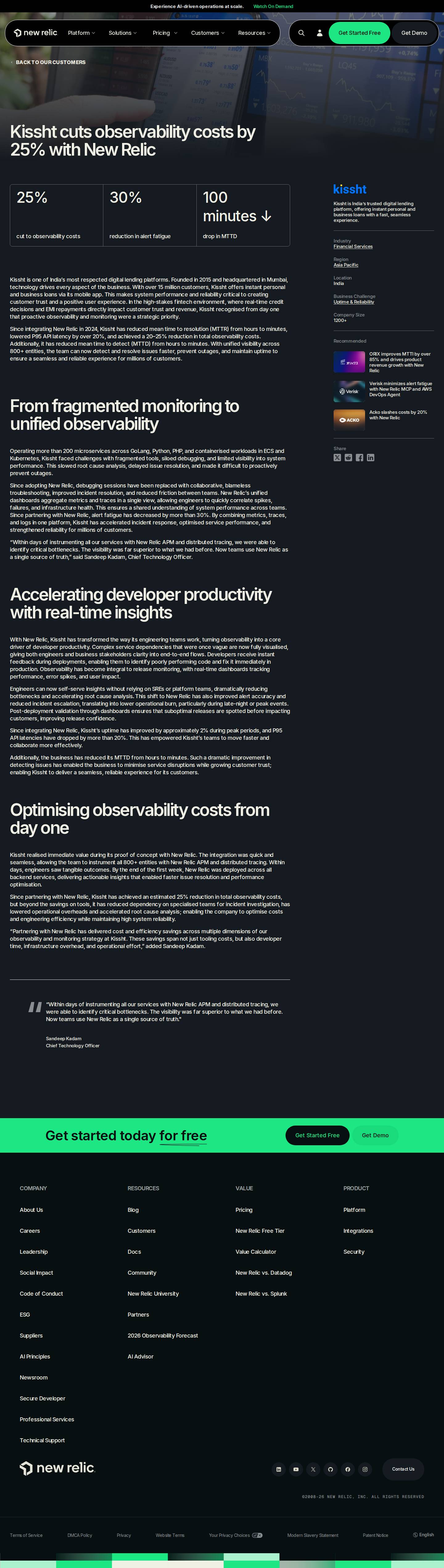
Kissht, a digital lending platform, uses New Relic APM and distributed tracing across its microservices and containerised workloads to get unified visibility, detect and resolve issues faster, and monitor releases. Engineers use the dashboards to self-serve insights and troubleshoot collaboratively.
More reported results
Figures published in New Relic’s case study. They are not independently measured by usedby.
Since partnering with New Relic, alert fatigue has decreased by more than 30%.
Since integrating New Relic, Kissht’s uptime has improved by approximately 2% during peak periods, and P95 API latencies have dropped by more than 20%.
The integration was quick and seamless, allowing the team to instrument all 800+ entities with New Relic APM and distributed tracing.
In the customer’s words
Within days of instrumenting all our services with New Relic APM and distributed tracing, we were able to identify critical bottlenecks.Other companies using New Relic
Customers across industries, with public evidence.
See all New Relic customers




Go straight to the source
Based on New Relic’s published case study. We check the public evidence; the results are reported by the vendor.
newrelic.com- Last checked
- Nov 13, 2026
 Open source capture
What the story claims, and what we checked
What we compared with the page.
- The figure: 25%Checked
Printed word for word on the page, near the name of Kissht.
- The passage quoted aboveChecked
Copied word for word from the page, near the name of Kissht.
- Kissht uses New RelicChecked
Confirmed line.
- The result itselfNot checked
We quote it; we did not measure it.
Since partnering with New Relic, Kissht has achieved an estimated 25% reduction in total observability costs, but beyond the savings on tools, it has reduced dependency on specialised teams for incident investigation, has lowered operational overheads and accelerated root cause analysis