

The use case: how Nanit deploys Pecan AI
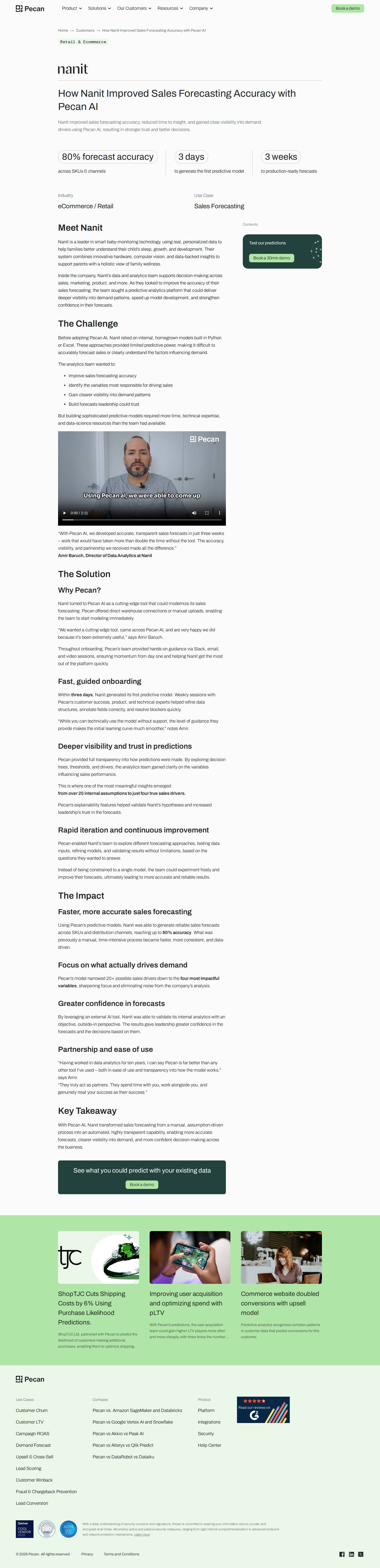
Nanit's data and analytics team uses Pecan AI's predictive models to forecast sales across SKUs and distribution channels, replacing homegrown Python and Excel models. They also use the platform's explainability features to identify which variables drive demand.
Figures in the source
Figures published in Pecan AI’s case study. They are not independently measured by usedby.
Within three days, Nanit generated its first predictive model.
With Pecan AI, we developed accurate, transparent sales forecasts in just three weeks – work that would have taken more than double the time without the tool.
Pecan’s model narrowed 20+ possible sales drivers down to the four most impactful variables, sharpening focus and eliminating noise from the company’s analysis.
In the customer’s words
With Pecan AI, we developed accurate, transparent sales forecasts in just three weeks – work that would have taken more than double the time without the tool. The accuracy, visibility, and partnership we received made all the difference.Other AI tools used by Nanit
Other public relationships recorded on usedby.
Explore Nanit’s AI stack

Other companies using Pecan AI
Customers across industries, with public evidence.
 Clearwave FiberConfirmed
 CoinmamaConfirmed
 DME AcquireConfirmedKSG MobileConfirmed
 Little SpoonConfirmed
 Million VictoriesConfirmed
Go straight to the source
Based on Pecan AI’s published case study. We check the public evidence; the results are reported by the vendor.
pecan.ai- Source published
- Nov 25, 2025
- Last checked
- Nov 25, 2026
 Open source capture
What the story claims, and what we checked
What we compared with the page.
- The passage quoted aboveChecked
Copied word for word from the page, near the name of Nanit.
- The publication dateChecked
Read from the page’s own metadata, never guessed.
- Nanit uses Pecan AIChecked
Confirmed line.
- The result itselfNot checked
We quote it; we did not measure it.
Using Pecan’s predictive models, Nanit was able to generate reliable sales forecasts across SKUs and distribution channels, reaching up to 80% accuracy. What was previously a manual, time-intensive process became faster, more consistent, and data-driven.