

The use case: how Paddle deploys Dust
Paddle consolidated fragmented departmental AI tools into a single company-wide agent platform on Dust. Employees query company data, build custom agents, and connect external tools, for example combining data warehouse figures with context from Slack and Gong to support sales and customer success, and producing data visualizations with Frames.
More reported results
Figures published in Dust’s case study. They are not independently measured by usedby.
They went from no centralized AI tooling to 342 active users in under six months.
Paddle had 114 builders and over 470 agents.
In the customer’s words
The frames functionality is easily what the entire business loves the most. There’s a lot of energy behind using frames to show new customers the value Paddle brings to the table, and to help our existing customers see how much more value they can unlock.Other AI tools used by Paddle
Other public relationships recorded on usedby.
Explore Paddle’s AI stack


Dust users in Fintech & Payments
Companies in the same sector, with public evidence.
See all Dust customers



Go straight to the source
Based on Dust’s published case study. We check the public evidence; the results are reported by the vendor.
dust.tt- Source published
- Jul 6, 2026
- Last checked
- Nov 4, 2026
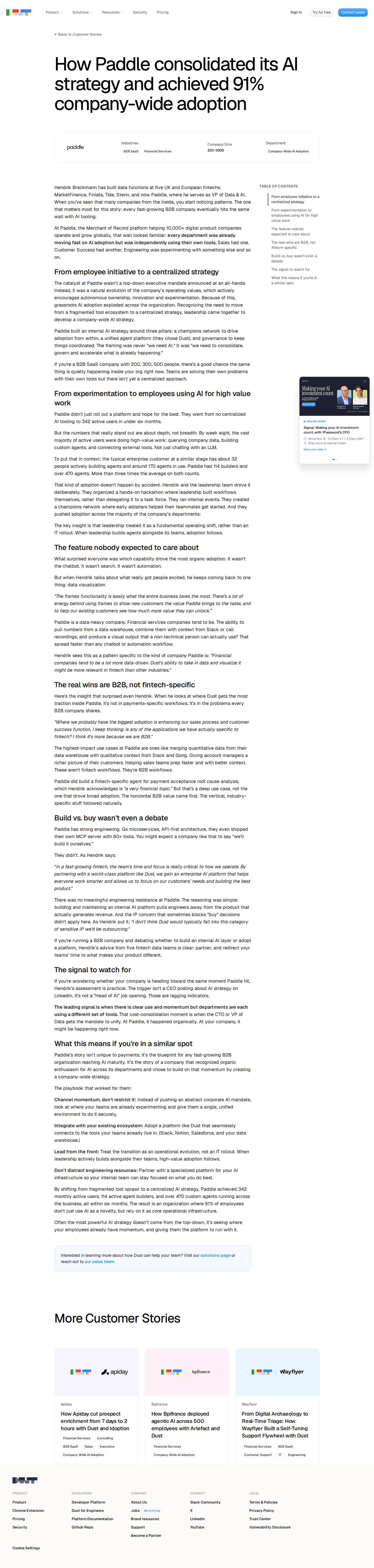 Open source capture
What the story claims, and what we checked
What we compared with the page.
- The figure: 91%Checked
Printed word for word on the page, near the name of Paddle.
- The passage quoted aboveChecked
Copied word for word from the page, near the name of Paddle.
- The publication dateChecked
Read from the page’s own metadata, never guessed.
- Paddle uses DustChecked
Confirmed line.
- The result itselfNot checked
We quote it; we did not measure it.
Paddle didn't just roll out a platform and hope for the best. They went from no centralized AI tooling to 342 active users in under six months.