

How St. Luke's Health System uses Ambience Healthcare
View captured proofThe use case: how St. Luke's Health System deploys Ambience Healthcare
St. Luke's uses Ambience's ambient AI documentation platform, integrated with Epic, with specialty-specific tailoring and point-of-care coding and compliance features. It was piloted across multiple specialties to reduce clinician documentation burden and improve coding accuracy.
More reported results
Figures published in Ambience Healthcare’s case study. They are not independently measured by usedby.
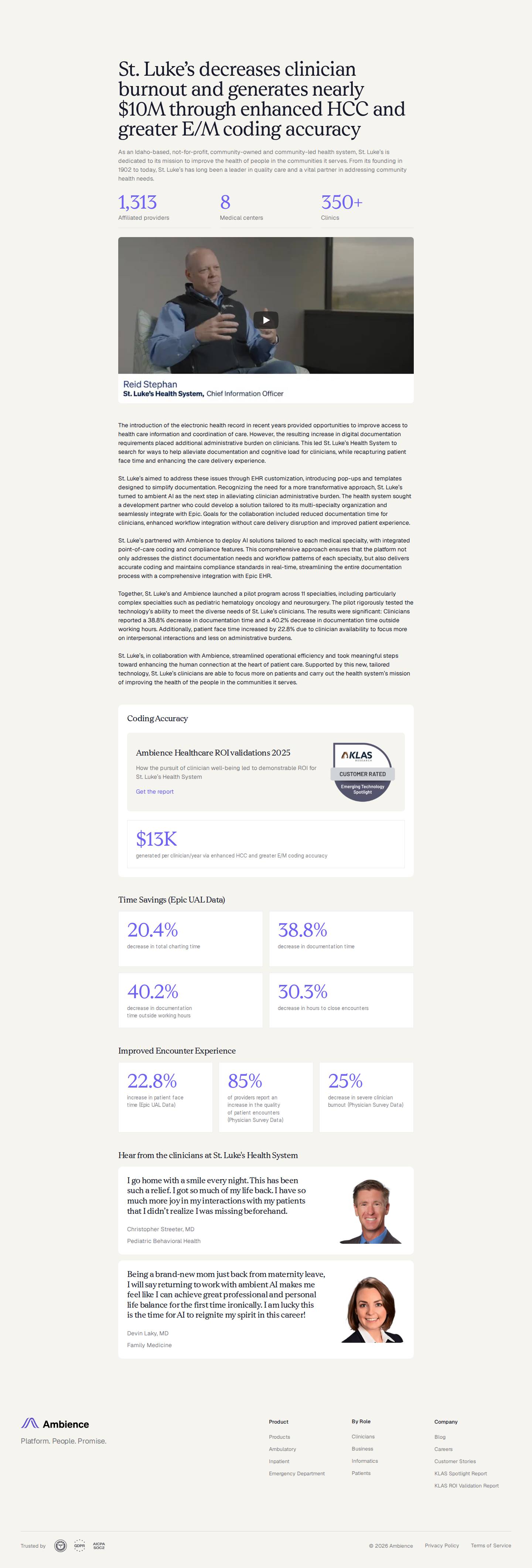
Clinicians reported a 38.8% decrease in documentation time and a 40.2% decrease in documentation time outside working hours.
Additionally, patient face time increased by 22.8% due to clinician availability to focus more on interpersonal interactions and less on administrative burdens.
In the customer’s words
I go home with a smile every night. This has been such a relief. I got so much of my life back. I have so much more joy in my interactions with my patients that I didn’t realize I was missing beforehand.Other AI tools used by St. Luke's Health System
Other public relationships recorded on usedby.
Explore St. Luke's Health System’s AI stack
Ambience Healthcare users in Hospitals & Care Providers
Companies in the same sector, with public evidence.
 Ardent HealthConfirmed
 Houston MethodistConfirmed
 John Muir HealthConfirmed
 MultiCareConfirmed
 Onvida HealthConfirmed
 Pediatric AssociatesConfirmed
Go straight to the source
Based on Ambience Healthcare’s published case study. We check the public evidence; the results are reported by the vendor.
ambiencehealthcare.com- Last checked
- Nov 8, 2026
 Open source capture
What the story claims, and what we checked
What we compared with the page.
- St. Luke's Health System uses Ambience HealthcareChecked
Confirmed line.
- The result itselfNot checked
We quote it; we did not measure it.
Clinicians reported a 38.8% decrease in documentation time and a 40.2% decrease in documentation time outside working hours. Additionally, patient face time increased by 22.8% due to clinician availability to focus more on interpersonal interactions and less on administrative burdens.