
The use case: how Sturdy Health deploys Notable
Sturdy Health uses Notable's AI agents to send social determinants of health and depression screening questionnaires to patients before visits through their preferred channel and language. The agents extract the responses and enter them into the EHR automatically.
More reported results
Figures published in Notable’s case study. They are not independently measured by usedby.
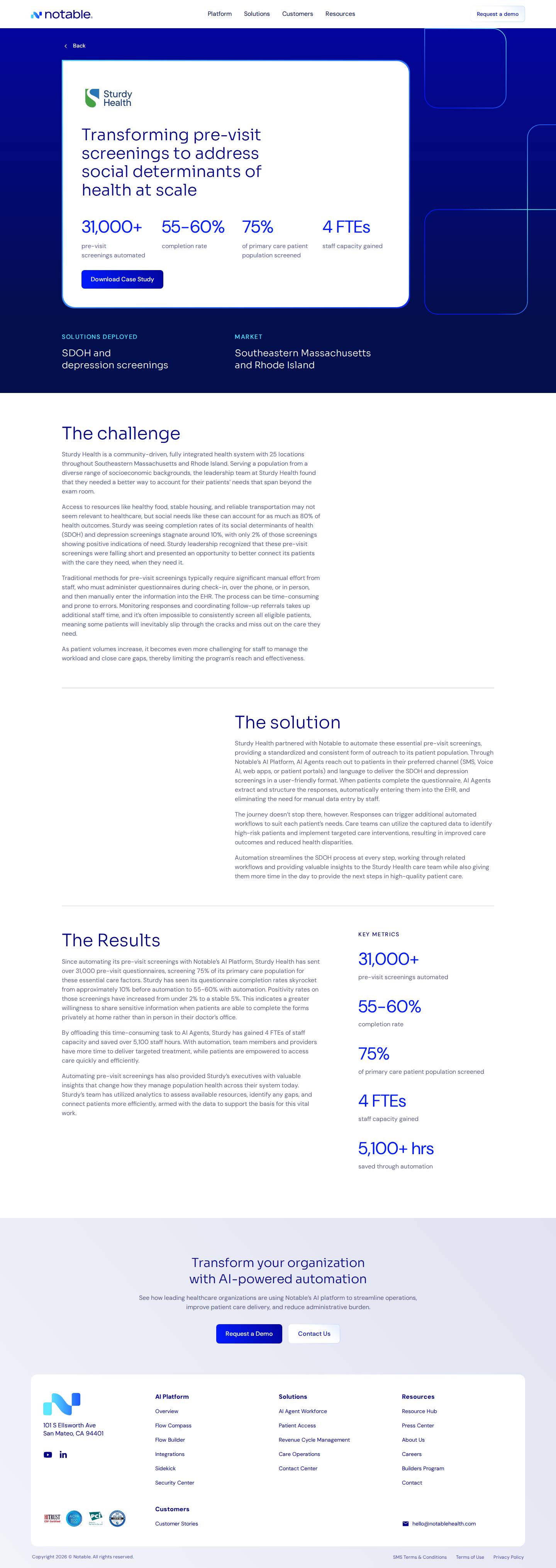
Sturdy Health has sent over 31,000 pre-visit questionnaires, screening 75% of its primary care population for these essential care factors.
Sturdy has gained 4 FTEs of staff capacity and saved over 5,100 staff hours.
Positivity rates on those screenings have increased from under 2% to a stable 5%.
Notable users in Hospitals & Care Providers
Companies in the same sector, with public evidence.
 Augusta HealthConfirmed
 Austin Regional ClinicConfirmed
 Care New EnglandConfirmed
 Catholic HealthConfirmed
 CommonSpirit HealthConfirmed
 Fort HealthCareConfirmed
Go straight to the source
Based on Notable’s published case study. We check the public evidence; the results are reported by the vendor.
notablehealth.com- Last checked
- Nov 19, 2026
 Open source capture
What the story claims, and what we checked
What we compared with the page.
- The figure: 55-60%Checked
Printed word for word on the page, near the name of Sturdy Health.
- The passage quoted aboveChecked
Copied word for word from the page, near the name of Sturdy Health.
- Sturdy Health uses NotableChecked
Confirmed line.
- The result itselfNot checked
We quote it; we did not measure it.
Sturdy has seen its questionnaire completion rates skyrocket from approximately 10% before automation to 55-60% with automation. Positivity rates on those screenings have increased from under 2% to a stable 5%.