

The use case: how Thomson Reuters deploys Invisible
Thomson Reuters uses Invisible to build high-quality training data for a document layout segmentation model. Invisible designed an annotation schema and an expert annotation and review workflow to label document components such as tables and forms.
More reported results
Figures published in Invisible’s case study. They are not independently measured by usedby.
< 2 wks to build novel data structure and annotation process
Other AI tools used by Thomson Reuters
Other public relationships recorded on usedby.
Explore Thomson Reuters’s AI stack





Other companies using Invisible
Customers across industries, with public evidence.
 Alliance Nationwide ExpositionConfirmed
 Boosted.aiConfirmed
 CohereConfirmed
 GetroConfirmed
 GrubhubConfirmed
 HeadwayConfirmed
Go straight to the source
Based on Invisible’s published case study. We check the public evidence; the results are reported by the vendor.
invisibletech.ai- Source published
- Jul 6, 2026
- Last checked
- Nov 24, 2026
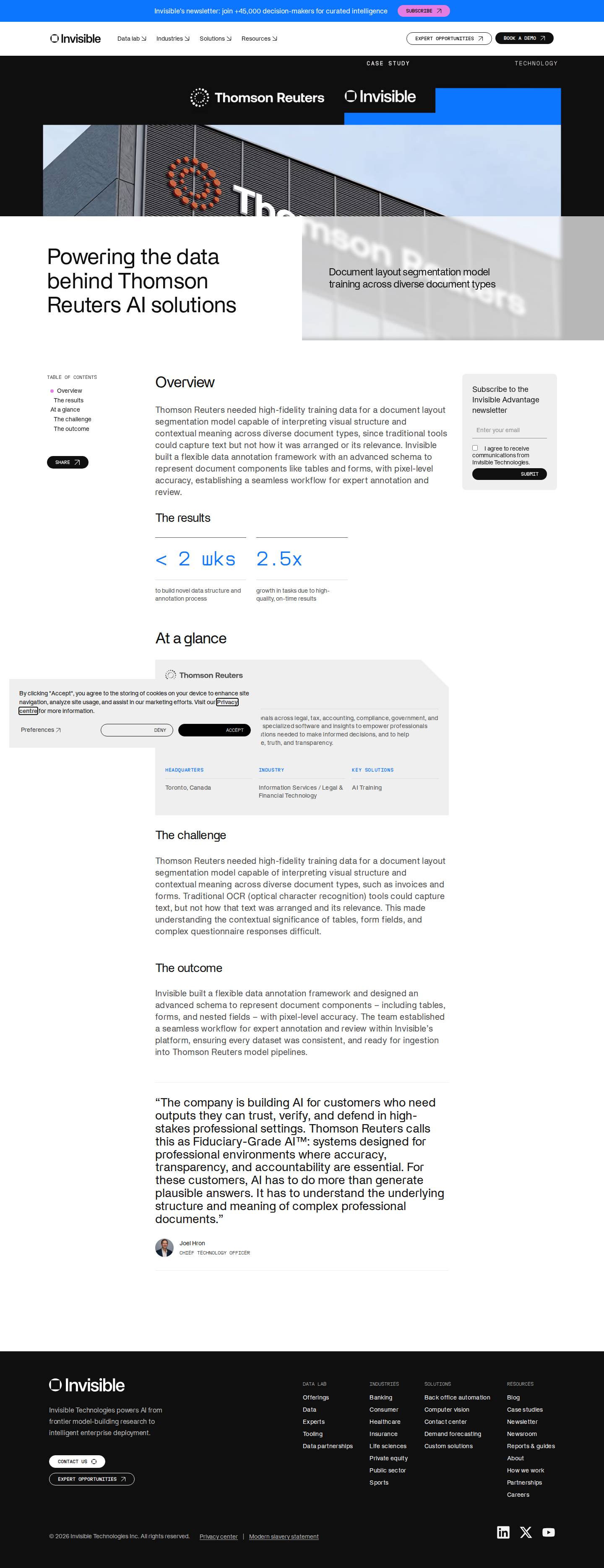 Open source capture
What the story claims, and what we checked
What we compared with the page.
- The figure: 2.5xChecked
Printed word for word on the page, near the name of Thomson Reuters.
- The passage quoted aboveChecked
Copied word for word from the page, near the name of Thomson Reuters.
- The publication dateChecked
Read from the page’s own metadata, never guessed.
- Thomson Reuters uses InvisibleChecked
Confirmed line.
- The result itselfNot checked
We quote it; we did not measure it.
Invisible built a flexible data annotation framework and designed an advanced schema to represent document components – including tables, forms, and nested fields – with pixel-level accuracy.