The use case: how UCSF Health deploys H2O.ai
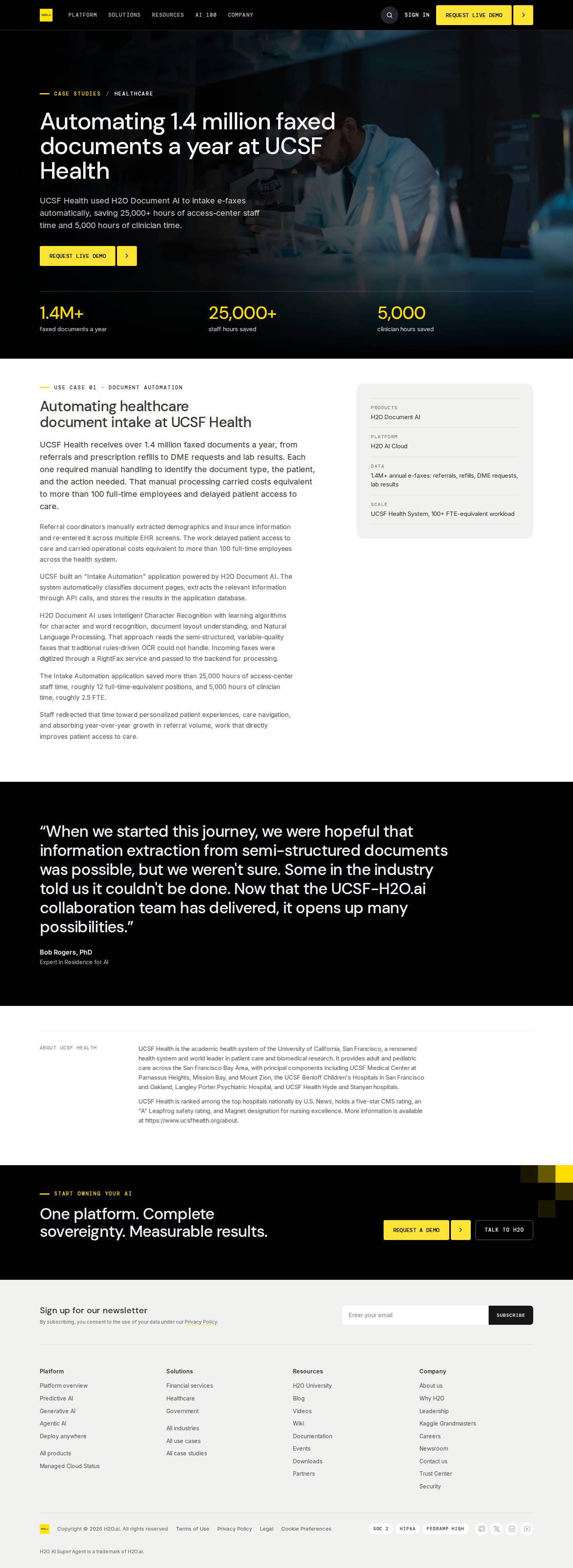
UCSF Health built an Intake Automation application on H2O Document AI that classifies incoming faxed documents, extracts patient and document information through API calls, and stores the results in an application database. It replaces manual identification and re-entry of information from referrals, refills, DME requests and lab results.
More reported results
Figures published in H2O.ai’s case study. They are not independently measured by usedby.
5,000 hours of clinician time
UCSF Health receives over 1.4 million faxed documents a year
In the customer’s words
When we started this journey, we were hopeful that information extraction from semi-structured documents was possible, but we weren't sure. Some in the industry told us it couldn't be done. Now that the UCSF-H2O.ai collaboration team has delivered, it opens up many possibilities.Other AI tools used by UCSF Health
Other public relationships recorded on usedby.
Explore UCSF Health’s AI stack
H2O.ai users in Hospitals & Care Providers
Companies in the same sector, with public evidence.
See all H2O.ai customers

Go straight to the source
Based on H2O.ai’s published case study. We check the public evidence; the results are reported by the vendor.
h2o.ai- Last checked
- Nov 9, 2026
 Open source capture
What the story claims, and what we checked
What we compared with the page.
- The figure: 25,000 hoursChecked
Printed word for word on the page, near the name of UCSF Health.
- The passage quoted aboveChecked
Copied word for word from the page, near the name of UCSF Health.
- UCSF Health uses H2O.aiChecked
Confirmed line.
- The result itselfNot checked
We quote it; we did not measure it.
The Intake Automation application saved more than 25,000 hours of access-center staff time, roughly 12 full-time-equivalent positions, and 5,000 hours of clinician time, roughly 2.5 FTE.