Onyx, Atolio or Sana: which search engine to shortlist when answers are scattered across apps
Onyx, Atolio and Sana can all search across Slack, Drive, Confluence or Salesforce. Here is how they differ on connectors, permissions, citations and hosting.
Onyx, Atolio and Sana on four search criteria, as stated by each vendor
| Criterion | Onyx | Atolio | Sana |
|---|---|---|---|
| Connected applications | 40+ connectors on the Business pricing page, 50+ on the homepage; Slack, Confluence, Jira, Drive, Salesforce listed.[1] [2] | Long named catalogue including Slack, Confluence, Jira, Salesforce; custom connector framework needing customer engineers.[3] [4] | 100+ apps advertised, with Slack, Confluence, Jira, Drive, Salesforce among turnkey connectors; custom integrations mentioned.[5] [6] |
| Respecting access rights | Source permissions synced and enforced at query time; RBAC and permission inheritance in Business; SSO in Enterprise.[2] [1] | Mirrors source permissions per the vendor; Salesforce handled at object and field level.[4] [3] | SAML SSO and SCIM listed; how source permissions are applied is not shown in the pages read.[7] [6] |
| Answers and citations | Answers with listed sources in demos; benchmarks are vendor-reported.[2] | Demo answer lists Slack, Confluence and Salesforce sources; format otherwise undocumented.[4] [3] | Assistant over company knowledge; citation display not described in the pages read.[6] |
| Deployment and price | Own cloud, bare metal or air-gapped; Business $20 per user per month; Enterprise by quote; free trial.[1] [2] | Own cloud or on premises, bring your own model; DPA published; no price in the pages read.[4] [8] | Enterprise plan by quote with SLA and enterprise DPA; hosting model not stated.[7] [6] |
Sources
The shared task, and why Sana Learn is left out
The task is simple to state. An employee needs a fact that lives in a Slack thread, a Confluence page, a Jira ticket or a Salesforce record, and should only see what their own access rights allow. Onyx, Atolio and Sana all sit in the enterprise search and knowledge category and aim at this problem.
Sana needs one clarification. The vendor sells Sana Agents, an assistant that searches and acts across company knowledge and apps, and Sana Learn, a separate learning platform for training teams. Its homepage presents the two side by side, so this article compares only the search and agent side. The homepage also states that Sana is now part of Workday.
There is no universal winner here. The three products differ mainly in how they are hosted, how they publish prices and how far their product reaches. Those differences decide the shortlist.
Sources: onyx.app · atolio.com · sanalabs.com · Sana (usedby.ai) · Onyx (usedby.ai) · Atolio (usedby.ai)
Connected applications
Onyx is described as open-source search and chat that connects to company knowledge sources. Its homepage speaks of 50+ connectors, while the pricing page lists 40+ app connectors in the Business plan and its architecture diagram says 40+ sources. The figures differ, so ask which connectors your plan includes. The named integrations in the catalogue include Confluence, Jira, GitHub, Google Drive, Gmail, Slack, Salesforce and SharePoint. Custom integrations appear only under Enterprise.
Atolio publishes the most detailed catalogue. It covers Bitbucket, Confluence, Jira, Box, Datadog, GitHub, GitLab, Gmail, Gong, Google Drive, SharePoint, Teams, Notion, Salesforce, Slack, ServiceNow and Zendesk. Several, such as Backstage, Highspot, Mattermost and PagerDuty, are marked as coming soon. For other systems there is a custom connector framework, but the vendor says your own engineers must build the connector.
Sana advertises 100+ apps. Its turnkey list includes Google Drive, GitHub, Slack, Zendesk, Confluence, SharePoint, Jira, Teams, Salesforce, Gmail and Workday, plus Notion, Box, Snowflake and SAP, and it mentions custom integrations. The page does not say what is indexed per connector, so check depth for the sources that matter to you.
Sources: onyx.app · Pricing (onyx.app) · Onyx (usedby.ai) · Connectors (atolio.com) · atolio.com · Atolio (usedby.ai) · Integrations (sanalabs.com) · sanalabs.com · Sana (usedby.ai)
Respecting access rights
Onyx says its connectors sync source permissions and that those permissions are enforced at query time. The pricing page lists role-based access control and permission inheritance from the Business plan, with OIDC and SAML single sign-on reserved for Enterprise. These are vendor statements about the product, not audited results.
Atolio describes answers limited to the connectors and rights of the person asking, and its overview says source permissions are mirrored in real time. The connector page is more precise in one place: for Salesforce, permissions are applied at object and field level, and access revocations are handled within the next sync cycle. That wording is less absolute than real time, so ask the vendor how quickly a revoked right disappears from results.
For Sana, the pricing page lists domain verification, SAML-based SSO and SCIM. It also shows a question titled "How are data permissions handled?", but the answer was not in the page text we read. How Sana applies source-system permissions at query time is therefore still an open point to confirm in a demo. The vendor also states ISO 27001 certification and GDPR compliance, which are its own claims.
Sources: onyx.app · Pricing (onyx.app) · Onyx (usedby.ai) · atolio.com · Connectors (atolio.com) · Atolio (usedby.ai) · Pricing (sanalabs.com) · sanalabs.com · Sana (usedby.ai)
Answers and citations
Onyx presents chat and search, an MCP server for agents, and a Slack bot, desktop app and browser extension. Its demos show answers built from indexed passages with the sources listed. Onyx also publishes benchmark results on its own EnterpriseRAG-Bench and head-to-head judging by two language-model judges on 99 questions. These are vendor-reported figures, not independent tests, and a different corpus may behave differently.
Atolio's homepage demo shows an answer about a customer renewal with its sources listed: a Slack channel, a Confluence page and a Salesforce record, retrieved through Atolio MCP. The connectors page also mentions question answering over call transcripts and other connected data. The exact citation format is documented only through that demonstration.
For Sana, the homepage describes instant access to company knowledge and agents that automate tasks across apps. None of the pages we read explains how sources or citations are displayed. That is unknown, not absent, and worth testing directly.
Sources: onyx.app · Onyx (usedby.ai) · atolio.com · Connectors (atolio.com) · Atolio (usedby.ai) · sanalabs.com · Sana (usedby.ai)
Deployment, maintenance and price
Onyx can run in your cloud, on bare metal or air-gapped, on AWS, GCP, Azure or your own Kubernetes, with swappable models including open weights. On-premises and region-specific deployments sit in the Enterprise plan. Business costs $20 per user per month with annual billing, and a free trial or free plan is offered. The vendor also offers a forward-deployed engineer to help with rollout. As a customer example, the homepage carries a testimonial from Ramp's product operations director about answer reliability, which is the vendor's own selection.
Atolio is deployed in the customer's own cloud or on premises and lets you bring your own model. For on-premises sources it places a connector agent inside your network, and its implementation team validates network paths and API quotas. Delta sync keeps the index current, and administrators see last-sync times and errors in a dashboard. A data processing agreement is published, though the page is dated October 2022. No price appears on the pages we read. Cribl, its one confirmed customer, is described by the vendor as running Atolio inside its own AWS environment.
Sana offers a single Enterprise plan with custom pricing. The vendor lists unlimited members, an enterprise data processing agreement, a wider range of models, an impact analytics dashboard, a dedicated success team with SLA, and an MCP client. Where Sana hosts data is not stated in the pages we read.
Sources: onyx.app · Pricing (onyx.app) · atolio.com · Dpa (atolio.com) · Connectors (atolio.com) · Pricing (sanalabs.com) · sanalabs.com · Sana (usedby.ai)
Which to shortlist, and what to test
Shortlist Onyx if you want an open-source, auditable codebase, a published $20 Business price and the option to self-host or run air-gapped. Shortlist Atolio if you need deployment in your own cloud or on premises, a long connector catalogue with a custom framework and a vendor implementation team, and can accept requesting a quote. Shortlist Sana if you want a broad platform with 100+ integrations, SSO, SCIM and an enterprise agreement, and the Workday connection and quote-based pricing suit you.
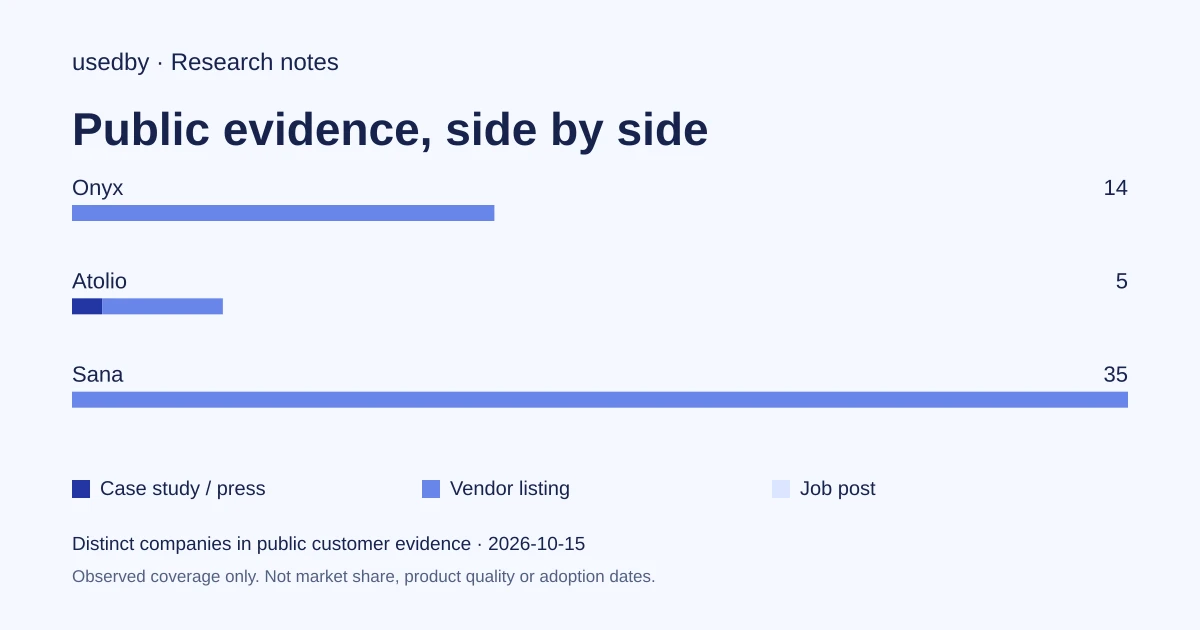
Editorial recommendation, not a vendor capability: run the same ten questions in each product, using accounts with different rights, and check that answers cite sources and that restricted documents never appear. Then revoke one right and see how long the change takes to show. Public customer lists are not a comparison, since they record who is named, not how well each tool performs.
Sources: onyx.app · atolio.com · sanalabs.com · Pricing (onyx.app) · Connectors (atolio.com) · Integrations (sanalabs.com) · Onyx (usedby.ai) · Atolio (usedby.ai) · Sana (usedby.ai)
Method and limits
2026-10-15
This dated snapshot counts distinct companies in public customer evidence. CONFIRMED means a case study, named testimonial or press source; OBSERVED means a vendor listing; SIGNAL means a job post. All three count, but their strength differs. Removed and unlevelled lines are excluded. Examples are a capped selection verified within 90 days. Vendor facts are sourced records checked within 60 days. Coverage is uneven and missing evidence is unknown. These figures measure neither market share nor product performance; capture dates are not adoption dates.
Sources
- Pricing (onyx.app)onyx.app
- onyx.apponyx.app
- Connectors (atolio.com)atolio.com
- atolio.comatolio.com
- Integrations (sanalabs.com)sanalabs.com
- sanalabs.comsanalabs.com
- Pricing (sanalabs.com)sanalabs.com
- Dpa (atolio.com)atolio.com
Questions
Which of the three is open source?
Onyx, formerly Danswer, is described as open source, and its vendor says the code can be audited. Atolio and Sana are presented as vendor products, and the pages we read do not describe them as open source.
Do Onyx, Atolio and Sana publish prices?
Onyx lists Business at $20 per user per month and Enterprise by quote. Sana lists Enterprise as custom pricing. No price for Atolio appears in the pages we read.
Is Sana Learn part of this comparison?
No. Sana Learn is a learning platform for training teams. This comparison covers only Sana Agents, the assistant that searches company knowledge and acts across apps, because that matches the cross-app search task.
Can I self-host each tool?
Onyx says it runs in your cloud, on bare metal or air-gapped. Atolio is deployed in the customer's own cloud or on premises. Sana's pages we read do not state a hosting model, so confirm it with the vendor.
Tools in this article



Explore the data
Who uses which AI tool, and how each line was found.