Fireflies or Grain: from a call moment you find to a clip you share and a CRM update
Fireflies and Grain both search calls, share moments and feed the CRM, but with different formats and plan limits. Here is which fits which team.
The short answer: it depends on the format and the CRM
Both tools record, transcribe and summarize calls, let you search past conversations and connect to other work tools. The difference shows up when a team reuses a call: finding the passage, turning it into something others will open, and sending the outcome to the CRM.
In short: Grain is built around video clips and names HubSpot and Salesforce as CRM syncs, but those two are included from its Business plan. Fireflies offers audio soundbites, channels and user groups, and advertises a wider set of CRM connections without naming them on the pages we read. Neither is a universal winner. The better choice depends on which step of the journey matters most to your team.
Sources: fireflies.ai · grain.com · Pricing (grain.com)
Finding the passage in the call library
Fireflies describes meeting search that takes you to the specific sentence and timestamp of a past call. It also offers AskFred, an assistant that reviews your meetings and answers questions. Its pricing grid lists search within meetings and a newer global search.
Grain describes asking questions across the whole meeting library and getting answers with citations. It also offers an MCP server and API so AI tools such as Claude or ChatGPT can query transcripts. Its grid lists global transcript search, custom vocabulary and multilingual transcripts.
Both claims come from vendor pages. How accurate either search is on your own accents, jargon and audio is something only a trial on your calls can show.
Sources: fireflies.ai · Pricing (fireflies.ai) · grain.com · Pricing (grain.com)
Turning a moment into something others will open
Fireflies offers soundbites, which are short audio snippets that can be shared, plus channels to organize meetings, user groups to share them with teams, and time-stamped comments and bookmarks. Its grid places video recording from the Pro plan and user groups and public meeting access in Business. The grid text does not make clear which plan includes soundbites.
Grain centers on video. Its grid lists shareable video clips, playlists, highlight reels, a shared team library and a Slack integration, and its homepage mentions sharing clips and recordings with colleagues and clients.
A Grain blog post on Arrows shows what this looks like in practice. According to the vendor, the customer success team records calls, clips customer feedback and shares it with product managers, who no longer need to join every call. Bugs are clipped and added to a Notion database for engineers. Insights go to a dedicated Slack channel, and weekly all-hands sessions play highlights. The team also searches by keyword and tag to find moments on a given feature. The lesson: the value comes from the clip traveling to where the audience already works.
On the Fireflies side, the vendor's own homepage quotes customers such as Clara, whose co-founder says it reduces extra customer calls, and Phyllo, whose co-founder says it helps analyze what customers need. These are testimonials, not workflow descriptions, so they say little about sharing mechanics.
Sources: fireflies.ai · Pricing (fireflies.ai) · grain.com · Pricing (grain.com) · Arrows customer success grain (grain.com) · fireflies.ai
Pushing what was learned into the CRM
Grain's integrations page names HubSpot, with contacts, companies and deals, along with Salesforce, Aircall, Slack and Zapier. Its pricing grid puts the HubSpot and Salesforce integrations in the Business plan at $29 per seat per month billed annually. Free and Starter do not list them, though Starter includes Slack and a personal Zapier integration.
Fireflies says it can fill in your CRM with notes and call logs and counts 5+ CRM integrations, but the pages we read do not name them. It also lists project management tools, ATS connections to Greenhouse and Lever, and Slack. Its grid shows integrations without a cap from Pro. If your CRM is not a mainstream one, confirm it directly. The synced fields are not documented on either vendor's pages we read.
Sources: Integrations (grain.com) · Pricing (grain.com) · fireflies.ai · Pricing (fireflies.ai)
Access rights, plans and cost per seat
Fireflies lists annual per-seat prices of $0 for Free, $10 for Pro, $19 for Business and $39 for Enterprise. Enterprise adds a rules engine for meeting access, SSO and SCIM, audit logs, private storage and HIPAA support. Fireflies lists SOC 2 Type II and HIPAA, says on its security page that it does not train on customer data by default, and offers a data processing agreement.
Grain lists $0 for Free, $15 for Starter and $29 for Business, billed annually, with Enterprise on request. Free allows unlimited meetings but caps them at 45 minutes and keeps 30 days of history. Enterprise adds SAML-based SSO. The grid also lists recording access controls, mutually signed DPAs and audit logs, and the security page states SOC 2 Type II with hosting in the USA on AWS.
Both vendors offer a free plan or trial. Customer counts on the usedby directory do not show which tool is better and no company is listed with both.
Sources: Pricing (fireflies.ai) · Security (fireflies.ai) · Dpa (fireflies.ai) · Pricing (grain.com) · Security (grain.com) · grain.com · Fireflies (usedby.ai) · Grain (usedby.ai)
Which one to evaluate first, and what to ask in a demo
Evaluate Grain Business first if video clips, playlists and a named HubSpot or Salesforce sync are central. Evaluate Fireflies first if you want audio soundbites, broad integrations and enterprise controls such as SSO with SCIM and HIPAA support. Reuse by research or product teams leans toward clips; admin-heavy or regulated setups lean toward the Fireflies Enterprise list. This is an editorial reading of the vendor pages.
Editorial suggestion for a demo: ask Fireflies which CRMs are in its 5+ and which fields are written. Ask Grain which fields reach HubSpot or Salesforce. Ask both who can open a shared clip outside the workspace, and run one real search on a past call.
Sources: fireflies.ai · grain.com · Pricing (fireflies.ai) · Pricing (grain.com)
Method and limits
2026-10-15
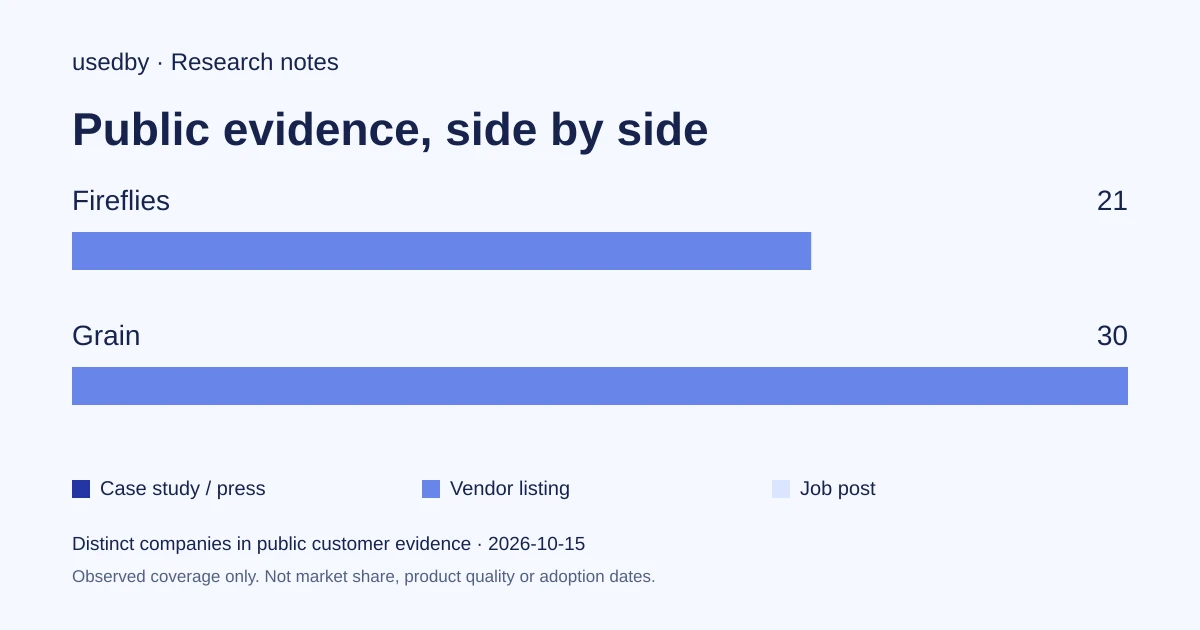
This dated snapshot counts distinct companies in public customer evidence. CONFIRMED means a case study, named testimonial or press source; OBSERVED means a vendor listing; SIGNAL means a job post. All three count, but their strength differs. Removed and unlevelled lines are excluded. Examples are a capped selection verified within 90 days. Vendor facts are sourced records checked within 60 days. Coverage is uneven and missing evidence is unknown. These figures measure neither market share nor product performance; capture dates are not adoption dates.
Sources
- fireflies.aifireflies.ai
- grain.comgrain.com
- Pricing (grain.com)grain.com
- Pricing (fireflies.ai)fireflies.ai
- Arrows customer success grain (grain.com)grain.com
- Integrations (grain.com)grain.com
- Security (fireflies.ai)fireflies.ai
- Dpa (fireflies.ai)fireflies.ai
- Security (grain.com)grain.com
Questions
Which tool names its CRM integrations more clearly?
Grain. Its integrations page names HubSpot and Salesforce, and its pricing grid places them in the Business plan. Fireflies advertises 5+ CRM integrations, but the pages we read do not name them.
Do both tools offer shareable clips?
Yes, in different formats. Fireflies describes audio soundbites; Grain lists video clips, playlists and highlight reels. Which plan includes soundbites at Fireflies is not clear from its grid text.
What does the per-seat cost look like?
On annual billing, Fireflies lists $10 for Pro, $19 for Business and $39 for Enterprise. Grain lists $15 for Starter and $29 for Business, with Enterprise on request. Both have a free plan, with different limits.
Do they publish security information?
Fireflies lists SOC 2 Type II and HIPAA and offers a DPA. Grain lists SOC 2 Type II and mutually signed DPAs in its grid. These are vendor statements; check the reports and your own requirements.
Tools in this article


Explore the data
Who uses which AI tool, and how each line was found.