Onyx or Sana Agents for finding internal knowledge with sourced answers and respected permissions
Onyx or Sana Agents for searching company knowledge? Connectors, answer sources, permissions and hosting, based on each vendor's product pages.
The short answer, and why Sana Learn is out of scope
If your main constraint is control over where the system runs, Onyx is the better-documented fit. Its public pages describe self-hosting in your own cloud, on bare metal or air-gapped, and list role-based access control and permission inheritance. If your main constraint is the number of business apps to connect, or you already live in Workday, Teams and Outlook, Sana Agents deserves a place on the shortlist, but its public pages say less about how answers are sourced and how permissions work.
One scoping point first. Sana sells two different products: Sana Agents, an assistant that searches and acts across company knowledge and apps, and Sana Learn, a learning platform for training teams. Many of Sana's published customer stories are about Learn. Polestar, for example, describes using it to build and translate courses in-house instead of relying on external vendors, and reports that localized training now ships in hours rather than weeks. That is a training workflow, not knowledge retrieval, so this comparison sets it aside and looks only at Sana Agents against Onyx.
Sources: onyx.app · sanalabs.com · Pricing (onyx.app) · Integrations (sanalabs.com) · Polestar (sanalabs.com)
Search connectors: 40+ or 50+ against 100+
Onyx's pricing page lists 40+ app connectors. Its homepage uses two figures: 40+ sources in the architecture diagram and 50+ connectors in the text. The numbers differ, so ask which connectors exist today for your stack. Publicly listed integrations include Confluence, Jira, GitHub, Google Drive, Gmail, Slack, Salesforce and SharePoint. The Enterprise plan mentions custom integrations.
Sana's integrations page says 100+ apps are synced and names a long list of turnkey connectors. It includes Google Drive, GitHub, Slack, Zendesk, Confluence, SharePoint, Jira, Teams, Salesforce, Gmail, Workday and Outlook, plus Notion, Snowflake, ServiceNow and SAP. Custom integrations are also offered, and the Enterprise plan includes an MCP client for building your own. A bigger catalogue helps only if it covers the systems your staff actually search, so count your own sources, not the headline.
Sources: Pricing (onyx.app) · onyx.app · Integrations (sanalabs.com) · Pricing (sanalabs.com) · sanalabs.com
Where answers come from
Onyx describes searching all indexed sources in parallel and returning an answer with its source documents. The homepage example shows a count of relevant documents, document labels and the note that permissions were enforced. Onyx also publishes cost and speed examples and an open benchmark where it ranks first. Those are vendor-reported results, not independent tests, and the example figures illustrate one scenario only.
Sana's homepage describes Find, Act, Build and Automate: instant access to company knowledge, task automation across apps, generated documents and dashboards, and automated workflows. The pages reviewed do not describe how citations or source links appear in an answer. That is an open question, not a missing feature, and it is the first thing to check in a demo if verifiable answers matter to you.
Sources: onyx.app · sanalabs.com
Permissions and access control
Onyx lists role-based access control and permission inheritance among its features, and OIDC/SAML single sign-on on the Enterprise plan. Its homepage says source permissions are synced and enforced at query time, so a user should only retrieve what the source system allows them to see. That is a vendor description; test it with a restricted document and a user who should not see it.
Sana's Enterprise plan lists domain verification, SAML-based SSO and SCIM, and an enterprise data processing agreement. Its pricing FAQ includes a question on how data permissions are handled, but the text reviewed does not include the answer. Whether Sana mirrors source-system permissions at query time is therefore unconfirmed here and should be asked directly.
Sources: onyx.app · Pricing (onyx.app) · Pricing (sanalabs.com) · sanalabs.com
Hosting and operations
This is the clearest difference. Onyx is open source and describes running entirely in your cloud account, on bare metal or air-gapped, with the index, embeddings and model traffic staying inside your boundary. It also says you can swap model providers or run open-weight models on your own GPUs. The Business plan is listed at 20 dollars per user per month, with a free trial or free plan, and Enterprise adds on-premise and region-specific deployments.
Sana's pricing page is quote-based. It states ISO 27001 certification and GDPR compliance, and describes AES 256 encryption at rest and TLS 1.2+ in transit; these are the vendor's own statements. It also lists a dedicated success team, an SLA and an extended range of LLMs. The page text does not mention self-hosting or region options. The homepage also says Sana is now part of Workday, which may matter for contracts, data handling and roadmap, and is worth clarifying.
Sources: onyx.app · Pricing (onyx.app) · Pricing (sanalabs.com) · sanalabs.com
Who should choose what
Choose Onyx first if your security team requires the index and model traffic inside your own infrastructure, if you want auditable code, or if you want to start small with a published per-user price. Evaluate Sana Agents if you want a managed enterprise platform with a wide connector catalogue, SCIM and SAML, and agents that act in apps as well as search.
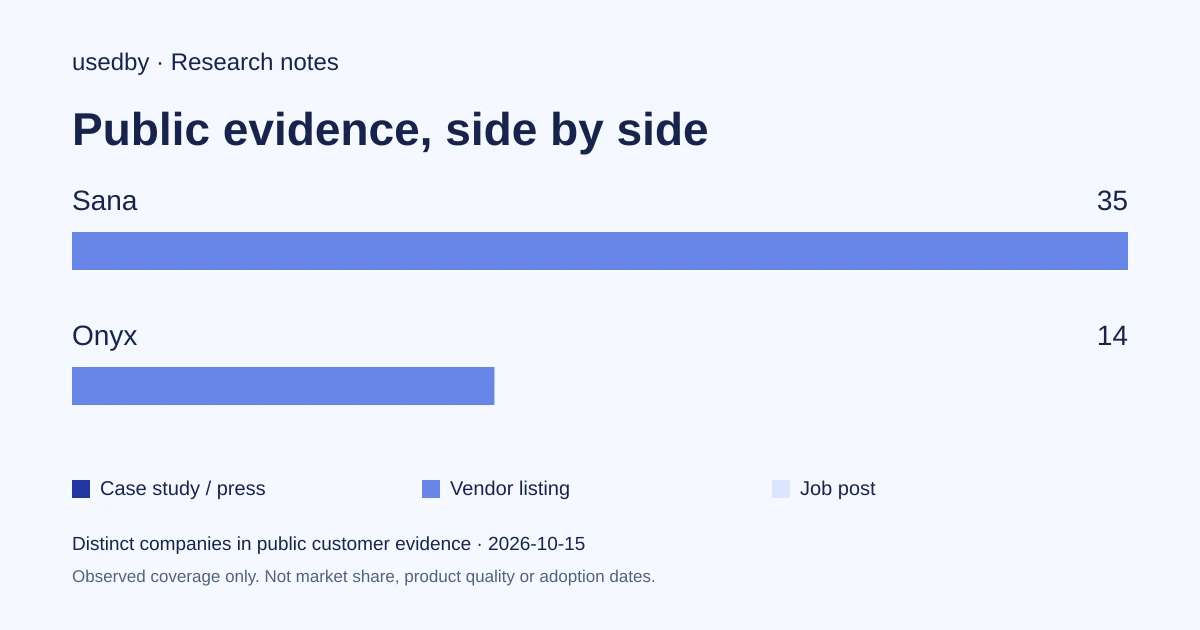
Public customer counts are not a preference signal. Sana lists 35 companies and Onyx 14 in the tracked data, and only Brex appears for both. Many Sana lines relate to Learn, so they say little about Agents. Treat the counts as a picture of who publishes what, not of which product works better.
Sources: onyx.app · sanalabs.com · Pricing (onyx.app) · Pricing (sanalabs.com)
Demo questions, as editorial recommendations
These are our suggestions, not vendor capabilities. For both vendors: run a query over your three most important sources and check that each answer links to the underlying document. Then test with a user who lacks access to a sensitive file and confirm it never appears. Ask how permission changes in the source propagate and how quickly.
For Sana, ask where data is stored and whether the Agents product can run in a region or environment you control. Ask what the Workday relationship changes. For Onyx, ask which connectors are production-ready for your stack, who operates upgrades if you self-host, and what the Business plan excludes compared with Enterprise.
Sources: onyx.app · sanalabs.com · Pricing (onyx.app)
Method and limits
2026-10-15
This dated snapshot counts distinct companies in public customer evidence. CONFIRMED means a case study, named testimonial or press source; OBSERVED means a vendor listing; SIGNAL means a job post. All three count, but their strength differs. Removed and unlevelled lines are excluded. Examples are a capped selection verified within 90 days. Vendor facts are sourced records checked within 60 days. Coverage is uneven and missing evidence is unknown. These figures measure neither market share nor product performance; capture dates are not adoption dates.
Sources
- onyx.apponyx.app
- sanalabs.comsanalabs.com
- Pricing (onyx.app)onyx.app
- Integrations (sanalabs.com)sanalabs.com
- Polestar (sanalabs.com)sanalabs.com
- Pricing (sanalabs.com)sanalabs.com
Questions
Is Sana Learn relevant to searching internal knowledge?
No. Sana Learn is a separate learning platform for training teams. Sana Agents is the product that searches and acts across company knowledge and apps, so it is the one to compare with Onyx.
Which one can be self-hosted?
Onyx describes self-hosting in your cloud, on bare metal or air-gapped, and is open source. The Sana pages reviewed do not mention self-hosting, which means the question is unanswered rather than ruled out.
Do both respect existing access rights?
Onyx says source permissions are synced and enforced at query time, and lists RBAC and permission inheritance. Sana lists SAML SSO and SCIM, but the text reviewed does not explain how document-level permissions are handled, so ask in a demo.
How do the prices compare?
Onyx publishes a Business plan at 20 dollars per user per month, with Enterprise on request and a free trial or free plan. Sana lists Enterprise pricing on request only, so a cost comparison needs a quote.
Tools in this article


Explore the data
Who uses which AI tool, and how each line was found.