Connecting knowledge, instructions and apps in Writer for recurring work
How a recurring marketing or sales task maps onto Writer's context sources, Playbooks, team controls and plan limits, and what your teams still have to decide.
Start with one recurring job
Writer's homepage frames the product as an enterprise AI platform with agents for marketing and revenue teams. It describes a chain of jobs: campaign creation, content creation, sales personalization, account prep, meeting intelligence and campaign optimization. Each one is listed with the features and connectors it relies on.
That list is a useful way to choose a first workflow. Pick something repeated weekly, with a clear input and a reviewer, such as a campaign brief, a product page update or a sales email tailored from approved material. The rest of this article follows that kind of job through four blocks: context sources, instructions and actions, team controls, and deployment and follow-up.
Sources: writer.com · Writer (usedby.ai)
Block one: where the context comes from
For campaign creation, the homepage names Memory, Knowledge Graph and web research as the sources of context, with connectors such as Adobe, Salesforce and Snowflake. Sales personalization uses Knowledge Graph and web research, with Salesforce, Microsoft 365 and Google Workspace. Account prep lists Salesforce, PitchBook and ZoomInfo.
Plan limits shape this block. The plans page says Starter includes basic connectors and up to three active connectors, while Enterprise lists full Knowledge Graph capabilities with unrestricted connectors. If your job needs several systems at once, check whether the connectors you want count as basic and whether three active ones are enough.
Sources: writer.com · Writer (usedby.ai) · Plans (writer.com)
Block two: instructions, voice and actions
Content creation on the homepage lists Playbooks, Voice, Terms, Style Guide and Skills. Writer's plans page describes WRITER Agent as one interface for chat and automation, and Playbooks as the repeatable workflows that carry the steps, grounded in connected data and org-level rules. Writer says this is what separates it from a chat-only assistant.
Starter is limited here: up to five Playbooks, up to three scheduled routines and one team personality profile. Enterprise lists unrestricted Playbooks, routines and cross-team workflows, plus departmental brand and voice profiles. A single team with one recurring job may fit Starter. Several departments with different voices point to Enterprise.
Writer's pages say voice, style guides and data grounding keep outputs on brand and compliant, and the plans page says teams stay consistent without extra review cycles. Treat that as the vendor's claim. How often drafts need edits, and how much review time remains, is something your team has to observe on its own material.
Sources: writer.com · Writer (usedby.ai)
Block three: controls your teams still have to configure
Writer's trust page describes role-based permissions with least-privilege access, audit logs, activity traces and performance reports for agent observability, and a governed layer through which agent requests to connected systems are checked for identity and permissions and recorded. It also lists SSO and multi-factor authentication. The plans page lists guardrails as basic on Starter and advanced on Enterprise, and Enterprise adds approvals and admin controls.
These are capabilities, not outcomes. Someone still has to decide who may connect which sources, who approves a Playbook before others run it, and who reads the logs. The homepage speaks of reviewing only edge cases, which is a vendor aim. Whether a given team can reduce review depends on its own risk rules, especially for regulated content.
Sources: Writer (usedby.ai) · Trust (writer.com) · writer.com
Block four: deployment, data terms and plans
Starter has a 14-day free trial with no credit card, for up to five users. Enterprise is sold through sales contact. The plans page says Starter is billed per seat, monthly or annually, with fixed credit limits, and that Enterprise includes regular seats plus free collaborators. It also says payment is by card only.
On data, Writer states it does not train its models on customer data, and that customers can set organization-wide data controls including an automated deletion schedule. A data processing agreement is published, with Writer acting as processor, a subprocessor list and an annual audit right. Writer lists SOC 2 Type II and ISO 27001 among its certifications, and says managed multi-cloud options, including a dedicated private cloud, exist. The plans page says SOC 2 and HIPAA reports are available on request for Enterprise.
Sources: Plans (writer.com) · Writer (usedby.ai) · Trust (writer.com) · Data processing (writer.com)
A customer story: Commvault's sales enablement app
Commvault's Chief Market Officer describes building a chat app, Ask Commvault Cloud, on Writer's Knowledge Graph. It connects to product and messaging documents so sales reps can ask about competitor differentiation and buyer personas. In this account, a non-technical marketing team, helped by Writer's account team, deployed it in weeks rather than months.
The same executive reports, on Writer's own site, that a typical product marketing manager might spend an hour and a half on web copy, and that Commvault has brought that down to ten minutes. Work that might have taken eight to twelve hours can, they say, reach an outline ready for review in about twenty minutes. They describe a 70-30 rule: AI gets the draft most of the way, and people spend the rest adding value. Daily use in marketing grew from 30% to 80% over a year; the executive's stated adoption approach included giving everyone early access, assigning a leader to the tool, and sharing use cases through a council. This is one vendor-published story, not a benchmark.
Sources: Commvault customer story (writer.com)
Questions to bring to a demo
Ask to see your own recurring job built end to end. Which sources feed it, and are those connectors available on your plan? Who can edit the Playbook, and what approval does a change need? Which log or trace shows what the agent did with a connected system, and who can read it?
Then agree on how you will judge quality and review effort on real drafts. That is an editorial suggestion, not a Writer feature. The documented material covers capabilities and plan limits, and it does not by itself tell you how much review your content will need.
Sources: Writer (usedby.ai) · writer.com
Method and limits
2026-10-15
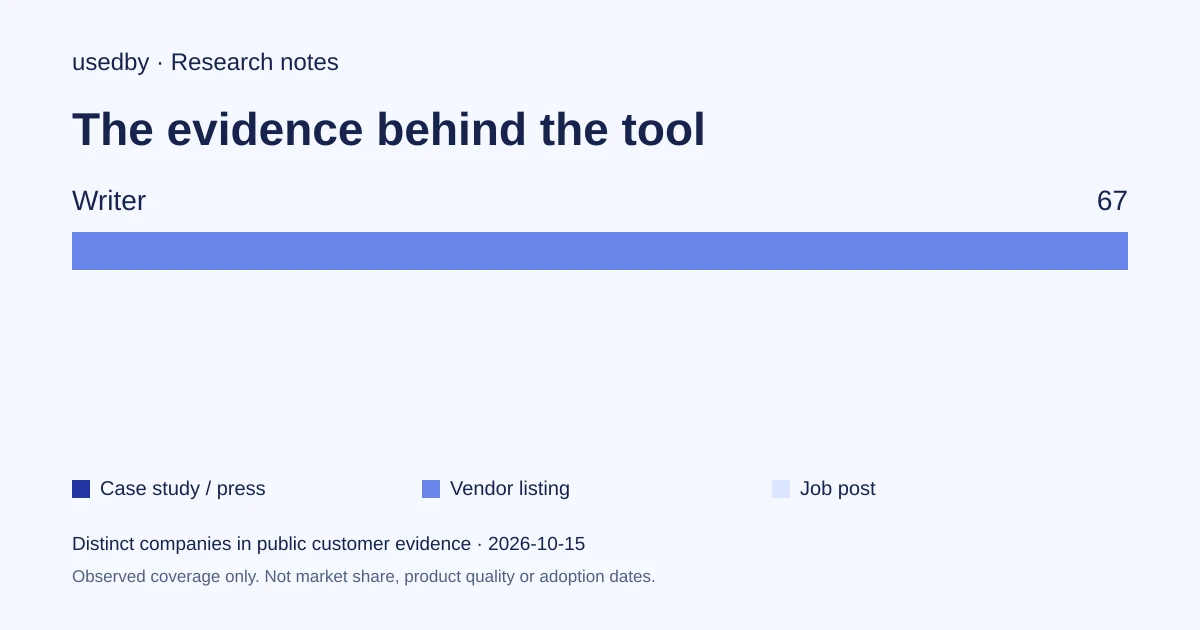
This dated snapshot counts distinct companies in public customer evidence. CONFIRMED means a case study, named testimonial or press source; OBSERVED means a vendor listing; SIGNAL means a job post. All three count, but their strength differs. Removed and unlevelled lines are excluded. Examples are a capped selection verified within 90 days. Vendor facts are sourced records checked within 60 days. Coverage is uneven and missing evidence is unknown. These figures measure neither market share nor product performance; capture dates are not adoption dates.
Sources
- writer.comwriter.com
- Plans (writer.com)writer.com
- Trust (writer.com)writer.com
- Data processing (writer.com)writer.com
- Commvault customer story (writer.com)writer.com
Questions
Can a small team start with the Starter plan?
Starter offers a 14-day trial without a credit card, up to five users, up to five Playbooks, one team personality profile and up to three active connectors, according to Writer's plans page. A single team with one or two recurring jobs may fit; larger rollouts point to Enterprise.
Does Writer train its models on customer data?
Writer states it does not train its models on customer data, inputs or outputs, and that customers can configure data controls including automated deletion. This is the vendor's statement; the data processing agreement and your contract set the binding terms.
Does Writer guarantee compliant, on-brand output?
Writer claims it does. Its plans page says personality profiles, style guides and data grounding ensure every deliverable reflects your brand and rules, and that teams stay consistent without extra review cycles. The sources we read publish no evidence of output quality or of how much review remains, so your team should verify drafts and set its own review rules.
What does the Commvault example show?
It shows one company's account of building a Knowledge Graph chat app for sales enablement in weeks, and of time savings on specific tasks. These figures come from Commvault's Chief Market Officer on Writer's site and do not predict results elsewhere.
Tools in this article

Explore the data
Who uses which AI tool, and how each line was found.