

The use case: how Legora deploys turbopuffer
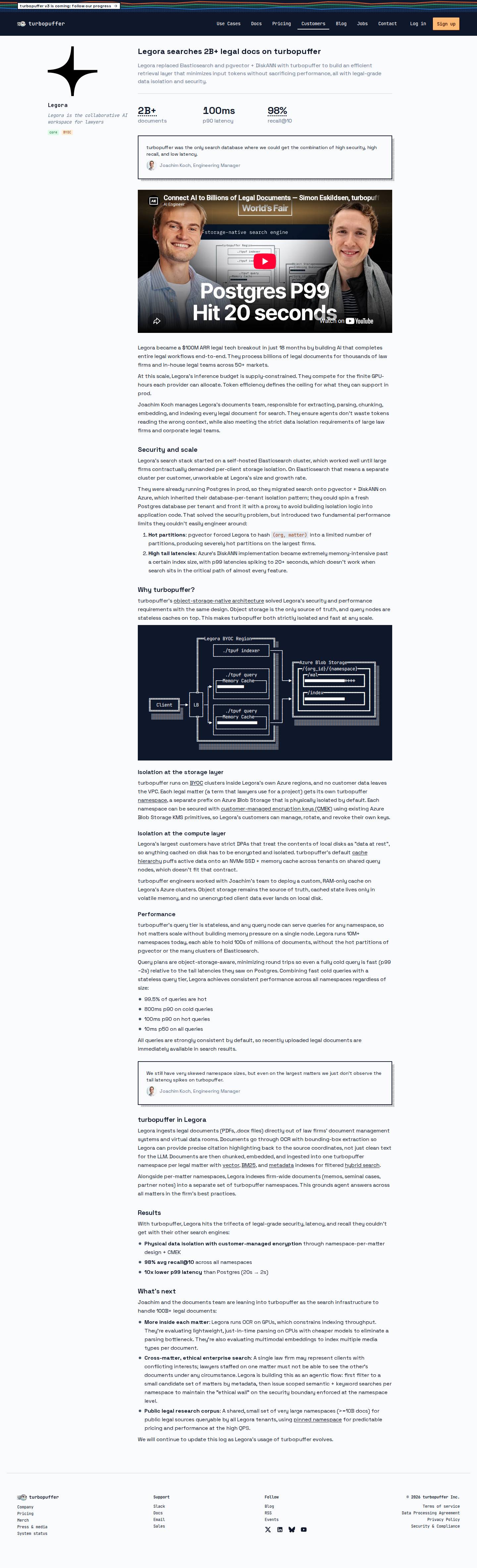
Legora uses turbopuffer as the search layer for legal documents, with one namespace per legal matter holding vector, BM25, and metadata indexes for filtered hybrid search. It runs in Legora's own Azure regions (BYOC) with storage-level isolation and customer-managed encryption keys, replacing Elasticsearch and pgvector + DiskANN.
More reported results
Figures published in turbopuffer’s case study. They are not independently measured by usedby.
98% avg recall@10 across all namespaces
100ms p90 on hot queries
800ms p90 on cold queries
10ms p50 on all queries
In the customer’s words
turbopuffer was the only search database where we could get the combination of high security, high recall, and low latency.Other AI tools used by Legora
Other public relationships recorded on usedby.
Explore Legora’s AI stack





turbopuffer users in Legal & Compliance
Companies in the same sector, with public evidence.
See all turbopuffer customers
Go straight to the source
Based on turbopuffer’s published case study. We check the public evidence; the results are reported by the vendor.
turbopuffer.com- Last checked
- Nov 12, 2026
 Open source capture
What the story claims, and what we checked
What we compared with the page.
- The figure: 10xChecked
Printed word for word on the page, near the name of Legora.
- The passage quoted aboveChecked
Copied word for word from the page, near the name of Legora.
- Legora uses turbopufferChecked
Confirmed line.
- The result itselfNot checked
We quote it; we did not measure it.
Query plans are object-storage-aware, minimizing round trips so even a fully cold query is fast (p99 ~2s) relative to the tail latencies they saw on Postgres.