

The use case: how Lifesum deploys QA Wolf
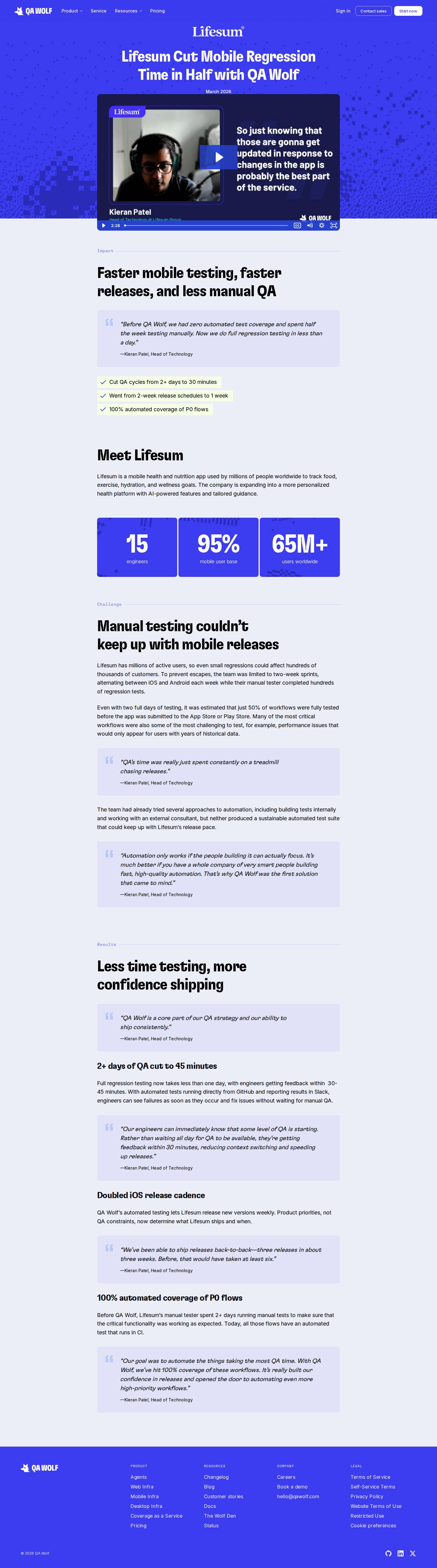
Lifesum, a mobile health and nutrition app, uses QA Wolf to automate its mobile regression testing. Automated tests run in CI from GitHub and report results in Slack, replacing most of the manual QA work.
More reported results
Figures published in QA Wolf’s case study. They are not independently measured by usedby.
Went from 2-week release schedules to 1 week
100% automated coverage of P0 flows
2+ days of QA cut to 45 minutes
In the customer’s words
Before QA Wolf, we had zero automated test coverage and spent half the week testing manually. Now we do full regression testing in less than a day.QA Wolf users in HealthTech & Digital Health
Companies in the same sector, with public evidence.
See all QA Wolf customers

Go straight to the source
Based on QA Wolf’s published case study. We check the public evidence; the results are reported by the vendor.
qawolf.com- Last checked
- Nov 10, 2026
 Open source capture
What the story claims, and what we checked
What we compared with the page.
- The figure: 30 minutesChecked
Printed word for word on the page, near the name of Lifesum.
- The passage quoted aboveChecked
Copied word for word from the page, near the name of Lifesum.
- Lifesum uses QA WolfChecked
Confirmed line.
- The result itselfNot checked
We quote it; we did not measure it.
Full regression testing now takes less than one day, with engineers getting feedback within 30-45 minutes. With automated tests running directly from GitHub and reporting results in Slack, engineers can see failures as soon as they occur and fix issues without waiting for manual QA.