

The use case: how NASA deploys Labelbox
NASA's Jet Propulsion Laboratory uses Labelbox Annotate to build a training dataset for a model that maps water and CO2 frost on Mars. Multiple experts label high-resolution orbiter imagery with polygons, explanations and confidence ratings, and the labels are combined with thermal data.
In the customer’s words
Just like on earth, freeze-thaw cycles can cause erosion which is why we want to look at how the Martian frost cycle is shaping the surface of Mars,Labelbox is so easy to use. The documentation is accessible, and the expert feedback pipeline is straightforward. We just had to upload our data, customize the editor to our exact requirements, and go. We had actually budgeted a week to get it set up, but we were done in a day.Other AI tools used by NASA
Other public relationships recorded on usedby.
Explore NASA’s AI stack




Other companies using Labelbox
Customers across industries, with public evidence.
Advent Health PartnersConfirmed AncestryConfirmed
 Blue River TechnologyConfirmed
 BurberryConfirmed
 CAPE AnalyticsConfirmed
 CriteoConfirmed
See all Labelbox customersAncestryConfirmedBlue River TechnologyConfirmedBurberryConfirmedCAPE AnalyticsConfirmedCriteoConfirmedGo straight to the source
Based on Labelbox’s published case study. We check the public evidence; the results are reported by the vendor.
labelbox.com- Last checked
- Nov 17, 2026
 Open source capture
What the story claims, and what we checked
What we compared with the page.
- NASA uses LabelboxChecked
Confirmed line.
- The result itselfNot checked
We quote it; we did not measure it.
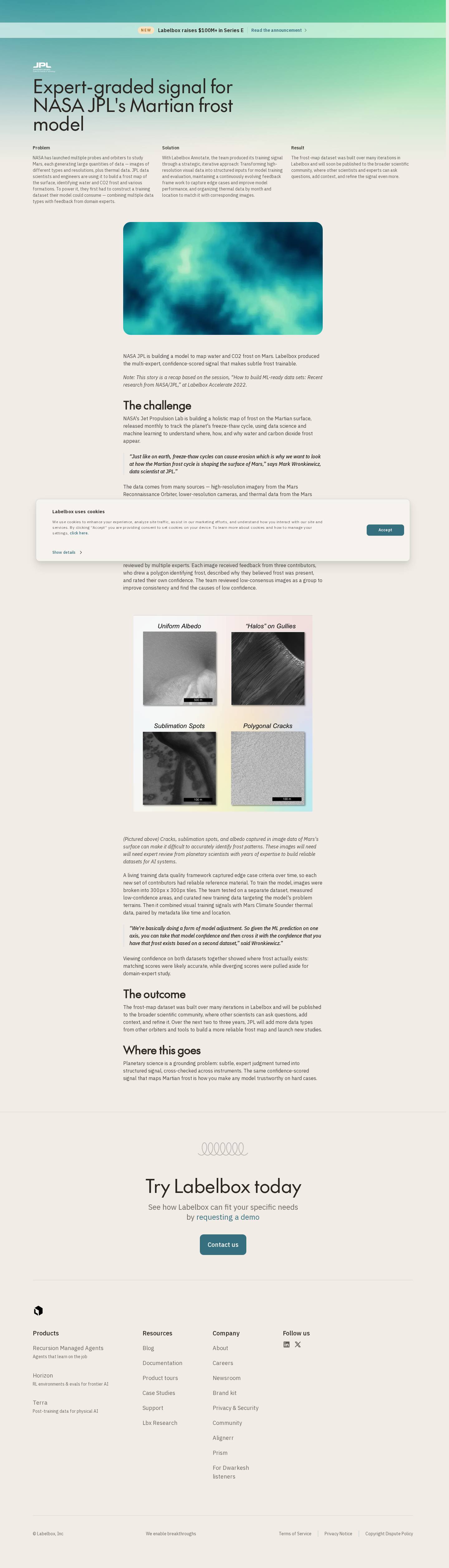
With Labelbox Annotate, JPL produced the signal with an iterative, consensus-driven approach. High-resolution images were broken into smaller squares, randomized and reviewed by multiple experts. Each image received feedback from three contributors, who drew a polygon identifying frost, described why they believed frost was present, and rated their own confidence.