
The use case: how NJ TRANSIT deploys Replicant
NJ TRANSIT's Access Link paratransit service uses Replicant's AI agents to handle its two highest-volume call types, checking ride status and canceling a ride, so callers get answers without waiting for a live agent. Human agents are left to handle more complex calls.
More reported results
Figures published in Replicant’s case study. They are not independently measured by usedby.
45 percent resolution rate
4.3 out of 5 average CSAT
68 percent of callers gave a 5 out of 5
Usage of the new system quickly surpassed the 9 percent ceiling of their old IVR.
In the customer’s words
With Replicant answering so many calls, supervisors actually get to supervise and coach agents, instead of helping out with the call queue themselves,” said Parker. “It's 'command' more than 'reprimand'. It's a career, not a job.Other companies using Replicant
Customers across industries, with public evidence.
 Bulwark Pest ControlConfirmedCentury Support ServicesConfirmed
 CorVelConfirmed
 ECSIConfirmed
 Evive BrandsConfirmed
 FanaticsConfirmed
Go straight to the source
Based on Replicant’s published case study. We check the public evidence; the results are reported by the vendor.
replicant.com- Last checked
- Oct 8, 2026
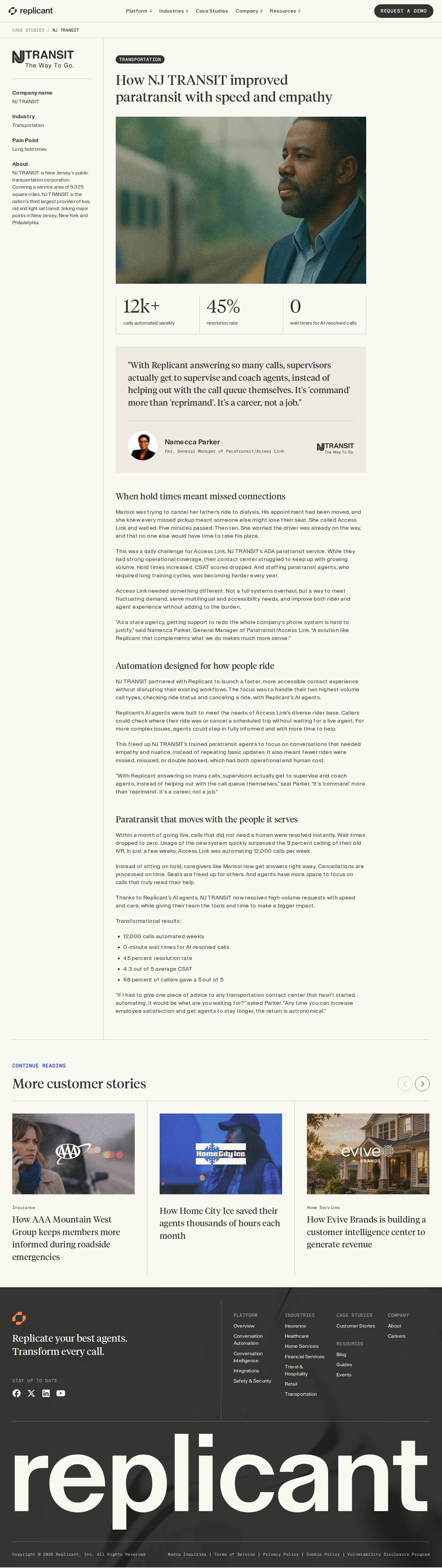 Open source capture
What the story claims, and what we checked
What we compared with the page.
- The figure: 12,000Checked
The figure is on the page; its label is our wording.
- The passage quoted aboveChecked
Copied word for word from the page, near the name of NJ TRANSIT.
- NJ TRANSIT uses ReplicantChecked
Confirmed line.
- The result itselfNot checked
We quote it; we did not measure it.
Within a month of going live, calls that did not need a human were resolved instantly. Wait times dropped to zero. Usage of the new system quickly surpassed the 9 percent ceiling of their old IVR. In just a few weeks, Access Link was automating 12,000 calls per week.