

The use case: how TrueLayer deploys incident.io
TrueLayer's core banking engineering team uses incident.io for incident management and on-call, replacing PagerDuty. They record root-cause and trend data in custom fields when closing incidents and review it monthly to prioritize reliability work on the roadmap.
More reported results
Figures published in incident.io’s case study. They are not independently measured by usedby.
Between 2025 and 2026, that work reduced incidents caused by product edge cases by roughly 70%.
21 teams onboarded, from compliance to finance
one bug kept getting pushed back until the data showed it was costing roughly 20 engineer-hours a month.
In the customer’s words
The conversations with product went from gut feelings to evidence-based prioritization. Problems that had been ignored for multiple quarters got prioritized because of the root-cause data.incident.io users in Fintech & Payments
Companies in the same sector, with public evidence.
See all incident.io customers





Go straight to the source
Based on incident.io’s published case study. We check the public evidence; the results are reported by the vendor.
incident.io- Source published
- Aug 3, 2026
- Last checked
- Nov 16, 2026
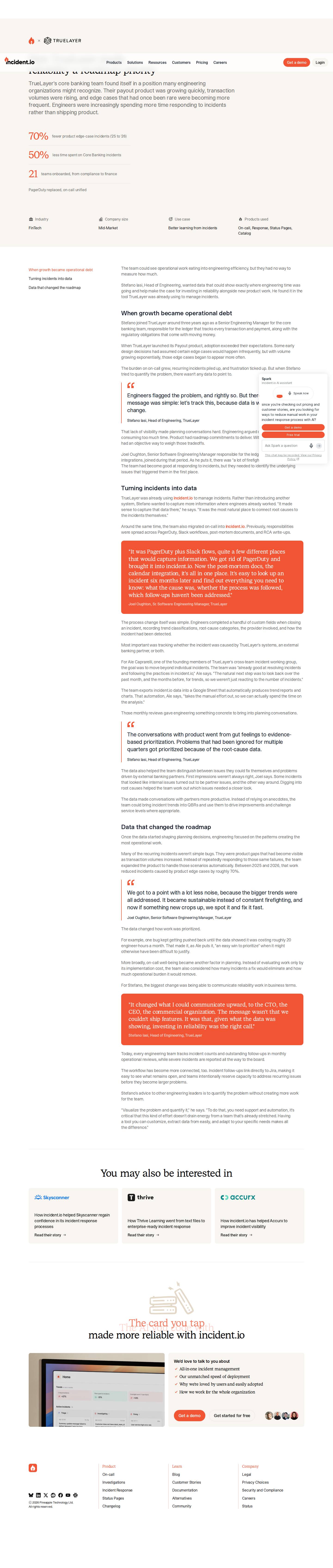 Open source capture
What the story claims, and what we checked
What we compared with the page.
- The figure: 50%Checked
Printed word for word on the page, near the name of TrueLayer.
- The passage quoted aboveChecked
Copied word for word from the page, near the name of TrueLayer.
- The publication dateChecked
Read from the page’s own metadata, never guessed.
- TrueLayer uses incident.ioChecked
Confirmed line.
- The result itselfNot checked
We quote it; we did not measure it.
Between 2025 and 2026, that work reduced incidents caused by product edge cases by roughly 70%.