

The use case: how Adidas deploys Databricks
adidas built a RAG-based GenAI chatbot that analyzes sentiment across its product reviews and returns insights to product decision-makers, including nontechnical users. It uses Databricks for embedding, vector search, model serving, governance and experiment tracking.
More reported results
Figures published in Databricks’s case study. They are not independently measured by usedby.
More efficient prompt engineering and smaller context windows reduced token input size by 98.5%, from 200,000 to just 3,000 tokens per query.
Through GenAI, adidas improved review analysis efficiency by up to 30–40%, cutting down extensive manual workloads across global teams.
91.67% cost savings
In the customer’s words
The GenAI infrastructure we built is already enabling use cases beyond product reviews,Other AI tools used by Adidas
Other public relationships recorded on usedby.
Explore Adidas’s AI stack





Databricks users in Fashion & Apparel
Companies in the same sector, with public evidence.
See all Databricks customers


Go straight to the source
Based on Databricks’s published case study. We check the public evidence; the results are reported by the vendor.
databricks.com- Last checked
- Nov 5, 2026
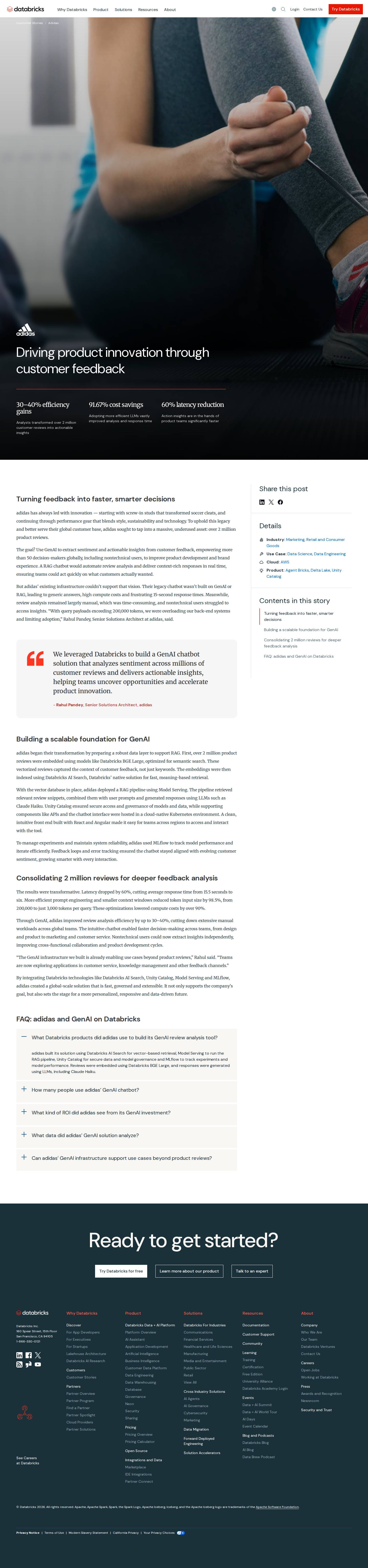 Open source capture
What the story claims, and what we checked
What we compared with the page.
- The figure: 60%Checked
Printed word for word on the page, near the name of Adidas.
- The passage quoted aboveChecked
Copied word for word from the page, near the name of Adidas.
- Adidas uses DatabricksChecked
Confirmed line.
- The result itselfNot checked
We quote it; we did not measure it.
Latency dropped by 60%, cutting average response time from 15.5 seconds to six. More efficient prompt engineering and smaller context windows reduced token input size by 98.5%, from 200,000 to just 3,000 tokens per query.