

The use case: how Buffer deploys incident.io
Buffer uses incident.io to run incident response in Slack across engineering and customer advocacy, replacing manual Slack workflows, Atlassian status pages and inconsistent postmortems with one platform for coordination, customer communications and post-incident learning.
More reported results
Figures published in incident.io’s case study. They are not independently measured by usedby.
it turns out we reduced the number of criticals by 70%
It takes us on average around five minutes to acknowledge and be in the action of investigating and debugging.
In the customer’s words
We empower every teammate to declare an incident early: smaller fires beat big ones. We log more incidents because we see them sooner and fix them faster.Other AI tools used by Buffer
Other public relationships recorded on usedby.
Explore Buffer’s AI stack

incident.io users in Marketing Tech
Companies in the same sector, with public evidence.
See all incident.io customers
Go straight to the source
Based on incident.io’s published case study. We check the public evidence; the results are reported by the vendor.
incident.io- Source published
- Sep 4, 2025
- Last checked
- Nov 16, 2026
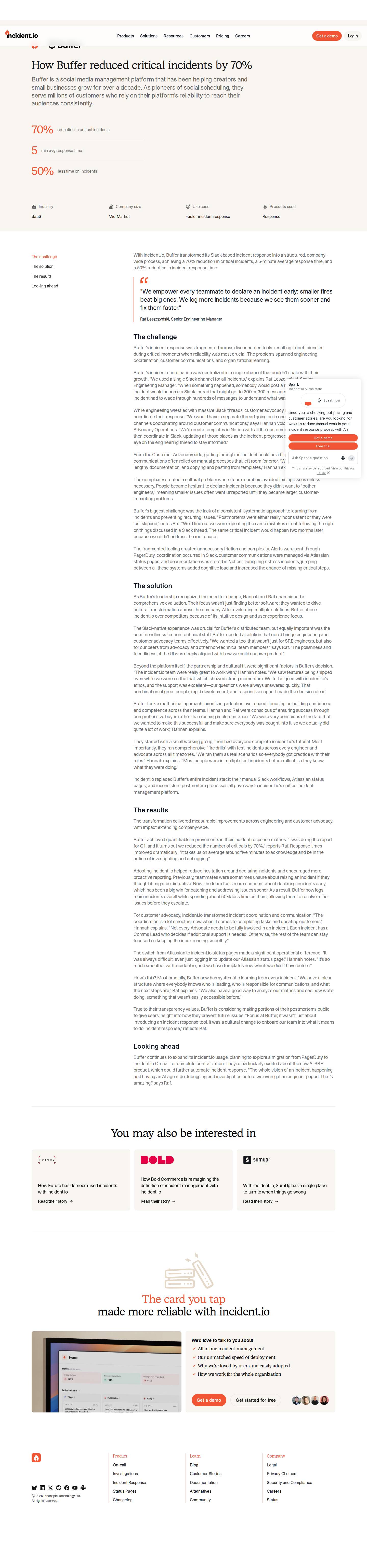 Open source capture
What the story claims, and what we checked
What we compared with the page.
- The figure: 50%Checked
Printed word for word on the page, near the name of Buffer.
- The passage quoted aboveChecked
Copied word for word from the page, near the name of Buffer.
- The publication dateChecked
Read from the page’s own metadata, never guessed.
- Buffer uses incident.ioChecked
Confirmed line.
- The result itselfNot checked
We quote it; we did not measure it.
Buffer now logs more incidents overall while spending about 50% less time on them, allowing them to resolve minor issues before they escalate.