

The use case: how Grammarly deploys Common Room
Grammarly uses Common Room to enrich its internal scoring models with buying signals and person-level enrichment, and as the action layer for its customer-facing teams in the field, supporting AI-assisted outbound personalization.
More reported results
Figures published in Common Room’s case study. They are not independently measured by usedby.
Decrease lead-to-opportunity time by 35%
In the customer’s words
We've seen an increase of 50% in our response rates.Other AI tools used by Grammarly
Other public relationships recorded on usedby.
Explore Grammarly’s AI stack





Common Room users in Artificial Intelligence
Companies in the same sector, with public evidence.
See all Common Room customers

Go straight to the source
Based on Common Room’s published case study. We check the public evidence; the results are reported by the vendor.
commonroom.io- Source published
- Jul 23, 2025
- Last checked
- Oct 7, 2026
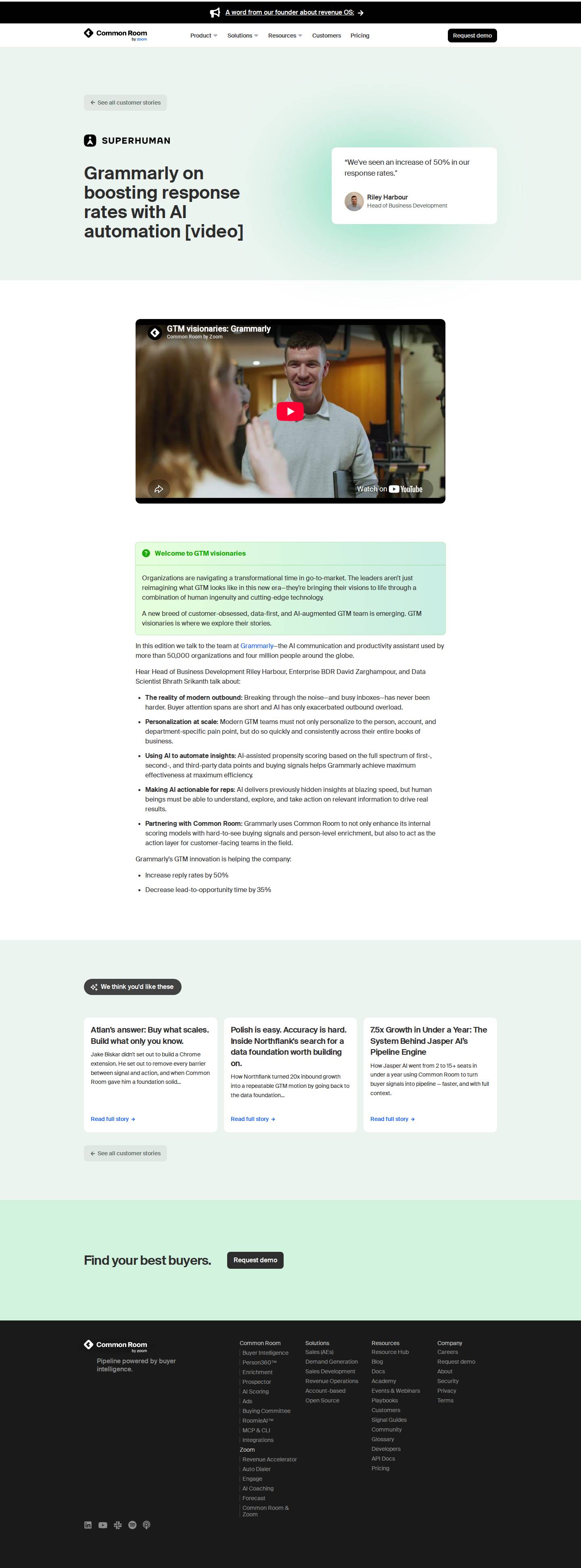 Open source capture
What the story claims, and what we checked
What we compared with the page.
- The figure: 50%Checked
The figure is on the page; its label is our wording.
- The passage quoted aboveChecked
Copied word for word from the page, near the name of Grammarly.
- The publication dateChecked
Read from the page’s own metadata, never guessed.
- Grammarly uses Common RoomChecked
Confirmed line.
- The result itselfNot checked
We quote it; we did not measure it.
Grammarly uses Common Room to not only enhance its internal scoring models with hard-to-see buying signals and person-level enrichment, but also to act as the action layer for customer-facing teams in the field.