

The use case: how MakersPlace deploys QA Wolf
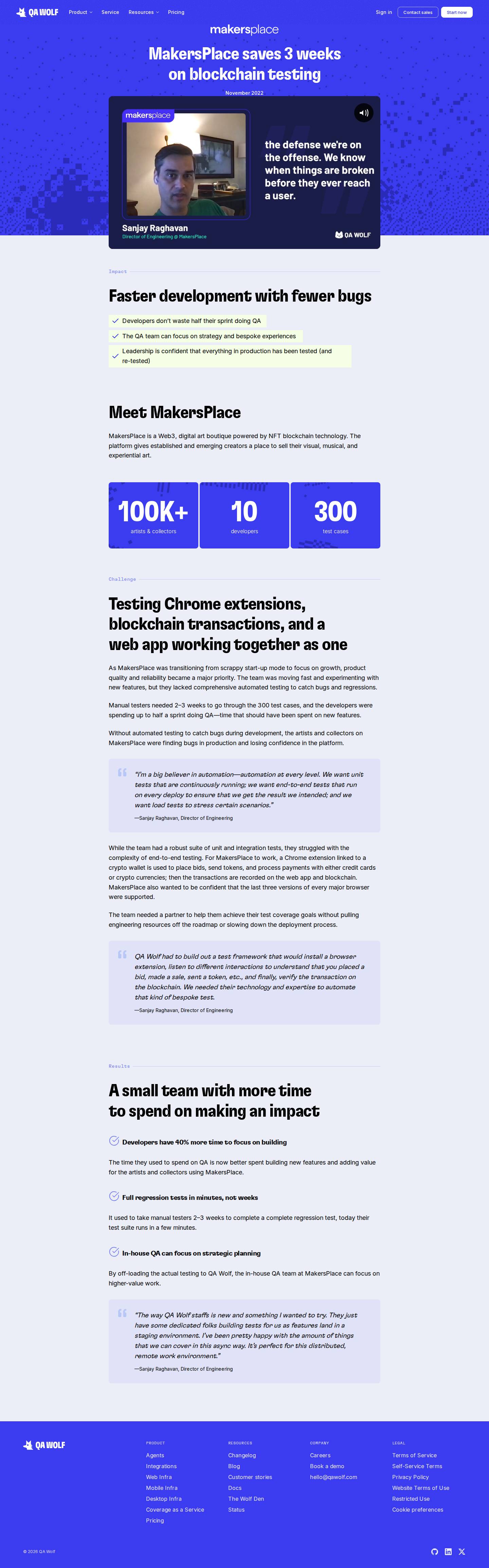
MakersPlace, a Web3 digital art marketplace, uses QA Wolf to build and run automated end-to-end tests covering its Chrome extension, crypto wallet transactions, blockchain verification, and web app. This replaced manual regression testing and developer-led QA.
More reported results
Figures published in QA Wolf’s case study. They are not independently measured by usedby.
It used to take manual testers 2–3 weeks to complete a complete regression test, today their test suite runs in a few minutes.
Manual testers needed 2–3 weeks to go through the 300 test cases, and the developers were spending up to half a sprint doing QA—time that should have been spent on new features.
In the customer’s words
The way QA Wolf staffs is new and something I wanted to try. They just have some dedicated folks building tests for us as features land in a staging environment. I’ve been pretty happy with the amount of things that we can cover in this async way. It’s perfect for this distributed, remote work environment.QA Wolf users in Crypto & Web3
Companies in the same sector, with public evidence.
See all QA Wolf customers
Go straight to the source
Based on QA Wolf’s published case study. We check the public evidence; the results are reported by the vendor.
qawolf.com- Last checked
- Nov 21, 2026
 Open source capture
What the story claims, and what we checked
What we compared with the page.
- The figure: 40%Checked
Printed word for word on the page, near the name of MakersPlace.
- The passage quoted aboveChecked
Copied word for word from the page, near the name of MakersPlace.
- MakersPlace uses QA WolfChecked
Confirmed line.
- The result itselfNot checked
We quote it; we did not measure it.
It used to take manual testers 2–3 weeks to complete a complete regression test, today their test suite runs in a few minutes.