What each vendor documents along one inbound call; "not detailed" means not seen on the pages read, not absent.
| Criterion | PolyAI | Replicant | Parloa | Bland AI |
|---|---|---|---|---|
| Telephony and integrations | PolyAI Docs list SIP trunk, number forwarding, Five9, NICE CXone, Twilio, Amazon… | Replicant Connectors not detailed on pages read; at NJ TRANSIT, the former head of… | Parloa Inbound connectors for Genesys, Amazon Connect, Cisco, Avaya, Five9, Talkdesk,… | Bland AI Twilio, SIP, Genesys, Five9, NICE CXone, Amazon Connect, Talkdesk, plus a REST API. |
PolyAIDocs list SIP trunk, number forwarding, Five9, NICE CXone, Twilio, Amazon Connect, Genesys, Zoom and more.[1] [2] ReplicantConnectors not detailed on pages read; at NJ TRANSIT, the former head of paratransit favored a solution that complements the existing phone system.[3] [4] ParloaInbound connectors for Genesys, Amazon Connect, Cisco, Avaya, Five9, Talkdesk, RingCentral, Vonage and others.[5] [6] Bland AITwilio, SIP, Genesys, Five9, NICE CXone, Amazon Connect, Talkdesk, plus a REST API.[7] | ||||
| Authorized actions | PolyAI Vendor docs: look up reservations, create tickets, read Salesforce records,… | Replicant Case studies show scheduling, payments, ride status and cancellation; systems touched are not detailed. | Parloa Salesforce lookups, identity checks and case updates; SAP and Stripe actions… | Bland AI Vendor example: account lookup, identity check and autopay update. |
PolyAIVendor docs: look up reservations, create tickets, read Salesforce records, healthcare record connectors.[1] [2] ReplicantCase studies show scheduling, payments, ride status and cancellation; systems touched are not detailed.[8] [4] [3] ParloaSalesforce lookups, identity checks and case updates; SAP and Stripe actions listed by the vendor.[5] [6] | ||||
| Human handoff | PolyAI Hands off to live agents; chat handoff to Salesforce, Zendesk, NICE CXone,… | Replicant Agents step in informed at NJ TRANSIT; Bulwark routes to specialists; mechanism not detailed. | Parloa Warm transfer with transcript and context attached, per its integrations page. | Bland AI Routes edge cases to humans with full context, according to its own FAQ. |
PolyAIHands off to live agents; chat handoff to Salesforce, Zendesk, NICE CXone, Genesys and others.[1] [2] ReplicantAgents step in informed at NJ TRANSIT; Bulwark routes to specialists; mechanism not detailed.[4] [8] [3] ParloaWarm transfer with transcript and context attached, per its integrations page.[5] [6] Bland AIRoutes edge cases to humans with full context, according to its own FAQ.[9] | ||||
| Testing and supervision | PolyAI Wren to design, test and optimize; guardrails and human-in-the-loop listed. | Replicant Test and launch in weeks; says it captures and analyzes all conversations. | Parloa Performance Lab, Parloa Lens, per-agent guardrails and audit-ready logs. | Bland AI Decision-level observability and safe testing of changes before release (vendor… |
PolyAIWren to design, test and optimize; guardrails and human-in-the-loop listed.[2] [10] ReplicantTest and launch in weeks; says it captures and analyzes all conversations.[3] ParloaPerformance Lab, Parloa Lens, per-agent guardrails and audit-ready logs.[6] Bland AIDecision-level observability and safe testing of changes before release (vendor claim).[9] | ||||
| Pricing and deployment | PolyAI Per-minute usage pricing in usedby's summary of poly.ai, not confirmed on pages… | Replicant Launch in weeks claimed; no pricing model on pages read. | Parloa Regional deployment through Parloa Zones and a calculator; no price seen. | Bland AI One per-minute rate; two to six weeks typical; cloud, VPC, on-premise or air-gapped. |
PolyAIPer-minute usage pricing in usedby's summary of poly.ai, not confirmed on pages read; data regions US, UK, EU, APAC.[2] [10] ParloaRegional deployment through Parloa Zones and a calculator; no price seen.[6] Bland AIOne per-minute rate; two to six weeks typical; cloud, VPC, on-premise or air-gapped.[9] | ||||
| Security and data | PolyAI ISO 27001 on its security page; DPA available, with a licence clause to check. | Replicant SOC 2 Type II, PCI DSS, HIPAA listed; data not used for training by default. | Parloa ISO 27001, SOC 2 Type II, PCI DSS, HIPAA listed; regional data control. | Bland AI SOC 2 Type II, HIPAA, GDPR, PCI DSS listed; DPA available. |
PolyAIISO 27001 on its security page; DPA available, with a licence clause to check.[11] [12] ReplicantSOC 2 Type II, PCI DSS, HIPAA listed; data not used for training by default.[13] ParloaISO 27001, SOC 2 Type II, PCI DSS, HIPAA listed; regional data control.[14] Bland AISOC 2 Type II, HIPAA, GDPR, PCI DSS listed; DPA available.[15] [9] | ||||




Sources
- Introduction (docs.poly.ai)
- poly.ai
- replicant.com
- New jersey transit (replicant.com)
- Integrations (parloa.com)
- parloa.com
- Integrations (bland.ai)
- Bulwark (replicant.com)
- bland.ai
- Polyai (usedby.ai)
- Security (poly.ai)
- Dpa (poly.ai)
- Safety ai security (replicant.com)
- Enterprise security governance (parloa.com)
- Trust security (bland.ai)
One inbound call, three moments to check
If your first question is telephony and contact-center connectors, PolyAI and Parloa publish the most detailed lists. If it is deployment control and billing, Bland AI's site explains the most: a per-minute rate and four deployment shapes. PolyAI is also summarized as per-minute, though that comes from a description of poly.ai and is not confirmed on the pages read. Replicant's public pages lean on security, analysis of every conversation and quick launch, and say less about connectors. No actual price appears on any of these vendor pages.
To make that concrete, we follow one inbound call: the agent understands the request, performs an allowed action in a business system, then hands the caller to a person when needed. Outbound campaigns are out of scope here, even though Bland AI also sells them. Each section places what a vendor documents on that path.
Sources: poly.ai · parloa.com · bland.ai · replicant.com · Polyai (usedby.ai) · Replicant (usedby.ai) · Parloa (usedby.ai)
What each platform says it is
PolyAI describes an agentic dialog platform for inbound enterprise calls, running on its own dialog models, with agents built from no-code to full code and a developer kit. Parloa describes an enterprise customer service platform: teams build agents in Agent Builder, improve them in Performance Lab and deploy across channels, with agents able to complete authenticated actions such as checking a delivery time.
Replicant offers agents for voice, chat and SMS in contact centers, built from existing conversation data and combining LLMs with deterministic reasoning for business decisions. Bland AI presents a platform for phone agents, and its site says the speech recognition, language model and voice all run on its own models rather than third-party ones. These are vendor descriptions, not tested claims.
Sources: poly.ai · Polyai (usedby.ai) · parloa.com · replicant.com · bland.ai
Telephony and integrations
PolyAI's documentation is the most granular on the phone side. It lists a SIP trunk, forwarding an existing number, Five9, NICE CXone, Twilio, Amazon Connect, Genesys, Zendesk Talk, Dialpad and Zoom. It also covers CRM (Salesforce, Zendesk, HubSpot, Dynamics 365), hospitality, healthcare record systems, MCP servers and custom HTTP APIs called from Python.
Parloa lists connectors that route inbound voice from Genesys, Amazon Connect, Cisco, Avaya, Five9, Talkdesk, Zoom, RingCentral, Vonage and UJET, plus Salesforce, Dynamics 365, ServiceNow and SAP on the business side. Bland AI's integration page shows 19 entries, including Twilio, SIP, Genesys, Five9, NICE CXone, Amazon Connect, Talkdesk, Salesforce and HubSpot, with a REST API for anything else and its own engineers scoping the work.
For Replicant, the pages read do not detail telephony connectors. What exists is a statement in the NJ TRANSIT case study from the person who formerly ran its paratransit service: a solution that complements what the agency already does makes much more sense than redoing the whole phone system. That is the customer's view, not a connector list, so treat connectors as a question for the demo.
Sources: Introduction (docs.poly.ai) · Polyai (usedby.ai) · Integrations (parloa.com) · parloa.com · Integrations (bland.ai) · bland.ai · New jersey transit (replicant.com) · replicant.com
Allowed actions and human handoff in real deployments
PolyAI's Simplyhealth case study is a good picture of a cautious start. The voice assistant handles about 5,500 calls a week on the consumer line, and the vendor reports 25% fully resolved, mostly FAQs. It texts a link to online resources, identifies vulnerable callers and routes them to the right team. Back-end identity verification was planned as a later phase. Atos, per PolyAI, built its assistant in eight weeks and reports 30% fewer agent calls, with freed agents moved to complex work.
Replicant's case studies show action-oriented calls. Bulwark Pest Control deployed voice automation for scheduling and payments, handled Monday and summer surges, and routed callers to specialists. (The case study is inconsistent on chat and SMS, describing them both as done and as a next step, so we leave them out.) NJ TRANSIT automated ride status and ride cancellation; Replicant reports 12,000 calls automated weekly, a 45% resolution rate and a 4.3 out of 5 CSAT, with agents taking harder calls and supervisors coaching instead of covering queues.
Parloa's integration page says its Salesforce connector looks up records, verifies identity and writes case updates back, SAP runs order and billing actions, Stripe takes payments, and handoffs pass transcript and context to a human. Its customer page headlines a 33% wait-time cut at Württembergische Versicherung and 3 million calls a year at HSE; those are headlines, not detailed workflows. Bland AI's own illustration shows an account lookup, identity check and autopay change, and its customer page says one MyPlanAdvocate agent qualifies every inbound call while another reads required disclosures after the sale.
One lesson: documented deployments are mostly FAQs, scheduling, payments or qualification, not open-ended account changes. The metrics also differ (resolution, call volume, revenue, wait time), so none of these figures is a head-to-head benchmark.
Sources: Simplyhealth (poly.ai) · Atos (poly.ai) · Bulwark (replicant.com) · New jersey transit (replicant.com) · Integrations (parloa.com) · Customers (parloa.com) · bland.ai · Case studies (bland.ai)
Testing, supervision, security and data
On supervision, PolyAI presents Wren to design, build, test and continuously optimize agents, with guardrails and human-in-the-loop; its Dialog-Eval scores come from a benchmark PolyAI publishes itself. Parloa lists Performance Lab, Parloa Lens, per-agent guardrails and audit-ready logs. Replicant says it captures and analyzes all conversations and promises testing and launch in weeks, without describing the test tooling. Bland AI claims decision-level observability and safe testing of changes before release.
On security, PolyAI's security page names ISO 27001 and third-party penetration testing, while its home page cites more frameworks. Replicant lists SOC 2 Type 2, PCI DSS and HIPAA. Parloa lists ISO 27001, SOC 2, PCI DSS, HIPAA, DORA and the EU AI Act, with real-time removal of sensitive passages and isolated card-data handling. Bland AI lists SOC 2 Type II, HIPAA, GDPR and PCI DSS, offers VPC, on-premise and air-gapped deployment, and says a DPA is available. These are vendor statements, not legal conclusions.
Read the data terms closely. Replicant says customer data is not used to train models by default. PolyAI's home page says it never trains on data without opt-in, yet its DPA also grants PolyAI a licence to use communications data to monitor and improve its services. The two statements are not reconciled on these pages, so confirm which applies in your contract. The DPA also sets 48-hour incident notice and annual audits.
Sources: poly.ai · Polyai (usedby.ai) · parloa.com · replicant.com · bland.ai · Security (poly.ai) · Safety ai security (replicant.com) · Enterprise security governance (parloa.com) · Trust security (bland.ai) · Dpa (poly.ai)
Pricing and deployment
Bland AI's site explains its billing model: one per-minute rate covering the language model, speech recognition, voice and telephony, with enterprise plans contracted on volume, infrastructure and compliance. It says most production agents go live in two to six weeks, while its integrations page says enterprise deployments go live in 30 days. No amounts are published.
PolyAI is described, in the summary of poly.ai that usedby maintains, as priced per minute with ongoing optimization and 24/7 support; the poly.ai pages read show no rate and do not confirm the model, so verify it in a quote. Its home page lists data residency in the US, UK, EU and APAC, and Atos took eight weeks to build and deploy. Parloa offers regional deployment through Parloa Zones and a financial-impact calculator, and Replicant talks of weeks to launch; neither shows a price.
Sources: bland.ai · Integrations (bland.ai) · poly.ai · Polyai (usedby.ai) · Atos (poly.ai) · parloa.com · replicant.com
Who should dig into which, and what to ask
These are editorial recommendations, not vendor claims. Start with PolyAI or Parloa if your contact center runs Genesys, Five9 or Amazon Connect and you need documented routing and handoff. Start with Bland AI if self-hosting or VPC deployment and an explained per-minute billing model decide the purchase. Start with Replicant if your priorities are scheduling and payment calls, conversation analytics and security, and you will confirm connectors directly.
In every demo, ask for the same call: your telephony platform, one real action in your CRM, a live transfer with context, the review screen afterward, and a written quote. That is the grid that makes these four comparable.
Sources: poly.ai · parloa.com · bland.ai · replicant.com · Introduction (docs.poly.ai) · Integrations (parloa.com) · Polyai (usedby.ai) · Replicant (usedby.ai) · Parloa (usedby.ai) · Bland ai (usedby.ai)
Method and limits
2026-10-15
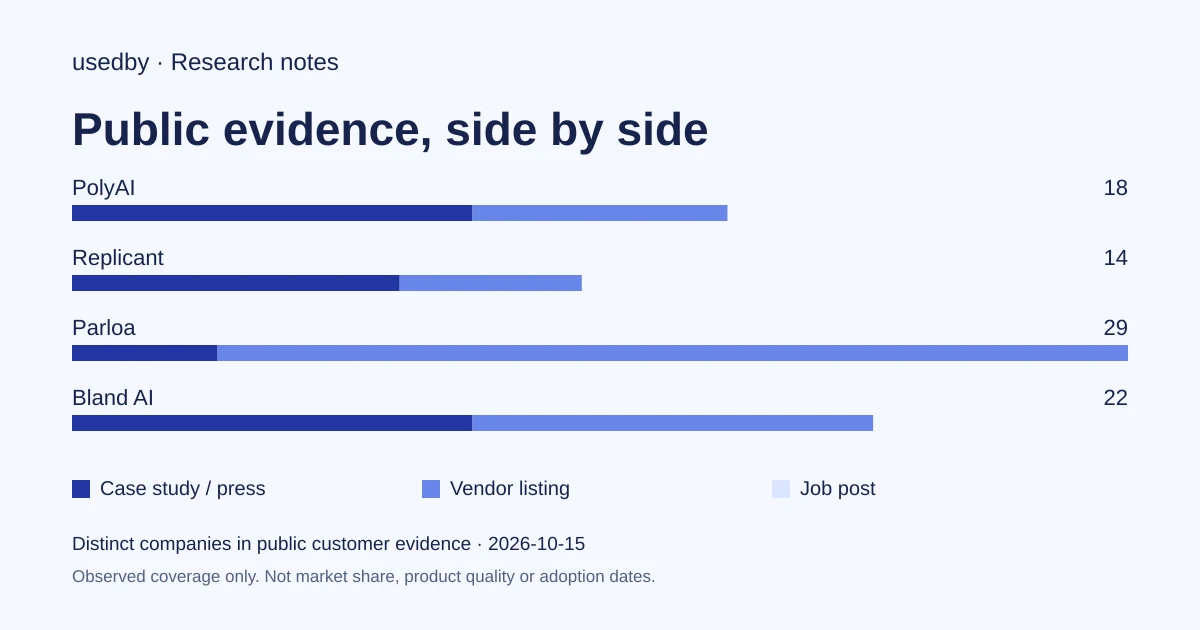
This dated snapshot counts distinct companies in public customer evidence. CONFIRMED means a case study, named testimonial or press source; OBSERVED means a vendor listing; SIGNAL means a job post. All three count, but their strength differs. Removed and unlevelled lines are excluded. Examples are a capped selection verified within 90 days. Vendor facts are sourced records checked within 60 days. Coverage is uneven and missing evidence is unknown. These figures measure neither market share nor product performance; capture dates are not adoption dates.