

The use case: how Verizon deploys New Relic
Verizon uses New Relic auto-telemetry with the Pixie integration to give developers application performance and Kubernetes monitoring on its Verizon 5G Edge platform. Lightweight Pixie agents on resource-constrained edge nodes relay data through central Kubernetes clusters to the New Relic cloud, so developers can debug edge workloads.
In the customer’s words
Imagine a scenario where you notice that gigabytes on gigabytes of data are being exchanged from the edge back to the parent region. You could actually use these insights to re-architect your edge application and introduce efficiencies in your end-to-end workflowsOther AI tools used by Verizon
Other public relationships recorded on usedby.
Explore Verizon’s AI stack





Other companies using New Relic
Customers across industries, with public evidence.
See all New Relic customers




Go straight to the source
Based on New Relic’s published case study. We check the public evidence; the results are reported by the vendor.
newrelic.com- Last checked
- Nov 12, 2026
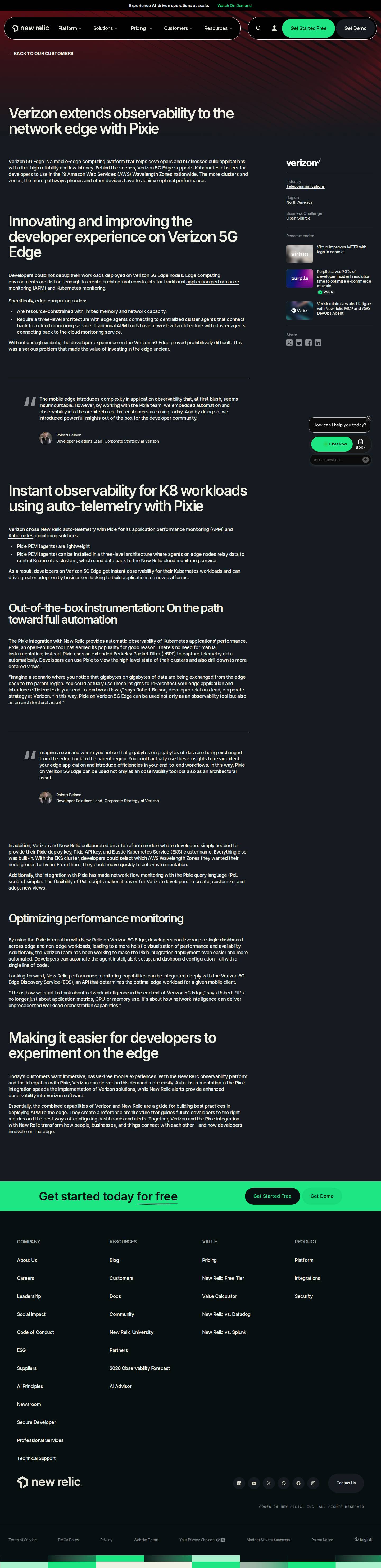 Open source capture
What the story claims, and what we checked
What we compared with the page.
- The passage quoted aboveChecked
Copied word for word from the page, near the name of Verizon.
- The numbers in our summaryChecked
Each one is printed on the page.
- Verizon uses New RelicChecked
Confirmed line.
- The result itselfNot checked
We quote it; we did not measure it.
As a result, developers on Verizon 5G Edge get instant observability for their Kubernetes workloads and can drive greater adoption by businesses looking to build applications on new platforms.