The use case: how T-Mobile deploys Rasa
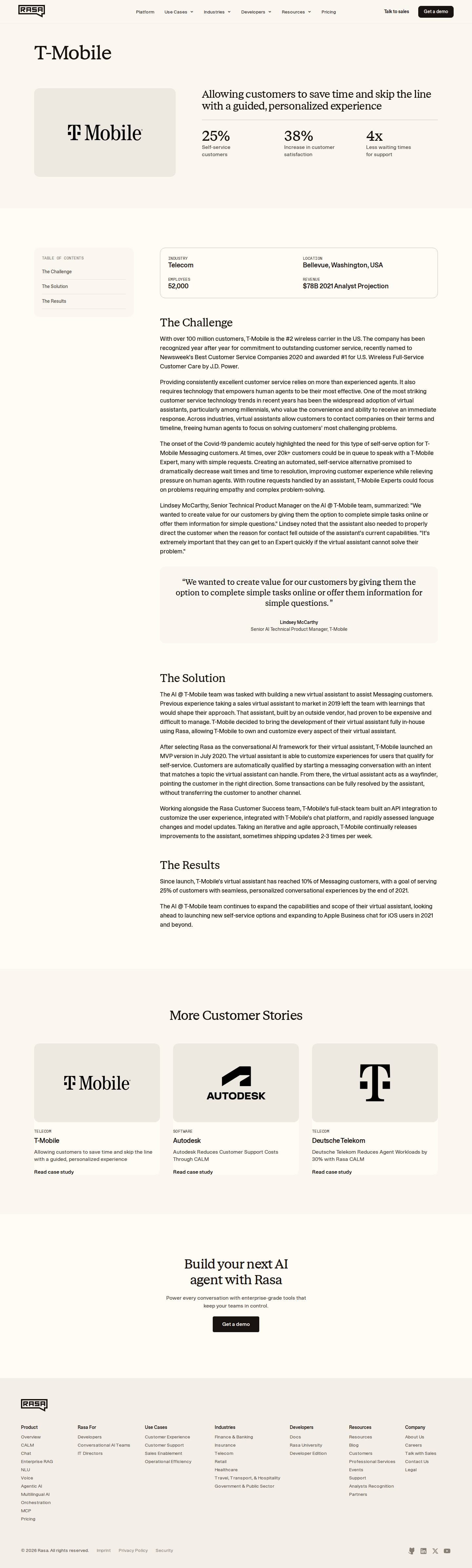
T-Mobile built an in-house virtual assistant for its Messaging customers using Rasa as the conversational AI framework. The assistant handles simple requests and guides customers to the right place, so human experts can focus on complex problems.
In the customer’s words
We wanted to create value for our customers by giving them the option to complete simple tasks online or offer them information for simple questions.Other AI tools used by T-Mobile
Other public relationships recorded on usedby.
 SmartlyConfirmed
 ZipConfirmed
 AmplitudeObserved
 BloomreachObserved
 DialpadObserved
 Docusign eSignatureObserved
Rasa users in Telecommunications
Companies in the same sector, with public evidence.
See all Rasa customers

Go straight to the source
Based on Rasa’s published case study. We check the public evidence; the results are reported by the vendor.
rasa.com- Source published
- Jan 1, 2025
- Last checked
- Nov 19, 2026
 Open source capture
What the story claims, and what we checked
What we compared with the page.
- The figure: 10%Checked
Printed word for word on the page, near the name of T-Mobile.
- The passage quoted aboveChecked
Copied word for word from the page, near the name of T-Mobile.
- The publication dateChecked
Read from the page’s own metadata, never guessed.
- T-Mobile uses RasaChecked
Confirmed line.
- The result itselfNot checked
We quote it; we did not measure it.
Since launch, T-Mobile's virtual assistant has reached 10% of Messaging customers, with a goal of serving 25% of customers with seamless, personalized conversational experiences by the end of 2021.